Matthew GriffinFounder, President and Futurist, 311 Institute
G7 · G20governments advised
850+keynotes
102countries
17codexes
Finance and banking sessions forAfricaONEShawbrook BankStandard Chartered BankThe Institute of Internal AuditorsWolters KluwerCrown Prince Court
Featured inBloombergThe Wall Street JournalThe Telegraph
Bharadwaj and the team at Infosys Finacle invited Matthew to keynote the Infosys Finacle Conclave 2018 in Antwerp, Belgium. He was asked to talk about the latest innovations in banking, cyber security, customer experience and regulation, and to show how investing in the future will change over the years and decades to come.
His starting point was that even the most future savvy and forward looking banks can find the pace of change daunting, especially once they realise its breadth. Many are busy developing strategies to cope, but the harsh truth is that change is often so extreme that those strategies are out of date before they reach the boardroom table.
"In many cases the pace of change is so extreme that many of those strategies are often out of date before they've hit the board room table."Matthew Griffin, Antwerp, November 2018
In such times, he argued, it is the banks that follow a path of continuous self-disruption and exploration, rather than just tweaking their business models, that survive and thrive. The conclave was designed to act as a catalyst for exactly that process.
Under the theme Accelerate Digital, the two-day event brought together more than 300 banking leaders and innovators from over thirty countries to discover new opportunities and identify strategies to accelerate their banks' digital transformation. Alongside Matthew's keynote, attendees heard industry keynotes from companies including Accenture and IBM, joined interactive panels and learned from leaders inside and outside banking.
311 Intelligence
What this means for your leadership team
Planning cycles now lag change.
The session made a blunt point. Many banks build strategies to cope with change, yet the change moves faster than the approval process. A plan that waits for a board date risks describing a market that has already moved. The rate of change is itself a trend to act on now, as shorter corporate lifespans compress planning cycles.
Self-disruption beats small tweaks.
The argument was that survivors keep exploring and disrupting themselves, rather than adjusting a business model at the edges. This looks like a never-ending loop of updates, a pattern already visible in connected products and digital twins. Digital twins are a live virtual copy of a real process, and they are at technology readiness level 9.
Rivals and rules are shifting together.
Branchless digital banks are on course to pass traditional banks on customer numbers in emerging markets by 2030. At the same time, open banking is widening into open finance as countries force banks to share customer data. Leaders face new competitors and new rules in one planning window.
Three questions for your next leadership meeting
Which of our strategies would be out of date by the next board meeting?
Are we exploring new models, or only tweaking the ones we have?
Who owns the decision to disrupt our own business before others do?
The trends and technologies behind this session
From the 311 Starburst, the 311 Strategic Intelligence Unit’s map of the technologies and trends shaping the next 50 years.
It means that slow strategy cycles are a risk in themselves. Organisations need a habit of continuous self-disruption and exploration, so that decisions keep pace with change across technology, customers and regulation.
How does the accelerating rate of change relate to it?
It explains the problem the keynote described. Faster adoption and shorter corporate lifespans compress business planning cycles, which is why strategies can age before they are approved. 311 rates this as act now.
How does continuous innovation relate to it?
It is the working method behind self-disruption. Connected products, digital twins and other tools turn development into a loop of updates, and 311 places wide use around 2032. The action rating is explore.
How does open banking relate to it?
Open banking is one of the shifts that makes old plans age quickly. Countries are forcing banks to share customer data, and 311 expects wide use by 2025. The action rating is act now.
How can 311 brief our leadership team on this?
311 offers a private executive briefing or leadership workshop, tailored to your sector. Sessions are held in person first.
Bring this to your leadership teamA private executive briefing or leadership workshop, tailored to your sector. In person first, anywhere in the world.
Analysis by the 311 Strategic Intelligence Unit, from Matthew Griffin’s session and 311 data.
If Matthew gave this session today
Whole industries could soon be disrupted in a day.
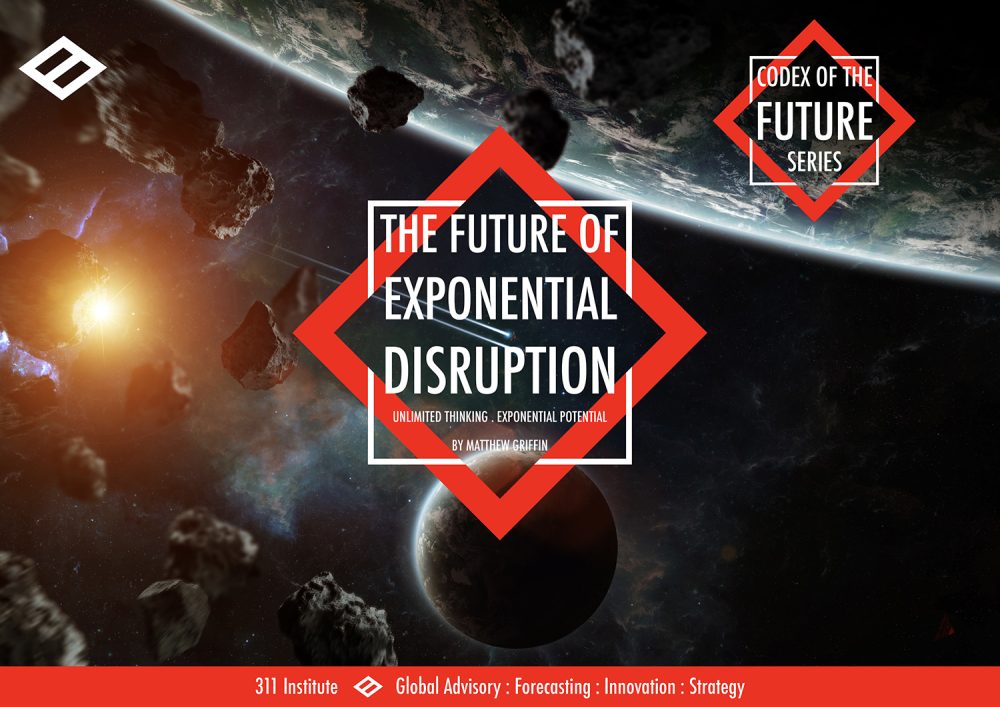
The Future of Exponential Disruption sets out the forces accelerating global disruption and how close we are to disrupting whole industries in a day, which is why banks that keep disrupting themselves stay ahead.