This new Japanese cipher system could protect computers from spyware
Spyware, malware, in fact all the cyber 'wares will be an increasing problem in the future, but this cipher for cache randomisation could be a good defence ...

Key takeaways
- A team of researchers from around the world has made significant progress in the field of computer security by creating a new and highly effective cipher for cache randomization.
- To overcome this Ueno and his team created SCARF which is based on a novel mathematical formula and the modelling of cache side-channel attacks.
- The team comprised members from Tohoku University, CASA at Ruhr University Bochum, and NTT Social Informatics Laboratories at Nippon Telegraph and Telephone Corporation.
Cite or link to this article
Griffin, M. (2024) 'This new Japanese cipher system could protect computers from spyware', 311 Institute, 29 February. Available at: https://www.311institute.com/this-new-japanese-cipher-system-could-protect-computers-from-spyware/ (Accessed: 1 October 2026).
A team of researchers from around the world has made significant progress in the field of computer security by creating a new and highly effective cipher for cache randomization. The innovative cipher, designed by Assistant Professor Rei Ueno from the Research Institute of Electrical Communication at Tohoku University, addresses the threat of cache side-channel attacks, offering both enhanced security and exceptional performance.
Modern computer systems are under serious threat from cache side-channel attacks, which can covertly gather sensitive data such as secret keys and passwords from unaware targets. Addressing these attacks is particularly difficult because they take advantage of flaws in the current working mechanisms of computers, making the creation of effective countermeasures extremely challenging.
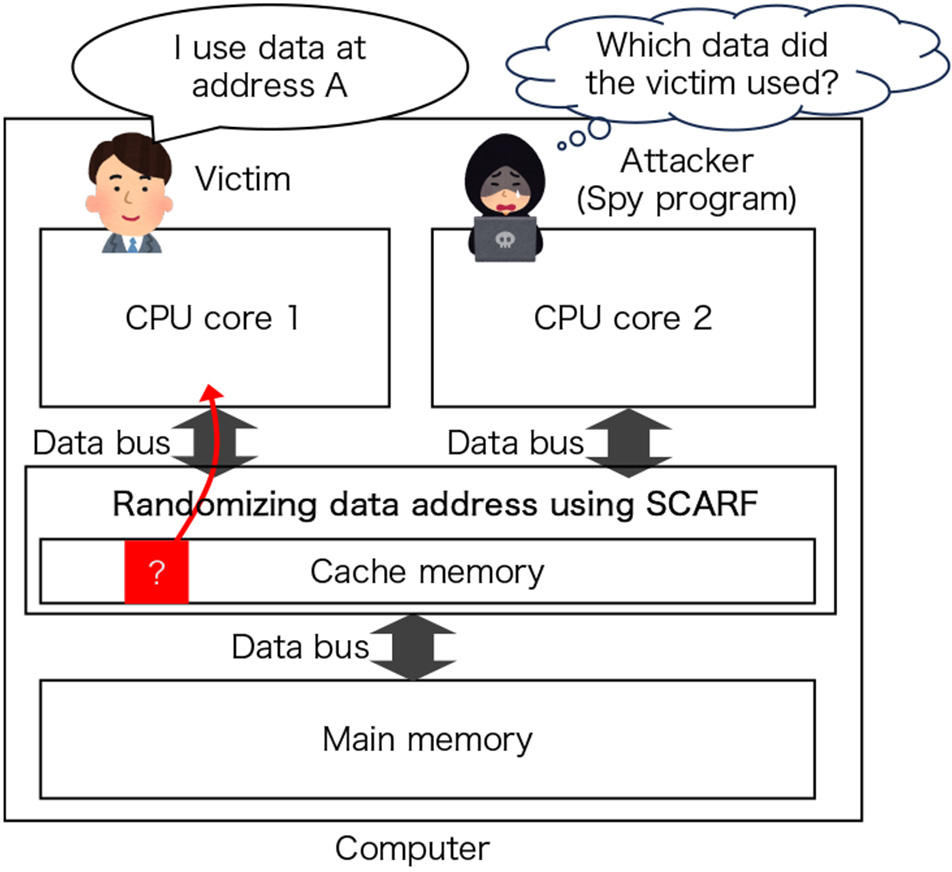
Cache randomization has emerged as a promising countermeasure; however, identifying a secure and effective mathematical function for this purpose has been a lingering challenge for a long time, until now it seems.
To overcome this Ueno and his team created SCARF which is based on a novel mathematical formula and the modelling of cache side-channel attacks. Moreover, SCARF exhibits remarkable performance, completing the randomization process with only half the latency of existing cryptographic techniques. The cipher’s practicality and performance were thoroughly validated through rigorous hardware evaluations and system-level simulations.
The team comprised members from Tohoku University, CASA at Ruhr University Bochum, and NTT Social Informatics Laboratories at Nippon Telegraph and Telephone Corporation.
“We are thrilled to announce SCARF, a powerful tool in enhancing computer security,” said Ueno. “Our innovative cipher is engineered to be compatible with various modern computer architectures, ensuring its widespread applicability and potential to bolster computer security significantly.”
The Future of Cyber Security, by keynote Matthew Griffin
SCARF’s potential impact extends beyond individual computers, as its implementation has the capacity to contribute to building a more secure information society. By mitigating cache side-channel attack vulnerabilities, SCARF takes a critical step toward safeguarding sensitive data and user privacy.
Reference: “SCARF: A Low-Latency Block Cipher for Secure Cache-Randomization,” USENIX Security Symposium
FAQ
Why does this matter?
Spyware, malware, in fact all the cyber 'wares will be an increasing problem in the future, but this cipher for cache randomisation could be a good defence ...

About the author
Matthew Griffin Founder, 311 Institute
Matthew Griffin is a multi-award winning Futurist and expert in Disruption and Innovation, Geopolitics, Leadership, and Technology, who NASA have described as a "walking encyclopaedia of the future" and a "futurist Polymath."
Read full bio
Matthew Griffin is a multi-award winning Futurist and expert in Disruption and Innovation, Geopolitics, Leadership, and Technology, who NASA have described as a "walking encyclopaedia of the future" and a "futurist Polymath." 15-time best selling author of the "Codex of the Future" series, Matthew is the Founder and Futurist in Chief of the 311 Institute, a global Futures and Deep Futures advisory firm working with royal households, world leaders, G7, G20, and G77 governments, NGOs, and multi-national mid and mega cap firms to help them explore, shape, and lead the next 50 years of business and society.
An award-winning YouTube creator with over a million followers, with an unrivalled global reach and impact, Matthew is a highly sought-after international keynote speaker, lecturer, and mentor who collaborates with global leaders through the United Nations Alliance of Civilizations (UNAOC) and United Nations General Assembly (UNGA) to shape pivotal initiatives such as the UN’s AI for Humanity program, the United Nations Conference of the Parties (UN COP), and the World Economic Forum in Davos.
As the former Global Head of Cloud, National Security, and Enterprise Sales for companies including Atos, Dell-EMC, and IBM, Matthew has a proven track record of building multi-billion dollar business units and turning failing divisions into market leaders. His ability to identify, analyse, and communicate the implications of hundreds of emerging technologies and trends is unparalleled, and his insights are trusted by many of the world’s most respected organisations, including ABB, Accenture, Adidas, AON, ARM, BCG, Centrica, Citi, Coca-Cola, Dentons, Deloitte, Dow Jones, EY, Google, KPMG, Lego, Legal & General, LinkedIn, Microsoft, PepsiCo, Qualcomm, RWE, Samsung, Siemens AG and Siemens Energy, T-Mobile, UBS, VISA, Walmart, Workday, Worldpay and many others.
Regularly featured in the global media including the AP, BBC, Bloomberg, CNBC, Discovery, Forbes, Khaleej Times, Telegraph, TIME, ViacomCBS, WIRED, and the WSJ, Matthews mission is to help organisations create a fair and sustainable future whose benefits are shared by everyone irrespective of their ability, background, or circumstances.
What future do you need to see?
Choose one to get started on security and privacy and the future of your organisation.
Sources and further reading
- USENIX Security Symposium eprint.iacr.org
Source: first published by the 311 Institute on 29 February 2024. Cite as: Griffin, M. (2024). This new Japanese cipher system could protect computers from spyware. 311 Institute. https://www.311institute.com/this-new-japanese-cipher-system-could-protect-computers-from-spyware/
You are welcome to quote this article with credit and a link to the original.