Autonomous delivery trucks and robot dogs to be couriers of the future
Irrespective of whether vehicles drive themselves delivery companies still have to solve the "last mile" problem, and this is one of their ideas.

Key takeaways
- A challenge for delivery robot concepts is the need for the robots, such as Domino Pizza’s four wheeled version they’re trying out in Germany at the moment, to travel long distances between drop-off locations.
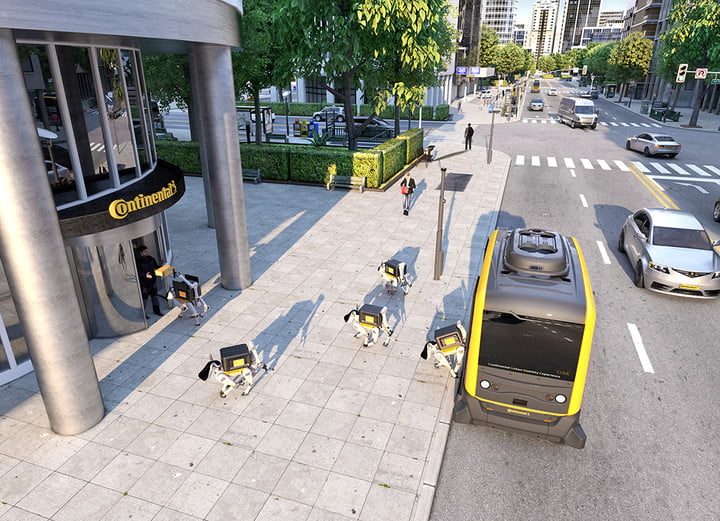
- Courtesy: Continental Continental is working on the driverless vehicle, called the Continental Urban Mobility Experience (Cube), which it will customize to meet the needs of robot manufacturers.
- The approach of using a deployment vehicle for autonomous robots is referred to as a Robo-taxi or pod, and promises to offer a more sustainable way to move goods around.
Cite or link to this article
Griffin, M. (2019) 'Autonomous delivery trucks and robot dogs to be couriers of the future', 311 Institute, 5 June. Available at: https://www.311institute.com/autonomous-delivery-trucks-and-robot-dogs-to-be-couriers-of-the-future/ (Accessed: 1 October 2026).
As we all order more and more stuff from Amazon and other online retailers, delivery of goods becomes an increasingly pressing concern, and one solution that’s now being presented by Continental, the same company behind your car’s tyres, is to combine autonomous delivery vehicles with autonomous robot delivery dogs – the same type of Robo-dogs that Boston Dynamics, one of the world’s most advanced robotics company’s, recently showed off dancing to Uptown Funk.
A challenge for delivery robot concepts is the need for the robots, such as Domino Pizza’s four wheeled version they’re trying out in Germany at the moment, to travel long distances between drop-off locations. Then, of course, the robots need to be small and manoeuvrable enough to actually make a delivery to a home or place of business whose access might be tricky or awkward. Continental’s approach to this challenge is to break it down into two components - one driverless vehicle about the size of a small car, and a number of smaller delivery robots. The robots can be transported inside the vehicle and then deployed to actually make the delivery.
 Courtesy: Continental
Continental is working on the driverless vehicle, called the Continental Urban Mobility Experience (Cube), which it will customize to meet the needs of robot manufacturers. The Cube should be able to navigate busy urban environments in an efficient way, avoiding obstacles and offering a solution to the sop called “last mile” problem in logistics. The approach of using a deployment vehicle for autonomous robots is referred to as a Robo-taxi or pod, and promises to offer a more sustainable way to move goods around.
The idea of combining driverless vehicles and delivery robots is a natural one, according to Ralph Lauxmann, head of Systems and Technology at Continental.
“Both are electrified, both are autonomous and, in principle, both can be based on the same scalable technology portfolio,” he said in a statement. “These synergies create an exciting potential for holistic delivery concepts using similar solutions for different platforms. Beyond this technology foundation, it’s reasonable to expect a whole value chain to develop in this area.”
As driverless vehicles become commonplace, there will be many uses for them in addition to deliveries. For example, during busy rush hours, the vehicles could be used as taxis for commuters, then outside of these busy times, the same vehicles could be used for deliveries. Having the vehicles in operation almost 24/7, something that Toyota are also proposing with their new E-Pallette vehicle format, would make for much more efficient use of resources and could eventually lower or eliminate the need for privately owned cars.
FAQ
Why does this matter?
Irrespective of whether vehicles drive themselves delivery companies still have to solve the "last mile" problem, and this is one of their ideas.

About the author
Matthew Griffin Founder, 311 Institute
Matthew Griffin is a multi-award winning Futurist and expert in Disruption and Innovation, Geopolitics, Leadership, and Technology, who NASA have described as a "walking encyclopaedia of the future" and a "futurist Polymath."
Read full bio
Matthew Griffin is a multi-award winning Futurist and expert in Disruption and Innovation, Geopolitics, Leadership, and Technology, who NASA have described as a "walking encyclopaedia of the future" and a "futurist Polymath." 15-time best selling author of the "Codex of the Future" series, Matthew is the Founder and Futurist in Chief of the 311 Institute, a global Futures and Deep Futures advisory firm working with royal households, world leaders, G7, G20, and G77 governments, NGOs, and multi-national mid and mega cap firms to help them explore, shape, and lead the next 50 years of business and society.
An award-winning YouTube creator with over a million followers, with an unrivalled global reach and impact, Matthew is a highly sought-after international keynote speaker, lecturer, and mentor who collaborates with global leaders through the United Nations Alliance of Civilizations (UNAOC) and United Nations General Assembly (UNGA) to shape pivotal initiatives such as the UN’s AI for Humanity program, the United Nations Conference of the Parties (UN COP), and the World Economic Forum in Davos.
As the former Global Head of Cloud, National Security, and Enterprise Sales for companies including Atos, Dell-EMC, and IBM, Matthew has a proven track record of building multi-billion dollar business units and turning failing divisions into market leaders. His ability to identify, analyse, and communicate the implications of hundreds of emerging technologies and trends is unparalleled, and his insights are trusted by many of the world’s most respected organisations, including ABB, Accenture, Adidas, AON, ARM, BCG, Centrica, Citi, Coca-Cola, Dentons, Deloitte, Dow Jones, EY, Google, KPMG, Lego, Legal & General, LinkedIn, Microsoft, PepsiCo, Qualcomm, RWE, Samsung, Siemens AG and Siemens Energy, T-Mobile, UBS, VISA, Walmart, Workday, Worldpay and many others.
Regularly featured in the global media including the AP, BBC, Bloomberg, CNBC, Discovery, Forbes, Khaleej Times, Telegraph, TIME, ViacomCBS, WIRED, and the WSJ, Matthews mission is to help organisations create a fair and sustainable future whose benefits are shared by everyone irrespective of their ability, background, or circumstances.
What future do you need to see?
Choose one to get started on robotics and the future of your organisation.
Source: first published by the 311 Institute on 5 June 2019. Cite as: Griffin, M. (2019). Autonomous delivery trucks and robot dogs to be couriers of the future. 311 Institute. https://www.311institute.com/autonomous-delivery-trucks-and-robot-dogs-to-be-couriers-of-the-future/
You are welcome to quote this article with credit and a link to the original.