Florida to unleash Lionfish hunter-killer robots onto its reefs
When are killer robots a good thing? When they're saving the Earth.

Key takeaways
- Where there are robots there's always inevitably talk about the emergence of killer robots that will destroy humanity, and while killer robots are often seen as a bad thing sometimes - apparently, they can be a good thing too.
- The killer robot in action Creating a robot to exterminate a specific species sounds a bit harsh, but it's an environmental issue.
- Culling the Lionfish population is essential to protecting the local ecosystem.
Cite or link to this article
Griffin, M. (2016) 'Florida to unleash Lionfish hunter-killer robots onto its reefs', 311 Institute, 26 August. Available at: https://www.311institute.com/florida-to-unleash-killer-robots-onto-the-reefs/ (Accessed: 1 October 2026).
Where there are robots there's always inevitably talk about the emergence of killer robots that will destroy humanity, and while killer robots are often seen as a bad thing sometimes - apparently, they can be a good thing too. Weird hey?
Now scientists at Robots In Service of the Environment (RISE) - yes that's a real company BTW, are talking about using robots to cull invasive species specifically they are talking about developing a robot to fight an invasive population of Lionfish that's threatening ecosystems off the coast of Florida as well as in the Caribbean and Bermuda.
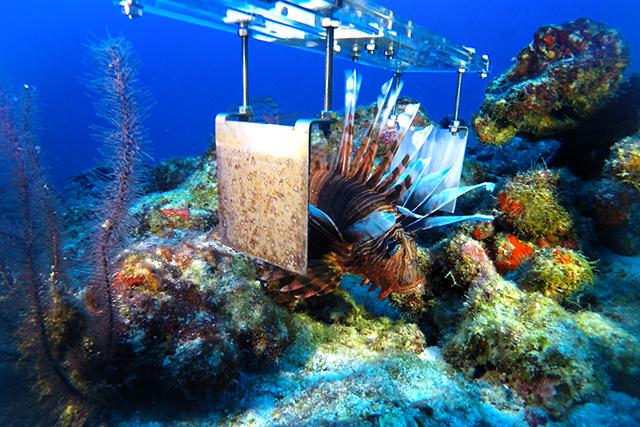
The killer robot in action
Creating a robot to exterminate a specific species sounds a bit harsh, but it's an environmental issue. The Lionfish population in question isn't native to Caribbean waters and don't register as predators to the local wildlife, as a consequence the local marine life don't avoid them and, as a result the voracious Lionfish end up with a free fish dinner, decimating the local fish populations, killing coral reef systems and starving other species.
While the idea of culling a species always brings out mixed feelings in people, as a marine biologist myself I can tell you that certain non-native species - such as the Australian Crown of Thorns, when left to their own devices can wreak havoc in an ecosystem decimating it and leaving it almost devoid of all life and so it is here. Culling the Lionfish population is essential to protecting the local ecosystem.
Unfortunately though there are millions of Lionfish and only a few hunters and humans so the solution? Build robot hunters.
This idea came to RISE founder and iRobot CEO Colin Angle after witnessing the issue first-hand in Bermuda. His group has since designed a concept robot capable of electrocuting Lionfish between a pair of telescoping electrodes. The concept is still in its early stages, but the team has been testing a prototype arm in reef waters to make sure the robot doesn't scare the fish off before it has a chance to zap them and so far, so good. Lionfish don't have many predators, and don't seem scared of the deadly fish-zapper.
RISE says it's testing out the actual shocking mechanism on Lionfish in aquariums before taking it out to sea, and is also developing a spear-based Lionfish hunter. It'll be awhile before either unit is ready for action, too. Hopefully, the completed robots will be able to keep the population under control and help the natural ecosystem thrive. Still, it's a little weird to think that under the right circumstances, killer robots can be a good thing.
FAQ
Why does this matter?
When are killer robots a good thing? When they're saving the Earth.

About the author
Matthew Griffin Founder, 311 Institute
Matthew Griffin is a multi-award winning Futurist and expert in Disruption and Innovation, Geopolitics, Leadership, and Technology, who NASA have described as a "walking encyclopaedia of the future" and a "futurist Polymath."
Read full bio
Matthew Griffin is a multi-award winning Futurist and expert in Disruption and Innovation, Geopolitics, Leadership, and Technology, who NASA have described as a "walking encyclopaedia of the future" and a "futurist Polymath." 15-time best selling author of the "Codex of the Future" series, Matthew is the Founder and Futurist in Chief of the 311 Institute, a global Futures and Deep Futures advisory firm working with royal households, world leaders, G7, G20, and G77 governments, NGOs, and multi-national mid and mega cap firms to help them explore, shape, and lead the next 50 years of business and society.
An award-winning YouTube creator with over a million followers, with an unrivalled global reach and impact, Matthew is a highly sought-after international keynote speaker, lecturer, and mentor who collaborates with global leaders through the United Nations Alliance of Civilizations (UNAOC) and United Nations General Assembly (UNGA) to shape pivotal initiatives such as the UN’s AI for Humanity program, the United Nations Conference of the Parties (UN COP), and the World Economic Forum in Davos.
As the former Global Head of Cloud, National Security, and Enterprise Sales for companies including Atos, Dell-EMC, and IBM, Matthew has a proven track record of building multi-billion dollar business units and turning failing divisions into market leaders. His ability to identify, analyse, and communicate the implications of hundreds of emerging technologies and trends is unparalleled, and his insights are trusted by many of the world’s most respected organisations, including ABB, Accenture, Adidas, AON, ARM, BCG, Centrica, Citi, Coca-Cola, Dentons, Deloitte, Dow Jones, EY, Google, KPMG, Lego, Legal & General, LinkedIn, Microsoft, PepsiCo, Qualcomm, RWE, Samsung, Siemens AG and Siemens Energy, T-Mobile, UBS, VISA, Walmart, Workday, Worldpay and many others.
Regularly featured in the global media including the AP, BBC, Bloomberg, CNBC, Discovery, Forbes, Khaleej Times, Telegraph, TIME, ViacomCBS, WIRED, and the WSJ, Matthews mission is to help organisations create a fair and sustainable future whose benefits are shared by everyone irrespective of their ability, background, or circumstances.
What future do you need to see?
Choose one to get started on earth and energy and the future of your organisation.
Sources and further reading
- Robots In Service of the Environment riserobotics.com
Source: first published by the 311 Institute on 26 August 2016. Cite as: Griffin, M. (2016). Florida to unleash Lionfish hunter-killer robots onto its reefs. 311 Institute. https://www.311institute.com/florida-to-unleash-killer-robots-onto-the-reefs/
You are welcome to quote this article with credit and a link to the original.