MIT computing breakthrough will put a human brain in your pocket
New computing platforms are getting closer than ever before to being able to pack the power of an entire human brain into a tiny computer chip.

Key takeaways
- The human brain operates on roughly 20 watts of power, or to put it another way, on a third of a 60 watt light bulb, in a space the size of, well, a human head.
- In a recent paper in Nature Nanotechnology, a team of MIT scientists say their tiny new neuromorphic chip was used to store, retrieve, and manipulate images of Captain America’s Shield and MIT’s Killian Court.
- The fall in cost to actually run such an algorithm was even more dramatic - it took $10,000 to classify a billion images in 2017 and just $0.03 in 2019.
Cite or link to this article
Griffin, M. (2020) 'MIT computing breakthrough will put a human brain in your pocket', 311 Institute, 14 August. Available at: https://www.311institute.com/mit-computing-breakthrough-will-put-a-human-brain-in-your-pocket/ (Accessed: 1 October 2026).
The human brain operates on roughly 20 watts of power, or to put it another way, on a third of a 60 watt light bulb, in a space the size of, well, a human head. Meanwhile, the biggest machine learning algorithms use closer to a nuclear power plant’s worth of electricity and racks of chips to learn.
That’s not to slander machine learning, but nature may have a tip or two to improve the situation. Luckily, there’s a branch of computer chip design heeding that call right now and recently researchers in the UK spun up a million core computer that gets us closer to our goal of mimicking the human brain with all its energy efficiencies, in computer form. I am, of course, talking about revolutionary neuromorphic computers. And by mimicking the brain, super-efficient neuromorphic chips aim to take AI off the cloud and put it right in your pocket instead.
MIT's latest such chip is smaller than a piece of confetti and has tens of thousands of artificial synapses made out of memristors - silicon-based components that mimic the information-transmitting synapses in the human brain.
In a recent paper in Nature Nanotechnology, a team of MIT scientists say their tiny new neuromorphic chip was used to store, retrieve, and manipulate images of Captain America’s Shield and MIT’s Killian Court. Whereas images stored with existing methods tended to lose fidelity over time, the new chip’s images remained crystal clear.
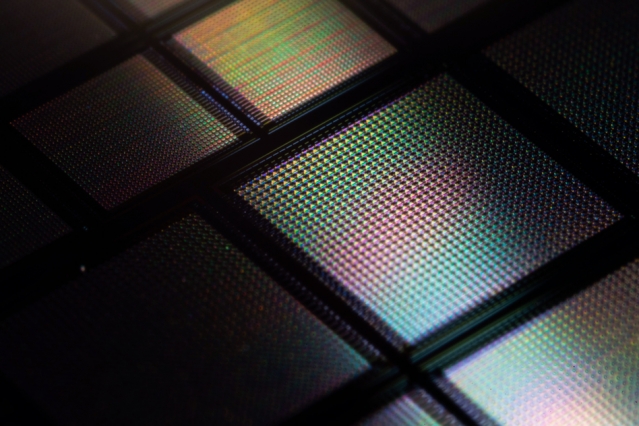 Close-up of the new neuromorphic “Brain-on-a-Chip,” including thousands of memristors, or memory transistors. Credit: Peng Lin
“So far, artificial synapse networks only exist as software. We’re trying to build real neural network hardware for portable artificial intelligence systems,” Jeehwan Kim, associate professor of mechanical engineering at MIT said in a press release. “Imagine connecting a neuromorphic device to a camera on your car, and having it recognize lights and objects and make a decision immediately, without having to connect to the internet. We hope to use energy-efficient memristors to do those tasks on-site, in real-time.”
Whereas the computers in our phones and laptops use separate digital components for processing and memory - and therefore need to shuttle information between the two - the new MIT chip uses analog components called memristors that process and store information in the same place. This is similar to the way the brain works and makes memristors far more efficient. To date, however, they’ve struggled with reliability and scalability.
To overcome these challenges, the MIT team designed a new kind of silicon-based, alloyed memristor. Ions flowing in memristors made from unalloyed materials tend to scatter as the components get smaller, meaning the signal loses fidelity and the resulting computations are less reliable. The team found an alloy of silver and copper helped stabilize the flow of silver ions between electrodes, allowing them to scale the number of memristors on the chip without sacrificing functionality.
While MIT’s new chip is promising, there’s likely a ways to go before memristor-based neuromorphic chips go mainstream. Between now and then, engineers like Kim have their work cut out for them to further scale and demonstrate their designs. But if successful, they could make for smarter smartphones and other even smaller devices.
“We would like to develop this technology further to have larger-scale arrays to do image recognition tasks,” Kim said. “And some day, you might be able to carry around artificial brains to do these kinds of tasks, without connecting to supercomputers, the internet, or the cloud.”
Furthermore, in a recent cost analysis of machine learning, research and investment firm ARK Invest said cost declines in developing and running new AI’s and AI models have far outpaced performance declines in Moore’s Law. In a particular example, they found the cost to train an image recognition algorithm (ResNet-50) went from around $1,000 in 2017 to roughly $10 in 2019. The fall in cost to actually run such an algorithm was even more dramatic - it took $10,000 to classify a billion images in 2017 and just $0.03 in 2019.
While some of these cost declines can be traced to better AI software, according to ARK specialized chips, like the new neuromorphic chips, as well as new and improved GPU’s and specialist AI chips like Google’s TPU processors, have improved in performance by nearly 16 times in the last three years alone, and it’s these developments that have helped improve the cost-performance equation. And if it continues, which it likely will, then soon it will be almost free to develop and run AI’s, and soon we might all be carrying a human brain in our pockets that can do the work of today’s best AI.
Source: MIT
FAQ
Why does this matter?
New computing platforms are getting closer than ever before to being able to pack the power of an entire human brain into a tiny computer chip.

About the author
Matthew Griffin Founder, 311 Institute
Matthew Griffin is a multi-award winning Futurist and expert in Disruption and Innovation, Geopolitics, Leadership, and Technology, who NASA have described as a "walking encyclopaedia of the future" and a "futurist Polymath."
Read full bio
Matthew Griffin is a multi-award winning Futurist and expert in Disruption and Innovation, Geopolitics, Leadership, and Technology, who NASA have described as a "walking encyclopaedia of the future" and a "futurist Polymath." 15-time best selling author of the "Codex of the Future" series, Matthew is the Founder and Futurist in Chief of the 311 Institute, a global Futures and Deep Futures advisory firm working with royal households, world leaders, G7, G20, and G77 governments, NGOs, and multi-national mid and mega cap firms to help them explore, shape, and lead the next 50 years of business and society.
An award-winning YouTube creator with over a million followers, with an unrivalled global reach and impact, Matthew is a highly sought-after international keynote speaker, lecturer, and mentor who collaborates with global leaders through the United Nations Alliance of Civilizations (UNAOC) and United Nations General Assembly (UNGA) to shape pivotal initiatives such as the UN’s AI for Humanity program, the United Nations Conference of the Parties (UN COP), and the World Economic Forum in Davos.
As the former Global Head of Cloud, National Security, and Enterprise Sales for companies including Atos, Dell-EMC, and IBM, Matthew has a proven track record of building multi-billion dollar business units and turning failing divisions into market leaders. His ability to identify, analyse, and communicate the implications of hundreds of emerging technologies and trends is unparalleled, and his insights are trusted by many of the world’s most respected organisations, including ABB, Accenture, Adidas, AON, ARM, BCG, Centrica, Citi, Coca-Cola, Dentons, Deloitte, Dow Jones, EY, Google, KPMG, Lego, Legal & General, LinkedIn, Microsoft, PepsiCo, Qualcomm, RWE, Samsung, Siemens AG and Siemens Energy, T-Mobile, UBS, VISA, Walmart, Workday, Worldpay and many others.
Regularly featured in the global media including the AP, BBC, Bloomberg, CNBC, Discovery, Forbes, Khaleej Times, Telegraph, TIME, ViacomCBS, WIRED, and the WSJ, Matthews mission is to help organisations create a fair and sustainable future whose benefits are shared by everyone irrespective of their ability, background, or circumstances.
What future do you need to see?
Choose one to get started on computing and the future of your organisation.
Sources and further reading
- a nuclear power plant’s wired.com
- recent paper in Nature Nanotechnology nature.com
- a press release news.mit.edu
- recent cost analysis of machine learning ark-invest.com
Source: first published by the 311 Institute on 14 August 2020. Cite as: Griffin, M. (2020). MIT computing breakthrough will put a human brain in your pocket. 311 Institute. https://www.311institute.com/mit-computing-breakthrough-will-put-a-human-brain-in-your-pocket/
You are welcome to quote this article with credit and a link to the original.