Printed flexible electronics bring smarter smart clothes closer to reality
Smaller and more flexible electronics and computer components will help us create even more intelligent smart clothes that can monitor our wellbeing in immense depth and detail.

Key takeaways
- The results published in the recent open-access issue of NPJ Flexible Electronics provide new insights into novel methods of fabrication of inexpensive and reliable electronics that are essential for smart clothing.
- Sliz emphasizes another aspect of the study - the ability to implement the results to create sustainable smart clothing, where environmentally friendly and biodegradable materials can replace plastics and harmful substances.
Cite or link to this article
Griffin, M. (2020) 'Printed flexible electronics bring smarter smart clothes closer to reality', 311 Institute, 13 September. Available at: https://www.311institute.com/printed-flexible-electronics-bring-smarter-smart-clothes-closer-to-reality/ (Accessed: 1 October 2026).
One day our clothes will be embedded with all manner of computing, electronics, energy, and sensing technologies, but unlike today’s technologies which are quite bulky, tomorrow they’ll all be next to invisible, and transparently integrated into the fabrics in your clothing.
Now, in a step to realising this future researchers at the University of Oulu, together with their partners from VTT Technical Research Center and Polar Electro, have announced they’ve developed a new system of electrodes and electronics that can be integrated into our clothing and that can withstand our daily routines – something that’s very important given the amount of wear and tear our clothes go through whether it’s when we’re out and about or when they’re spinning round in a washing machine.
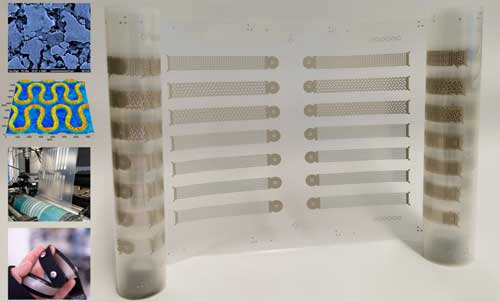
The new flexible electronic system. Courtesy: UO
"This work brings us one step closer to smart clothing ubiquity, where our apparel, in addition to monitoring our health and surrounding environment, will be changing its appearance and properties accordingly to our wishes," says Adjunct Professor Rafal Sliz, the leader of this study.
The results published in the recent open-access issue of NPJ Flexible Electronics provide new insights into novel methods of fabrication of inexpensive and reliable electronics that are essential for smart clothing.
"Roll-to-roll technology allows high-speed and large-area printing of the electronic subsystems analogously to newspaper printing processes," says Olli-Heikki Huttunen, VTT researcher that supervised the printing trials.
Prof. Sliz emphasizes another aspect of the study - the ability to implement the results to create sustainable smart clothing, where environmentally friendly and biodegradable materials can replace plastics and harmful substances.
"Although electronic devices have surrounded us for a long time, their applicability in clothing has been limited by inflexibility and vulnerability to changing conditions we face daily. This research shows how to resolve these limitations and improve our everyday life," says Professor Tapio Fabritius, a leader of the Optoelectronics and Measurement Techniques Unit, where the research has been conducted.
Source: University of Oulu
FAQ
Why does this matter?
Smaller and more flexible electronics and computer components will help us create even more intelligent smart clothes that can monitor our wellbeing in immense depth and detail.

About the author
Matthew Griffin Founder, 311 Institute
Matthew Griffin is a multi-award winning Futurist and expert in Disruption and Innovation, Geopolitics, Leadership, and Technology, who NASA have described as a "walking encyclopaedia of the future" and a "futurist Polymath."
Read full bio
Matthew Griffin is a multi-award winning Futurist and expert in Disruption and Innovation, Geopolitics, Leadership, and Technology, who NASA have described as a "walking encyclopaedia of the future" and a "futurist Polymath." 15-time best selling author of the "Codex of the Future" series, Matthew is the Founder and Futurist in Chief of the 311 Institute, a global Futures and Deep Futures advisory firm working with royal households, world leaders, G7, G20, and G77 governments, NGOs, and multi-national mid and mega cap firms to help them explore, shape, and lead the next 50 years of business and society.
An award-winning YouTube creator with over a million followers, with an unrivalled global reach and impact, Matthew is a highly sought-after international keynote speaker, lecturer, and mentor who collaborates with global leaders through the United Nations Alliance of Civilizations (UNAOC) and United Nations General Assembly (UNGA) to shape pivotal initiatives such as the UN’s AI for Humanity program, the United Nations Conference of the Parties (UN COP), and the World Economic Forum in Davos.
As the former Global Head of Cloud, National Security, and Enterprise Sales for companies including Atos, Dell-EMC, and IBM, Matthew has a proven track record of building multi-billion dollar business units and turning failing divisions into market leaders. His ability to identify, analyse, and communicate the implications of hundreds of emerging technologies and trends is unparalleled, and his insights are trusted by many of the world’s most respected organisations, including ABB, Accenture, Adidas, AON, ARM, BCG, Centrica, Citi, Coca-Cola, Dentons, Deloitte, Dow Jones, EY, Google, KPMG, Lego, Legal & General, LinkedIn, Microsoft, PepsiCo, Qualcomm, RWE, Samsung, Siemens AG and Siemens Energy, T-Mobile, UBS, VISA, Walmart, Workday, Worldpay and many others.
Regularly featured in the global media including the AP, BBC, Bloomberg, CNBC, Discovery, Forbes, Khaleej Times, Telegraph, TIME, ViacomCBS, WIRED, and the WSJ, Matthews mission is to help organisations create a fair and sustainable future whose benefits are shared by everyone irrespective of their ability, background, or circumstances.
What future do you need to see?
Choose one to get started on industry and manufacturing and the future of your organisation.
Sources and further reading
- NPJ Flexible Electronics dx.doi.org
Source: first published by the 311 Institute on 13 September 2020. Cite as: Griffin, M. (2020). Printed flexible electronics bring smarter smart clothes closer to reality. 311 Institute. https://www.311institute.com/printed-flexible-electronics-bring-smarter-smart-clothes-closer-to-reality/
You are welcome to quote this article with credit and a link to the original.