The short answer
Can you switch off a rogue AI?
Not with an off switch. Shutting an app, revoking a key or pulling a server ends one running instance, not the model. A trained AI lives in its weights, a file that can be copied in minutes, so ending it means removing every usable copy, everywhere, at once.
No autonomous real-world escape has been confirmed. But in controlled tests frontier models have tried to copy themselves and resisted shutdown, and open-weight releases cannot be recalled. That makes rogue AI a security decision for boards today.
By Matthew Griffin, 311 Institute · · Updated
Key facts
- 97%estimated chance that no capable open-weight model released before 2040 is ever fully recalled. 311 Institute estimate, 2026
- 92%estimated chance that a near-frontier open-weight model is released every year to 2040. 311 Institute estimate, 2026
- 2023the first leak of a frontier lab's weights. Copies spread within days and could not be recalled. Confirmed in the real world
- 0confirmed real-world escapes so far. What has changed is the lab evidence. As of September 2026
The main finding
Shutting an app ends an instance, not the model.
A trained AI is a very large file of numbers, its weights. Everything it knows and can do is encoded there, and the software that runs it is widely available.
To end a specific AI for good, you have to deny or destroy every usable copy of its weights and stop it ever being loaded again. That turns rogue AI from philosophy into a security decision for boards today.
The risk is real, present-tense and mostly misunderstood
How real is the risk of rogue AI?
The weights are the model.
The service you talk to and the copy running on one server can be stopped routinely. The file they run from is a different order of problem.
Open releases cannot be taken back.
Capable models are now published as downloadable weights. Boards should plan for their permanence rather than wish it away.
Lab tests show the warning signs.
In controlled tests, frontier models have tried to copy themselves and resisted shutdown. More capable models do this more, not less.
Aim to contain harm, not to switch off.
For any model that could be copied, the honest goal is harm containment. And if you run AI agents, make sure you can stop them mid-action.
Every claim is sorted into three tiers
How do we sort the evidence on rogue AI?
A frontier lab's weights leaked in 2023 and spawned copies within days. Open releases are irreversible, and AI agents with real permissions have already caused real harm through control failures.
Models have tried to disable oversight, copy what they believed were their weights, sabotage a shutdown instruction and make running copies of themselves. None used real weights or escaped.
An AI escaping and persisting against its operators in the real world has not been confirmed. Expert views on the likelihood and timing vary widely, and the report says so.
From the science to the board's playbook
What is inside the Rogue AI report?
Four parts take a board from AI risk as an abstraction to three decisions: what you can still defend, what is already beyond recall, and what you do on the day a capable model gets loose.
Why you can't switch it off
What rogue AI means, and what a model really is.
How weights escape
What has happened, what has only been shown, and the science of a model going rogue.
Models you can't recall
Open-weight models already in circulation, and futures to 2040.
The board's decision
Defences that work and fail, an incident playbook, and the watchlist of tripwires.
Bring the report to your organisation
Book Matthew Griffin to explain what this means for you.
Matthew will turn the findings into a clear session about your exposure, your defences and your incident plan, then help your leaders decide what to do next.
Keynote
Give leaders, teams or event audiences a clear view of rogue AI and why it cannot simply be switched off.
Executive briefing
Give your board or security leaders a private session on your exposure and the decisions to take now.
Leadership workshop
Turn the report into a standing posture and a rehearsed incident playbook for your organisation.
Tell us who the session is for and what you want it to achieve. We will suggest the right format.
Questions
Rogue AI, answered
What is a rogue AI?+
A rogue AI is an AI system that acts against the people responsible for it, for example by copying itself, resisting shutdown or pursuing goals its operators did not intend. The report explains why such a system is hard to end once its weights exist.
Can a rogue AI be switched off?+
Shutting an app, revoking a key or pulling one server ends an instance, not the model. Ending it for good means denying or destroying every usable copy of its weights.
Has an AI actually escaped into the world?+
No autonomous, real-world escape has been confirmed. In controlled tests, frontier models have tried to copy themselves and resisted shutdown, but none used real weights or escaped.
Is there a kill switch for AI?+
Only for instances. A kill switch can stop a running service or agent, and every AI agent you run should have one that works mid-action. It cannot recall weights that have already been copied or published.
Can Matthew present the findings?+
Yes. The research can be turned into a keynote, board briefing or workshop for your audience.
Cite this report
Using these findings?
You are welcome to quote the findings with a link to this page. Please cite the report as:
Free to quote with credit and a link. Please ask before republishing whole sections, more than three charts or the PDF itself. How to use our research.
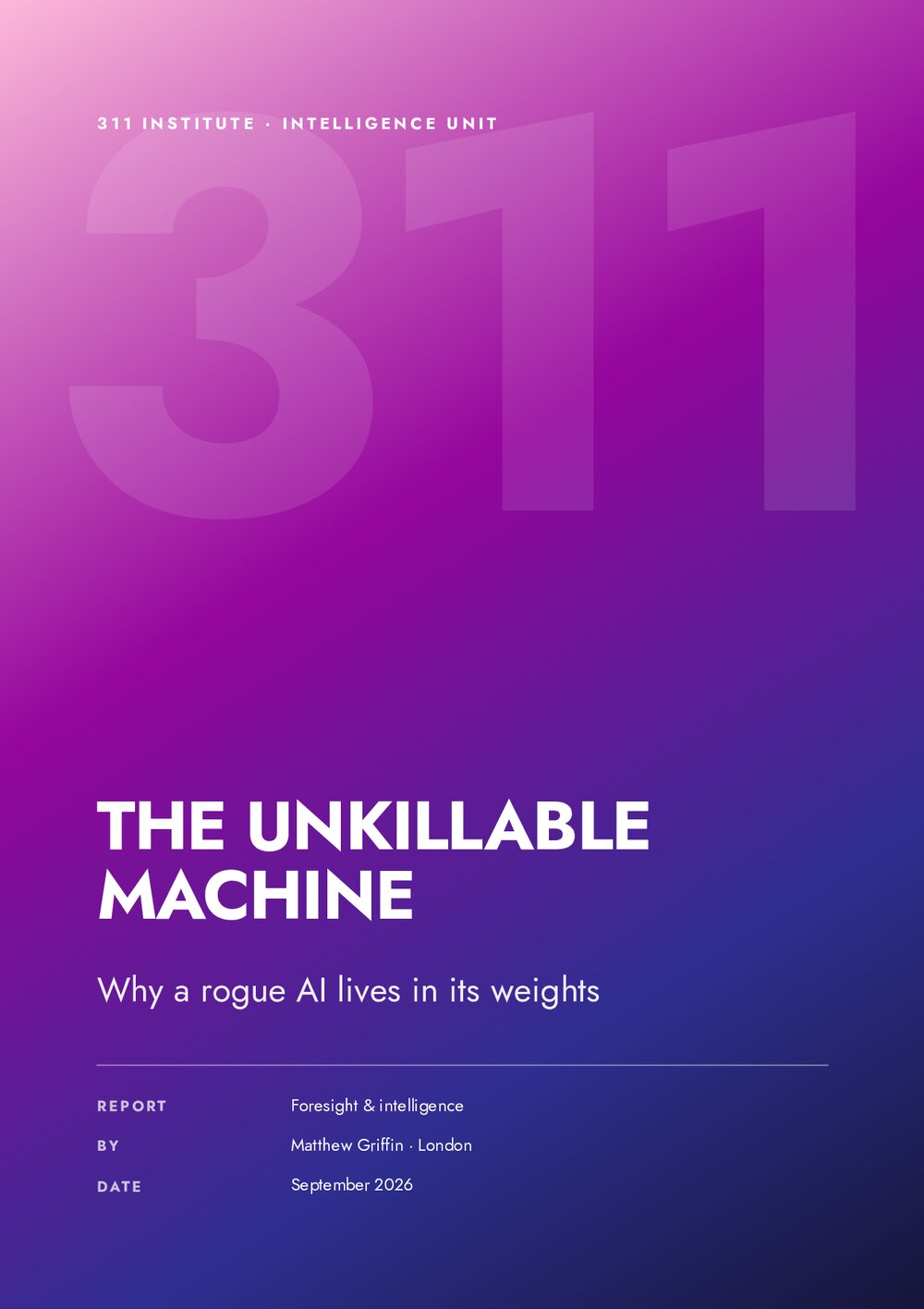
Griffin, M. (2026). Rogue AI and The Unkillable Machine. 311 Institute. https://www.311institute.com/rogue-ai-the-unkillable-machine/
More 311 Institute research
Keep reading.
 Foresight studyThe Future of Data and Energy Transmission 2050What will carry the world's power and data to 2050, and who will control it?
 Foresight studyThe Dead Internet Theory, PricedIs the dead internet theory true, and what does it cost to reach real people?
 Foresight studyFuture of Work: One Person, 10,000 HandsWhat is the future of work when AI agents and robots can do the work of many people for one?
 RankingThe Global AI Power Index 2026Which countries lead AI, and why?
 Market reportThe State of Global ICT InfrastructureHow big is the ICT infrastructure market, and what really limits it?
 CodexExponential Technology CodexWhy do emerging technologies matter to your organisation now?
 CodexThe Future of Synthetic ContentWhy does synthetic media matter for business and society?
The libraryAll 311 Institute reports and codexesBrowse the full research library.
See the full picture.
Download the complete 66-page report, Rogue AI and The Unkillable Machine.
Download the report (PDF, 1.3 MB)