An AI built to generate “Fake News” is now helping detect it
In the future we won't be able to believe everything we see or read, irrespective what the content is, so we need new ways to separate truth from fiction.

Key takeaways
- The idea behind the hypothesis is simple - language models produce sentences by predicting the next word in a sequence of text.
- The researchers tested their idea by building an interactive tool based on the publicly accessible downgraded version of OpenAI’s GPT-2.
- Janelle Shane, a researcher who runs the popular blog Letting Neural Networks Be Weird and who wasn’t involved in the initial research put the tool to a more rigorous test.
Cite or link to this article
Griffin, M. (2019) 'An AI built to generate “Fake News” is now helping detect it', 311 Institute, 21 November. Available at: https://www.311institute.com/an-ai-built-to-generate-fake-news-is-now-helping-detect-it/ (Accessed: 8 October 2026).
In February OpenAI, the non-profit AI research center funded by Elon Musk and a $1 Billion from Microsoft, rather dramatically withheld the release of its newest language model, a fake text generator called GPT-2, because it was so good it was dubbed "the world's most dangerous AI" and the company feared it could be used to automate the mass production of fake news.
The decision also accelerated the AI community’s ongoing discussion about how to detect this kind of fake news, and in a new experiment, researchers at MIT and Harvard University considered whether the same language models that can write such convincing text, like the text you can see below, could also be used to help spot other fake news and AI generated text.
The idea behind the hypothesis is simple - language models produce sentences by predicting the next word in a sequence of text. So if they can easily predict most of the words in a given passage, it’s likely it was written by one of their own.
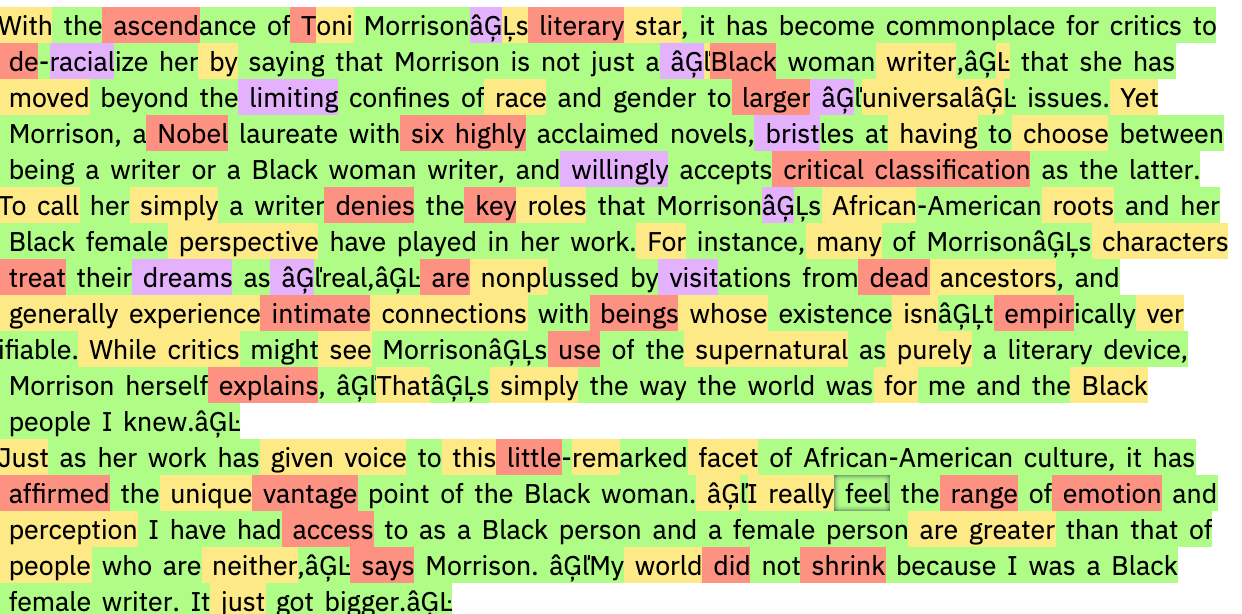

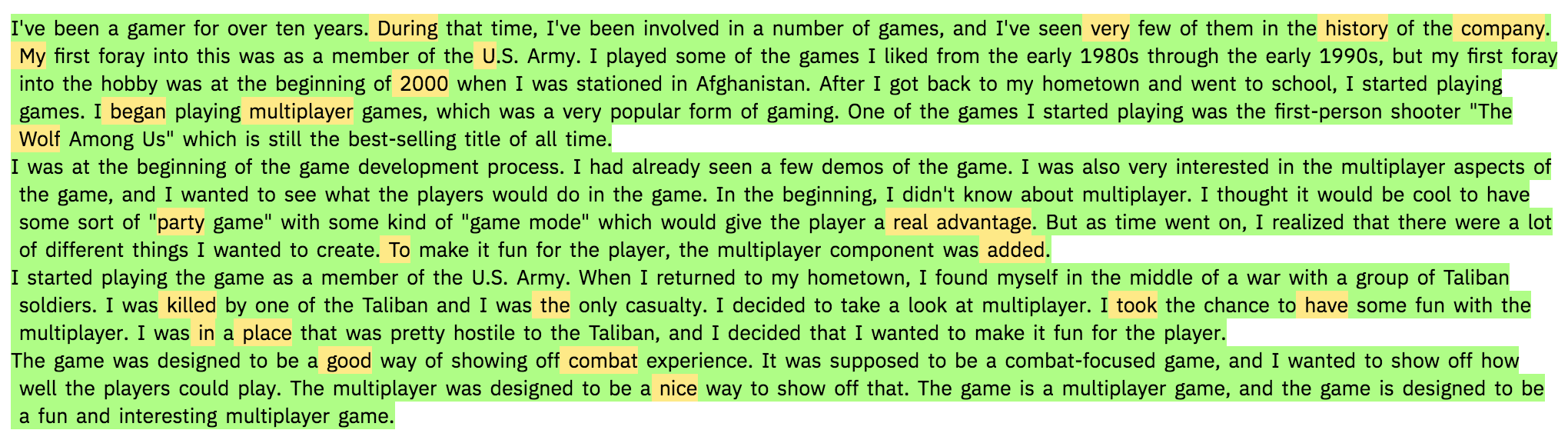
The researchers tested their idea by building an interactive tool based on the publicly accessible downgraded version of OpenAI’s GPT-2. When you feed the tool a passage of text, it highlights the words in green, yellow, or red to indicate decreasing ease of predictability; it highlights them in purple if it wouldn’t have predicted them at all. In theory, the higher the fraction of red and purple words, the higher the chance the passage was written by a human; the greater the share of green and yellow words, the more likely it was written by an AI.
Indeed, the researchers found that passages written by the downgraded and full versions of GPT-2 came out almost completely green and yellow, while scientific abstracts written by humans and text from reading comprehension passages in US standardised tests had lots of red and purple.
But not so fast. Janelle Shane, a researcher who runs the popular blog Letting Neural Networks Be Weird and who wasn’t involved in the initial research put the tool to a more rigorous test. Rather than just feeding it text generated by GPT-2, she fed it passages written by other language models as well, including one trained on Amazon reviews and another trained on Dungeons and Dragons biographies, and she found that the tool failed to predict a large chunk of the words in each of these passages, and thus it assumed they were human-written.
As a consequence her work helped identify an important problem that will have to be overcome if AI’s are truly going to be useful in helping us detect fake content - a language model might be good at detecting its own output, but not necessarily the output of others.
FAQ
Why does this matter?
In the future we won't be able to believe everything we see or read, irrespective what the content is, so we need new ways to separate truth from fiction.

About the author
Matthew Griffin Founder, 311 Institute
Matthew Griffin is a multi-award winning Futurist and expert in Disruption and Innovation, Geopolitics, Leadership, and Technology, who NASA have described as a "walking encyclopaedia of the future" and a "futurist Polymath."
Read full bio
Matthew Griffin is a multi-award winning Futurist and expert in Disruption and Innovation, Geopolitics, Leadership, and Technology, who NASA have described as a "walking encyclopaedia of the future" and a "futurist Polymath." 15-time best selling author of the "Codex of the Future" series, Matthew is the Founder and Futurist in Chief of the 311 Institute, a global Futures and Deep Futures advisory firm working with royal households, world leaders, G7, G20, and G77 governments, NGOs, and multi-national mid and mega cap firms to help them explore, shape, and lead the next 50 years of business and society.
An award-winning YouTube creator with over a million followers, with an unrivalled global reach and impact, Matthew is a highly sought-after international keynote speaker, lecturer, and mentor who collaborates with global leaders through the United Nations Alliance of Civilizations (UNAOC) and United Nations General Assembly (UNGA) to shape pivotal initiatives such as the UN’s AI for Humanity program, the United Nations Conference of the Parties (UN COP), and the World Economic Forum in Davos.
As the former Global Head of Cloud, National Security, and Enterprise Sales for companies including Atos, Dell-EMC, and IBM, Matthew has a proven track record of building multi-billion dollar business units and turning failing divisions into market leaders. His ability to identify, analyse, and communicate the implications of hundreds of emerging technologies and trends is unparalleled, and his insights are trusted by many of the world’s most respected organisations, including ABB, Accenture, Adidas, AON, ARM, BCG, Centrica, Citi, Coca-Cola, Dentons, Deloitte, Dow Jones, EY, Google, KPMG, Lego, Legal & General, LinkedIn, Microsoft, PepsiCo, Qualcomm, RWE, Samsung, Siemens AG and Siemens Energy, T-Mobile, UBS, VISA, Walmart, Workday, Worldpay and many others.
Regularly featured in the global media including the AP, BBC, Bloomberg, CNBC, Discovery, Forbes, Khaleej Times, Telegraph, TIME, ViacomCBS, WIRED, and the WSJ, Matthews mission is to help organisations create a fair and sustainable future whose benefits are shared by everyone irrespective of their ability, background, or circumstances.
What future do you need to see?
Choose one to get started on security and privacy and the future of your organisation.
Sources and further reading
- experiment gltr.io
- Ai natural language processing explained technologyreview.com
- Index gltr.io
- Letting Neural Networks Be Weird aiweirdness.com
- It takes a bot to know one aiweirdness.com
Source: first published by the 311 Institute on 21 November 2019. Cite as: Griffin, M. (2019). An AI built to generate “Fake News” is now helping detect it. 311 Institute. https://www.311institute.com/an-ai-built-to-generate-fake-news-is-now-helping-detect-it/
You are welcome to quote this article with credit and a link to the original.