DARPA’s unveils its revolutionary CRANE X-Plane with no moving parts
Flaps and aerlons create drag and increase fuel consumption on planes, but what if you didn't need any of that?

Key takeaways
- DARPA's new X-plane concept will remove these moving external control surfaces to reduce aerodynamic drag and increase fuel efficiency, contradicting a century of standard aviation design practices.
- Such aircraft have been around since at least the 1910s, with the now-retired supersonic Concorde aircraft as perhaps the most prominent example.
- The next portion of CRANE, known as Phase 2, will entail designing and developing the controls and flight software.
Cite or link to this article
Griffin, M. (2023) 'DARPA’s unveils its revolutionary CRANE X-Plane with no moving parts', 311 Institute, 28 January. Available at: https://www.311institute.com/darpas-unveils-its-revolutionary-crane-x-plane-with-no-moving-parts/ (Accessed: 1 October 2026).
As we continue to see new kinds of aircraft take shape, from hydrogen fuelled behemoths like those from Airbus, and ones with metamaterial morphing wings and even physics defying ion engines, the US Defense Advanced Research Projects Agency (DARPA) says it's time for some airplanes to drop elevators, flaps, and rudders for flight control altogether.
DARPA's new X-plane concept will remove these moving external control surfaces to reduce aerodynamic drag and increase fuel efficiency, contradicting a century of standard aviation design practices. But the advanced-technology branch of the US Department of Defense says it has a workable alternative to keep control in the air at high speeds.
Aurora Flight Sciences received a design contract from DARPA this Tuesday under the Control of Revolutionary Aircraft with Novel Effectors (CRANE) program, which seeks fly an experimental aircraft without any moving joints.
The subsidiary of Boeing "will design a full-scale X-plane that relies solely on changes in air flow for in-flight manoeuvres," DARPA wrote in a Tuesday tweet of Aurora's award. Should the concept succeed, officials added, the design will be "a new phase in creation of an aircraft."
Moving aircraft parts has been a necessary inconvenience for more than a century. On the one hand, control surfaces create drag and reduce fuel efficiency. Pilots, however, need to safely move the airplane around and elevators, flaps and rudders have been tried, tested and improved for decades.
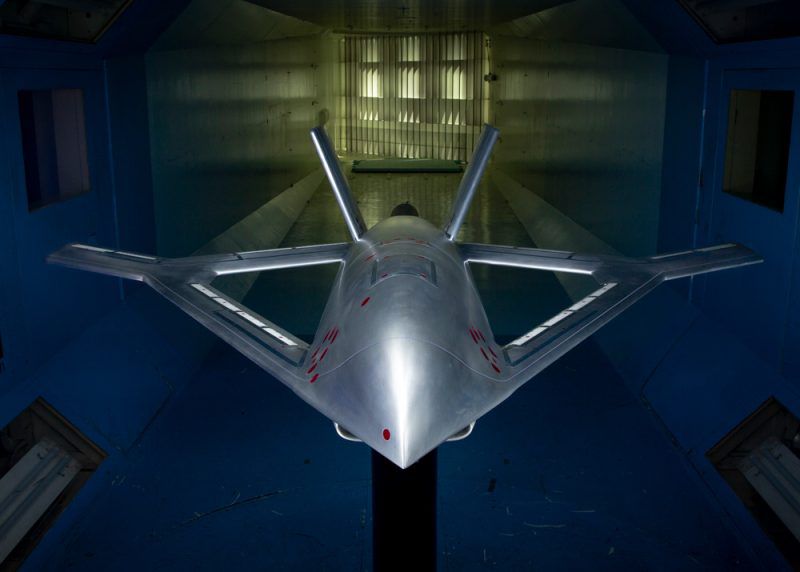
The CRANE
DARPA is by no means the first to consider removing parts previously considered essential to flight operations. In 2018, a team at MIT flew what they called the "first-ever plane with no moving parts", but that term was referring more to propulsion. MIT used an electric charge on the plane to stay aloft, an effect known as Ionic Propulsion not traditional propellers or engine turbines, and since 2018 they and others have been developing the concept further with some interesting gains.
Some aircraft of the past have done away with one or more traditional moving surfaces, however. "Tailless aircraft," for example, incorporate pitch and roll into the main wing but usually still require a rudder. Such aircraft have been around since at least the 1910s, with the now-retired supersonic Concorde aircraft as perhaps the most prominent example.
There are few details available now about how CRANE will stay stable in the air, but intriguing hints are available via a 2021 presentation by Alexander "Xander" Walan, program manager of DARPA's Tactical Technology Office.
Active Flow Control (AFC) uses a variety of methods such as jets of air or even electric discharges to shape or sculpt the flow of air over the aircraft, the presentation notes. DARPA seeks to use commercial parts where possible to provide affordable alternatives and to "fully explore the AFC trade space," meaning to seek technologies that could provide viable alternatives.
While no further details on AFC are available on DARPA's laconic CRANE website, the Aurora announcement suggests their design would use "modular wing configurations that enable future integration of advanced technologies" to achieve AFC.
That's not much to go on, but in the 2021 presentation, Aurora's bid pledged to model several conceptual wing designs to find the best one. Judging from available photos, it looks like the X-plane will use a type of "Co-planar joined wing," which includes two forward wings and two aft wings instead of the traditional V-shaped wing on most commercial and military aircraft.
The next portion of CRANE, known as Phase 2, will entail designing and developing the controls and flight software. It will complete with a critical design review of the X-plane. DARPA may ask for a Phase 3 to fly a 7,000-pound (3,175-kg) X-plane demonstrator with AFC technology. No financial or timeline details were released.
What this means for your organisation
A century of practice is being questioned.
Elevators, flaps and rudders have been refined for decades but create drag. Challenging a settled design is where real efficiency gains sit.
Fewer parts, less maintenance.
No moving joints means fewer components to inspect and fail. The operating cost case may matter as much as the fuel saving.
Control is the hard part.
Pilots need to manoeuvre safely, so the alternative must be proven at high speeds. Expect a long test programme before any adoption.
Three questions for your next leadership meeting
- Which settled designs in our products create avoidable waste?
- What would fewer moving parts save us in maintenance?
- How would we prove a radical design is safe?
The trends and technologies behind this story
From the 311 Starburst, the 311 Strategic Intelligence Unit’s map of the technologies and trends shaping the next 50 years.
Analysis by the 311 Strategic Intelligence Unit, from Matthew Griffin’s article and 311 data. First published on Fanatical Futurist.
FAQ
Why does this matter?
Flaps and aerlons create drag and increase fuel consumption on planes, but what if you didn't need any of that?

About the author
Matthew Griffin Founder, 311 Institute
Matthew Griffin is a multi-award winning Futurist and expert in Disruption and Innovation, Geopolitics, Leadership, and Technology, who NASA have described as a "walking encyclopaedia of the future" and a "futurist Polymath."
Read full bio
Matthew Griffin is a multi-award winning Futurist and expert in Disruption and Innovation, Geopolitics, Leadership, and Technology, who NASA have described as a "walking encyclopaedia of the future" and a "futurist Polymath." 17-time best selling author of the "Codex of the Future" series, Matthew is the Founder and Futurist in Chief of the 311 Institute, a global Futures and Deep Futures advisory firm working with royal households, world leaders, G7, G20, and G77 governments, NGOs, and multi-national mid and mega cap firms to help them explore, shape, and lead the next 50 years of business and society.
An award-winning YouTube creator with over a million followers, with an unrivalled global reach and impact, Matthew is a highly sought-after international keynote speaker, lecturer, and mentor who collaborates with global leaders through the United Nations Alliance of Civilizations (UNAOC) and United Nations General Assembly (UNGA) to shape pivotal initiatives such as the UN’s AI for Humanity program, the United Nations Conference of the Parties (UN COP), and the World Economic Forum in Davos.
As the former Global Head of Cloud, National Security, and Enterprise Sales for companies including Atos, Dell-EMC, and IBM, Matthew has a proven track record of building multi-billion dollar business units and turning failing divisions into market leaders. His ability to identify, analyse, and communicate the implications of hundreds of emerging technologies and trends is unparalleled, and his insights are trusted by many of the world’s most respected organisations, including ABB, Accenture, Adidas, AON, ARM, BCG, Centrica, Citi, Coca-Cola, Dentons, Deloitte, Dow Jones, EY, Google, KPMG, Lego, Legal & General, LinkedIn, Microsoft, PepsiCo, Qualcomm, RWE, Samsung, Siemens AG and Siemens Energy, T-Mobile, UBS, VISA, Walmart, Workday, Worldpay and many others.
Regularly featured in the global media including the AP, BBC, Bloomberg, CNBC, Discovery, Forbes, Khaleej Times, Telegraph, TIME, ViacomCBS, WIRED, and the WSJ, Matthews mission is to help organisations create a fair and sustainable future whose benefits are shared by everyone irrespective of their ability, background, or circumstances.
What future do you need to see?
Choose one to get started on transport and mobility and the future of your organisation.
Sources and further reading
- received a design contract darpa.mil
- a Tuesday tweet twitter.com
- First ionic wind plane no moving parts 1121 news.mit.edu
- Wed Walan.pdf ndiastorage.blob.core.usgovcloudapi.net
- Control of revolutionary aircraft with novel effectors darpa.mil
Source: first published by the 311 Institute on 28 January 2023. Cite as: Griffin, M. (2023). DARPA’s unveils its revolutionary CRANE X-Plane with no moving parts. 311 Institute. https://www.311institute.com/darpas-unveils-its-revolutionary-crane-x-plane-with-no-moving-parts/
You are welcome to quote this article with credit and a link to the original.