New machine vision system lets gym users ditch the wearables
As we see advances in AI and machine vision in the future you won't need a wearable to improve, monitor or measure your workouts, all you'll need is a camera.

Key takeaways
- Interesting things happen when a machine’s vision, and its ability to understand what it’s seeing, becomes as good as, and in many cases better than, human vision.
- For starters, it can help AI’s train world class violinists, help plant and harvest crops and keep people safe, as well as keep them in check, and much more.
- The problem with wearable devices is that while they're able to identify exercise-associated movements of the body part upon which they're being worn, so they may miss everything else that’s going on.
Cite or link to this article
Griffin, M. (2019) 'New machine vision system lets gym users ditch the wearables', 311 Institute, 10 November. Available at: https://www.311institute.com/new-machine-vision-system-lets-gym-users-ditch-the-wearables/ (Accessed: 1 October 2026).
Interesting things happen when a machine’s vision, and its ability to understand what it’s seeing, becomes as good as, and in many cases better than, human vision. For starters, it can help AI’s train world class violinists, help plant and harvest crops and keep people safe, as well as keep them in check, and much more. There’s no denying that machine vision has come a long way in the past decade. And now there’s a new way it can help.
Many people already use wearables such as smartwatches to count their repetitions while exercising, and now researchers at Carnegie Mellon University have developed what could be a better alternative in the form of a user-monitoring computer vision system.
The problem with wearable devices is that while they're able to identify exercise-associated movements of the body part upon which they're being worn, so they may miss everything else that’s going on. It was with this limitation in mind that PhD students Rushil Khurana and Karan Ahuja created the GymCam system.
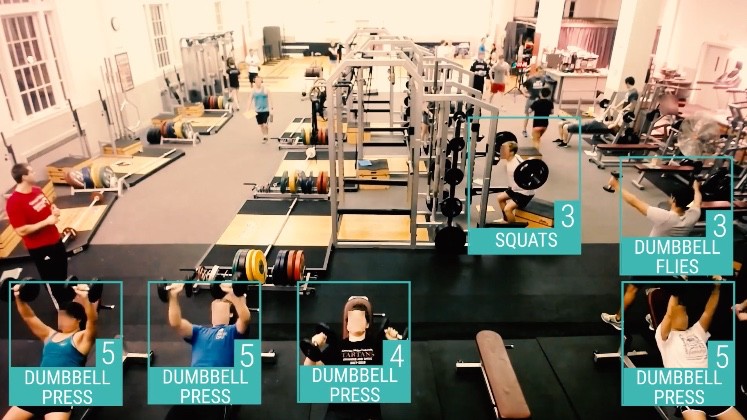
The GymCam "Dashboard"
It utilizes an ordinary stationary video camera, that's hooked up to a computer – the technology could even be incorporated into a smartphone app. As the camera "watches" the user while they're working out, a custom-designed algorithm automatically detects repetitive body movements, matches them up to known exercises, and counts the number of reps.
And although the system can be used by individuals in their homes, it's also capable of tracking many users at once within the same room. In fact, by learning which exercise machines are located in which parts of a room, the system is better able to determine which activity each person is performing.
Obstacles such as the gym equipment itself, which may partially block the camera's view of the user's body, reportedly aren't problematic when it comes to tracking and identifying movements. And because the system doesn't record or transmit images of users' faces, their privacy is protected.
In tests that were performed in a crowded university gym, the current version of GymCam was reportedly 85 percent accurate at differentiating exercises from other sorts of movement, 94 percent accurate at then recognizing the type of exercise being performed, plus it was able to count reps within an accuracy of plus or minus 1 percent.
So, as health and wellness continue to top most governments and individuals lists of important things to conquer this could be a great new tool in helping people train better, avoid easily preventable injuries, and get more from their workouts – whether that’s at home, in the gym, or by the office water cooler.
Source: Carnegie Mellon University
FAQ
Why does this matter?
As we see advances in AI and machine vision in the future you won't need a wearable to improve, monitor or measure your workouts, all you'll need is a camera.

About the author
Matthew Griffin Founder, 311 Institute
Matthew Griffin is a multi-award winning Futurist and expert in Disruption and Innovation, Geopolitics, Leadership, and Technology, who NASA have described as a "walking encyclopaedia of the future" and a "futurist Polymath."
Read full bio
Matthew Griffin is a multi-award winning Futurist and expert in Disruption and Innovation, Geopolitics, Leadership, and Technology, who NASA have described as a "walking encyclopaedia of the future" and a "futurist Polymath." 15-time best selling author of the "Codex of the Future" series, Matthew is the Founder and Futurist in Chief of the 311 Institute, a global Futures and Deep Futures advisory firm working with royal households, world leaders, G7, G20, and G77 governments, NGOs, and multi-national mid and mega cap firms to help them explore, shape, and lead the next 50 years of business and society.
An award-winning YouTube creator with over a million followers, with an unrivalled global reach and impact, Matthew is a highly sought-after international keynote speaker, lecturer, and mentor who collaborates with global leaders through the United Nations Alliance of Civilizations (UNAOC) and United Nations General Assembly (UNGA) to shape pivotal initiatives such as the UN’s AI for Humanity program, the United Nations Conference of the Parties (UN COP), and the World Economic Forum in Davos.
As the former Global Head of Cloud, National Security, and Enterprise Sales for companies including Atos, Dell-EMC, and IBM, Matthew has a proven track record of building multi-billion dollar business units and turning failing divisions into market leaders. His ability to identify, analyse, and communicate the implications of hundreds of emerging technologies and trends is unparalleled, and his insights are trusted by many of the world’s most respected organisations, including ABB, Accenture, Adidas, AON, ARM, BCG, Centrica, Citi, Coca-Cola, Dentons, Deloitte, Dow Jones, EY, Google, KPMG, Lego, Legal & General, LinkedIn, Microsoft, PepsiCo, Qualcomm, RWE, Samsung, Siemens AG and Siemens Energy, T-Mobile, UBS, VISA, Walmart, Workday, Worldpay and many others.
Regularly featured in the global media including the AP, BBC, Bloomberg, CNBC, Discovery, Forbes, Khaleej Times, Telegraph, TIME, ViacomCBS, WIRED, and the WSJ, Matthews mission is to help organisations create a fair and sustainable future whose benefits are shared by everyone irrespective of their ability, background, or circumstances.
What future do you need to see?
Choose one to get started on AI and intelligence and the future of your organisation.
Sources and further reading
- Carnegie Mellon University smashlab.io
Source: first published by the 311 Institute on 10 November 2019. Cite as: Griffin, M. (2019). New machine vision system lets gym users ditch the wearables. 311 Institute. https://www.311institute.com/new-machine-vision-system-lets-gym-users-ditch-the-wearables/
You are welcome to quote this article with credit and a link to the original.