New penny size computer monitors bone health in vivo
If you've got osteoporosis or have broken a bone then this could revolutionise your treatments ...

Key takeaways
- Margolis is co-senior author of a paper describing the devices in Nature Communications.
- Knowing how quickly and how well the bone is healing could also inform clinical treatment decisions, such as when to remove temporary hardware like plates, rods, or screws.
- Some patients are prescribed drugs designed to speed up bone healing or improve bone density, but these prescriptions can have side effects.
Cite or link to this article
Griffin, M. (2021) 'New penny size computer monitors bone health in vivo', 311 Institute, 26 November. Available at: https://www.311institute.com/new-penny-size-computer-monitors-bone-health-in-vivo/ (Accessed: 1 October 2026).
“As a surgeon, I am most excited about using measurements collected with osseosurface electronics to someday provide my patients with individualized orthopedic care—with the goal of accelerating rehabilitation and maximizing function after traumatic injuries,” says David Margolis, an assistant professor of orthopedic surgery in the University of Arizona (UA) and orthopedic surgeon at Banner University Medical Center Tucson.
Margolis is co-senior author of a paper describing the devices in Nature Communications.
Few people know that bone “fragility fractures,” which are associated with conditions like osteoarthritis and osteoporosis, account for more days spent in the hospital than heart attacks, breast cancer, or prostate cancer combined, and although not yet tested or approved for use in humans the team behind the wireless bone device believe they could one day be used not only to monitor bone health, but to improve it, says co-senior author Philipp Gutruf, an assistant professor at UA.
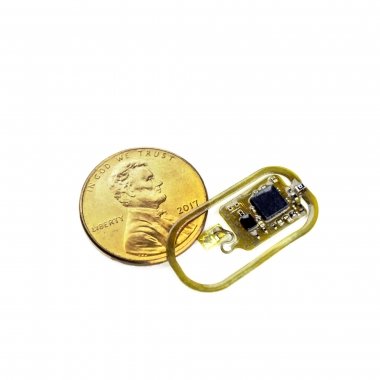 The new computer
“Being able to monitor the health of the musculoskeletal system is super important,” says Gutruf, who is also a member of the university’s BIO5 Institute. “With this interface, you basically have a computer on the bone. This technology platform allows us to create investigative tools for scientists to discover how the musculoskeletal system works and to use the information gathered to benefit recovery and therapy.”
Because muscles are so close to bones and move so frequently, it is important that the device be thin enough to avoid irritating surrounding tissue or becoming dislodged, Gutruf explains.
“The device’s thin structure, roughly as thick as a sheet of paper, means it can conform to the curvature of the bone, forming a tight interface,” says Alex Burton, a doctoral student in biomedical engineering and co-first author of the study. “They also do not need a battery. This is possible using a power casting and communication method called near-field communication, or NFC, which is also used in smartphones for contactless pay.”
The outer layers of bones shed and renew just like the outer layers of skin. So, if a traditional adhesive was used to attach something to the bone, it would fall off after just a few months. To address this challenge, co-author John Szivek, a professor of orthopedic surgery and biomedical engineering and BIO5 Institute member, developed an adhesive that contains calcium particles with an atomic structure similar to bone cells, which is used as to secure osseosurface electronics to the bone.
“The bone basically thinks the device is part of it, and grows to the sensor itself,” Gutruf says. “This allows it to form a permanent bond to the bone and take measurements over long periods of time.”
For instance, a doctor could attach the device to a broken or fractured bone to monitor the healing process. This could be particularly helpful in patients with conditions such as osteoporosis since they frequently suffer refractures. Knowing how quickly and how well the bone is healing could also inform clinical treatment decisions, such as when to remove temporary hardware like plates, rods, or screws.
Some patients are prescribed drugs designed to speed up bone healing or improve bone density, but these prescriptions can have side effects. Close bone monitoring would allow physicians to make more informed decisions about drug dosage levels.
Source: University of Arizona
FAQ
Why does this matter?
If you've got osteoporosis or have broken a bone then this could revolutionise your treatments ...

About the author
Matthew Griffin Founder, 311 Institute
Matthew Griffin is a multi-award winning Futurist and expert in Disruption and Innovation, Geopolitics, Leadership, and Technology, who NASA have described as a "walking encyclopaedia of the future" and a "futurist Polymath."
Read full bio
Matthew Griffin is a multi-award winning Futurist and expert in Disruption and Innovation, Geopolitics, Leadership, and Technology, who NASA have described as a "walking encyclopaedia of the future" and a "futurist Polymath." 15-time best selling author of the "Codex of the Future" series, Matthew is the Founder and Futurist in Chief of the 311 Institute, a global Futures and Deep Futures advisory firm working with royal households, world leaders, G7, G20, and G77 governments, NGOs, and multi-national mid and mega cap firms to help them explore, shape, and lead the next 50 years of business and society.
An award-winning YouTube creator with over a million followers, with an unrivalled global reach and impact, Matthew is a highly sought-after international keynote speaker, lecturer, and mentor who collaborates with global leaders through the United Nations Alliance of Civilizations (UNAOC) and United Nations General Assembly (UNGA) to shape pivotal initiatives such as the UN’s AI for Humanity program, the United Nations Conference of the Parties (UN COP), and the World Economic Forum in Davos.
As the former Global Head of Cloud, National Security, and Enterprise Sales for companies including Atos, Dell-EMC, and IBM, Matthew has a proven track record of building multi-billion dollar business units and turning failing divisions into market leaders. His ability to identify, analyse, and communicate the implications of hundreds of emerging technologies and trends is unparalleled, and his insights are trusted by many of the world’s most respected organisations, including ABB, Accenture, Adidas, AON, ARM, BCG, Centrica, Citi, Coca-Cola, Dentons, Deloitte, Dow Jones, EY, Google, KPMG, Lego, Legal & General, LinkedIn, Microsoft, PepsiCo, Qualcomm, RWE, Samsung, Siemens AG and Siemens Energy, T-Mobile, UBS, VISA, Walmart, Workday, Worldpay and many others.
Regularly featured in the global media including the AP, BBC, Bloomberg, CNBC, Discovery, Forbes, Khaleej Times, Telegraph, TIME, ViacomCBS, WIRED, and the WSJ, Matthews mission is to help organisations create a fair and sustainable future whose benefits are shared by everyone irrespective of their ability, background, or circumstances.
What future do you need to see?
Choose one to get started on computing and the future of your organisation.
Sources and further reading
- Banner University Medical Center bannerhealth.com
- S41467 021 27003 2 doi.org
- BIO5 Institute bio5.org
- University of Arizona news.arizona.edu
Source: first published by the 311 Institute on 26 November 2021. Cite as: Griffin, M. (2021). New penny size computer monitors bone health in vivo. 311 Institute. https://www.311institute.com/new-penny-size-computer-monitors-bone-health-in-vivo/
You are welcome to quote this article with credit and a link to the original.