Researchers create a bone like metal foam that heals at room temperature
When metal breaks it takes a huge amount of energy and heat to fix it, but this new breakthrough fixes that problem.

Key takeaways
- For 6,000 years, humans have been making things from metal because it's strong and tough, and because a lot of energy is required to damage it.
- The flip side of this property is that a lot of energy is also required to repair that said damage with the repair process typically involving melting the metal with welding torches that can reach 6,300 °F.
- The study was conducted by James Pikul, assistant professor in the Department of Mechanical Engineering and Applied Mechanics and Zakaria Hsain, a graduate student in his lab.
Cite or link to this article
Griffin, M. (2019) 'Researchers create a bone like metal foam that heals at room temperature', 311 Institute, 4 November. Available at: https://www.311institute.com/researchers-create-a-bone-like-metal-foam-that-heals-at-room-temperature/ (Accessed: 1 October 2026).
For 6,000 years, humans have been making things from metal because it's strong and tough, and because a lot of energy is required to damage it. The flip side of this property is that a lot of energy is also required to repair that said damage with the repair process typically involving melting the metal with welding torches that can reach 6,300 °F.
Now, for the first time, University of Pennsylvania engineers have developed a way to repair metal at room temperature, and they call their technique "healing" because of its similarity to the way bones heal, recruiting raw material and energy from an external source.
The study was conducted by James Pikul, assistant professor in the Department of Mechanical Engineering and Applied Mechanics and Zakaria Hsain, a graduate student in his lab.
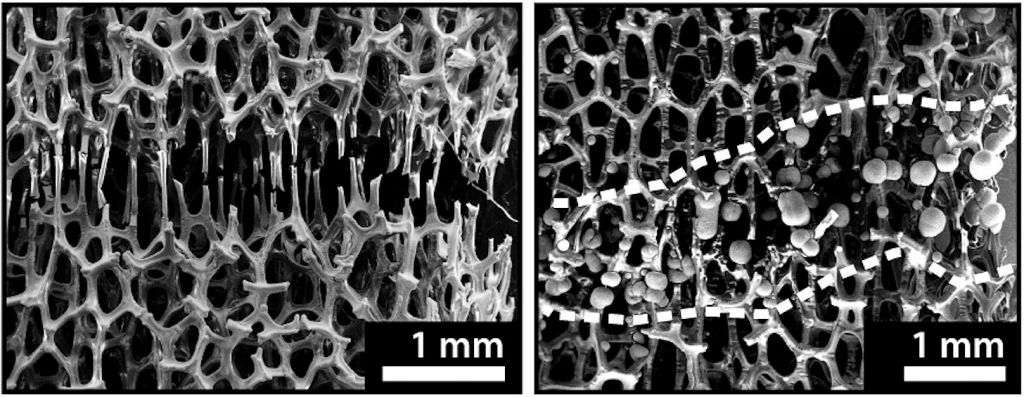
Courtesy: UoP, before and after
It was published in the journal Advanced Functional Materials.
Beyond the energy costs associated with the current process of repairing metal by melting it to a more pliable form, there are some metal components where such a repair strategy is not even an option. For example, melting removes the intricate internal structure of metallic foams, like the ones used in vehicle armor, which are metals made with internal pockets of air. This arrangement of struts and gaps reduces the material's weight while maintaining its overall strength.
While exploring ways to repair such porous metals, Pikul and Hsain looked at existing self-healing materials, which are generally made from relatively soft polymers and plastics.
"The way people do self-healing today is they impregnate these polymers with different chemicals that, when that polymer is ruptured, are released and mix like an epoxy, gluing the material back together," Pikul says. "That approach works for polymers because polymers can flow and are relatively easy to reshape at room temperature, but that means they have limited strength as a result."
To heal metal foams, which generally have better structural properties than polymers, Pikul and Hsain started by finding a way for them to "sense" where they had been damaged. Rather than encapsulating additional chemicals used in repair, the researchers realized that they could use the breaking of a polymer layer as a kind of chemical signal.
Pikul and Hsain used chemical vapor deposition to evenly coat each strut of the nickel foam with a layer of Parylene D, a chemically inert and stretchy polymer. Because this material's damage tolerance is slightly lower than that of nickel, it breaks first as the sample is damaged, revealing the metal underneath. The researchers could then use electroplating to build new nickel struts only on the exposed nickel where they were needed.
Electroplating is a relatively low-energy, room-temperature technique, most commonly used to add a layer of chrome to car parts or gold to jewellery. In the former example, a steel tire rim is placed in a liquid electrolyte bath that contains chromium ions. When a voltage is applied, ions near the steel react and form a uniform chromium metal coating on the steel.
"Unlike polymers, metals don't flow at room temperature," Pikul says. "The nice thing with electrochemistry is that metal ions can easily move through the liquid electrolyte. We then use electrochemistry to convert the ions to solid metal. The polymer acts like a lithography mask and only allows the ions to turn into metal where the metal foam was broken."
Pikul and Hsain healed three types of damage in their experiments on centimetre scale samples of their polymer coated nickel foam: samples with cracks, samples that had been pulled apart until they were connected by just a few struts, and samples that had been cleaved in two.
Healing the damage took about four hours, and because electroplating acts on all of the exposed nickel at once, the time it takes to heal damage is independent of the sample's size.
While this room-temperature approach is not truly "self-healing" because it requires an external power source and raw materials, Pikul sees it being in line with how self-healing occurs in the body.
"I think most people would say bone is a self-healing material," Pikul says, "and I think, in practice, our material is very similar to bone. Bone is not fully self-contained either, it needs an energy source and nutrients to heal, both of which come from eating food. In our system, these function similarly to the voltage and electroplating bath."
Also, like bone, the repaired areas are actually stronger than they were before they were damaged because extra nickel is grown at the healing site. The new nickel, however, reduces the healing efficiency when repeatedly using this technique. Because the healed areas no longer have a polymer coating, nickel would continue to amass there should another piece of the sample need to be healed.
Pikul hopes that further research on this technique will increase the similarities to biological healing.
"The electrolyte fluid that allows the healing can be integrated into the metal foams so that it resembles blood in our body," Pikul says. "Once the foam is fractured, the electrolyte will surround the fractured area and heal the metal after the application of an external voltage, which can be from a battery."
The foam could be healed without having to remove and submerge the damaged part, particularly useful if the part in question is a car door, robotic arm, or space station component.
Source: UoP
What this means for your organisation
Repair without melting.
Fixing metal at room temperature avoids huge energy use. It also preserves delicate internal structures.
Light materials last longer.
Metal foams save weight but were hard to repair. Healing extends their useful life.
Field repairs become possible.
No welding torch means repairs where heat is unsafe. Defence and remote sites benefit.
Three questions for your next leadership meeting
- Which of our metal parts are scrapped because repair is hard?
- Could room temperature repair cut our maintenance energy use?
- Where would field repairs without heat help us?
The trends and technologies behind this story
From the 311 Starburst, the 311 Strategic Intelligence Unit’s map of the technologies and trends shaping the next 50 years.
Analysis by the 311 Strategic Intelligence Unit, from Matthew Griffin’s article and 311 data. First published on Fanatical Futurist.
FAQ
Why does this matter?
When metal breaks it takes a huge amount of energy and heat to fix it, but this new breakthrough fixes that problem.

About the author
Matthew Griffin Founder, President and Futurist, 311 Institute
Matthew Griffin is a multi-award winning Futurist and expert in Disruption and Innovation, Geopolitics, Leadership, and Technology, who NASA have described as a "walking encyclopaedia of the future" and a "futurist Polymath."
Read full bio
Matthew Griffin is a multi-award winning Futurist and expert in Disruption and Innovation, Geopolitics, Leadership, and Technology, who NASA have described as a "walking encyclopaedia of the future" and a "futurist Polymath." 17-time best selling author of the "Codex of the Future" series, Matthew is the Founder, President and Futurist of the 311 Institute, a global Futures and Deep Futures advisory firm working with royal households, world leaders, G7, G20, and G77 governments, NGOs, and multi-national mid and mega cap firms to help them explore, shape, and lead the next 50 years of business and society.
An award-winning YouTube creator with over a million followers, with an unrivalled global reach and impact, Matthew is a highly sought-after international keynote speaker, lecturer, and mentor who collaborates with global leaders through the United Nations Alliance of Civilizations (UNAOC) and United Nations General Assembly (UNGA) to shape pivotal initiatives such as the UN’s AI for Humanity program, the United Nations Conference of the Parties (UN COP), and the World Economic Forum in Davos.
As the former Global Head of Cloud, National Security, and Enterprise Sales for companies including Atos, Dell-EMC, and IBM, Matthew has a proven track record of building multi-billion dollar business units and turning failing divisions into market leaders. His ability to identify, analyse, and communicate the implications of hundreds of emerging technologies and trends is unparalleled, and his insights are trusted by many of the world’s most respected organisations, including ABB, Accenture, Adidas, AON, ARM, BCG, Centrica, Citi, Coca-Cola, Dentons, Deloitte, Dow Jones, EY, Google, KPMG, Lego, Legal & General, LinkedIn, Microsoft, PepsiCo, Qualcomm, RWE, Samsung, Siemens AG and Siemens Energy, T-Mobile, UBS, VISA, Walmart, Workday, Worldpay and many others.
Regularly featured in the global media including the AP, BBC, Bloomberg, CNBC, Discovery, Forbes, Khaleej Times, Telegraph, TIME, ViacomCBS, WIRED, and the WSJ, Matthews mission is to help organisations create a fair and sustainable future whose benefits are shared by everyone irrespective of their ability, background, or circumstances.
What future do you need to see?
Choose one to get started on industry and manufacturing and the future of your organisation.
Sources and further reading
- New bone metal foam can heal room temperature penntoday.upenn.edu
Source: first published by the 311 Institute on 4 November 2019. Cite as: Griffin, M. (2019). Researchers create a bone like metal foam that heals at room temperature. 311 Institute. https://www.311institute.com/researchers-create-a-bone-like-metal-foam-that-heals-at-room-temperature/
You are welcome to quote this article with credit and a link to the original.