Scientists create a liquid fuel that can store the Sun’s energy for 18 years
As the number of solar energy installations increase storing the energy they produce, so it can be released to the grid when the Sun goes in, is still holding the industry back from world domination.

Key takeaways
- Recently renewable energy became the cheapest form of energy in over 58 countries, and crossed the 1 Trillion Watts of installed capacity barrier, but no matter how abundant or renewable it is, solar power has a thorn in its side.
- When the energy is needed, the fluid is filtered through a special catalyst that converts the molecules back to their original form, warming the liquid by 63 degrees Celsius (113 degrees Fahrenheit).
- The researchers have put the fluid through this cycle more than 125 times, picking up heat and dropping it off without significant damage to the molecule.
Cite or link to this article
Griffin, M. (2019) 'Scientists create a liquid fuel that can store the Sun’s energy for 18 years', 311 Institute, 19 April. Available at: https://www.311institute.com/scientists-create-a-liquid-fuel-that-can-store-the-suns-energy-for-18-years/ (Accessed: 1 October 2026).
Recently renewable energy became the cheapest form of energy in over 58 countries, and crossed the 1 Trillion Watts of installed capacity barrier, but no matter how abundant or renewable it is, solar power has a thorn in its side. There is still no cheap and efficient long-term way to store, and then release, the energy it generates which means that when the sun shines everything is fine, but when night comes, unless you have a way to store this energy, the lights go out.
The solar industry has been struggling with this for a while now which is one of the reasons why over the past few years investment and research into affordable and scalable Grid Scale Storage solutions, that hope to replace the more expensive traditional Lithium Ion battery grid scale storage solutions, like those rolled out in Australia and on several Pacific Islands by Elon Musks’ SolarCity, which is now Tesla, have become all the vogue with even GoogleX recently entering the fray with its new Project Malta solution, a cheap, low cost grid scale storage solution that uses molten salt to store excess renewable energy.
Now scientists at the Chalmers University of Technology in Sweden have developed a special fluid, called a “solar thermal fuel,” that can store energy from the sun for well over a decade, and most importantly, release it when needed.
"A solar thermal fuel is like a rechargeable battery, but instead of electricity, you put sunlight in and get heat out, triggered on demand," Jeffrey Grossman, an engineer who works with these materials at MIT explained. The fluid is actually a molecule in liquid form that the team have been working on improving for over a year.
This molecule is composed of Carbon, Hydrogen and Nitrogen, and when it is hit by sunlight, it does something unusual - the bonds between its atoms are rearranged and it turns into an “energised new version” of itself, called an Isomer.
Like prey caught in a trap, energy from the sun is captured between the isomer's strong chemical bonds, and it stays there even when the molecule cools down to room temperature.
Then, when the energy is needed, for example at night time or during winter, the fluid is simply drawn through a catalyst that returns the molecule to its original form, releasing energy in the form of heat.
"The energy in this isomer can now be stored for up to 18 years," says one of the team, nanomaterials scientist Kasper Moth-Poulsen from Chalmers University.
"And when we come to extract the energy and use it, we get a warmth increase which is greater than we dared hope for."
A prototype of the energy system, placed on the roof of a university building, has put the new fluid to the test, and according to the researchers, unsurprisingly the results have caught the attention of numerous investors.
The renewable, emissions free energy device is made up of a concave reflector with a pipe in the centre, which tracks the sun like a sort-of satellite dish, ands the system works in a circular manner. Pumping through transparent tubes, the fluid is heated up by the sunlight, turning the molecule Norbornadiene into its heat-trapping isomer, Quadricyclane. The fluid is then stored at room temperature with minimal energy loss.
When the energy is needed, the fluid is filtered through a special catalyst that converts the molecules back to their original form, warming the liquid by 63 degrees Celsius (113 degrees Fahrenheit).
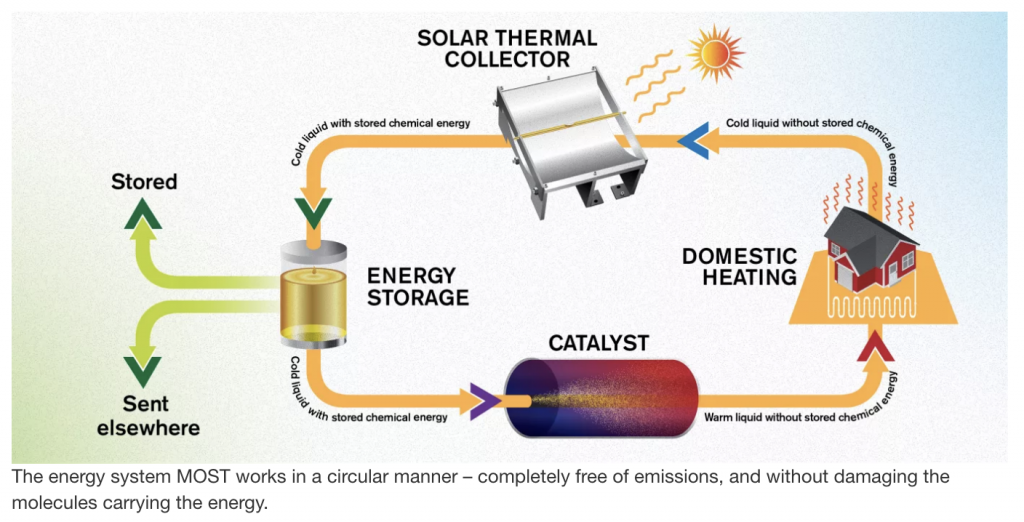
The hope is that this warmth can be used for domestic heating systems, powering a building's water heater, dishwasher, clothes dryer and much more, before heading back to the roof once again.
The researchers have put the fluid through this cycle more than 125 times, picking up heat and dropping it off without significant damage to the molecule.
"We have made many crucial advances recently, and today we have an emissions-free energy system which works all year around," says Moth-Poulsen.
After a series of rapid developments, the researchers claim their fluid can now hold 250 watt-hours of energy per kilogram, which is double the the energy capacity of Tesla's Powerwall batteries. But there's still plenty of room for improvement. With the right manipulations, the researchers think they can get even more heat out of this system, at least another 110 degrees Celsius (230 degrees Fahrenheit).
"There is a lot left to do. We have just got the system to work. Now we need to ensure everything is optimally designed," says Moth-Poulsen, and if all goes as planned, Moth-Poulsen thinks the technology could be available for commercial use within 10 years which would mean that the green energy revolution will then be firmly underway.
The study has been published in Energy & Environmental Science.
FAQ
Why does this matter?
As the number of solar energy installations increase storing the energy they produce, so it can be released to the grid when the Sun goes in, is still holding the industry back from world domination.

About the author
Matthew Griffin Founder, 311 Institute
Matthew Griffin is a multi-award winning Futurist and expert in Disruption and Innovation, Geopolitics, Leadership, and Technology, who NASA have described as a "walking encyclopaedia of the future" and a "futurist Polymath."
Read full bio
Matthew Griffin is a multi-award winning Futurist and expert in Disruption and Innovation, Geopolitics, Leadership, and Technology, who NASA have described as a "walking encyclopaedia of the future" and a "futurist Polymath." 15-time best selling author of the "Codex of the Future" series, Matthew is the Founder and Futurist in Chief of the 311 Institute, a global Futures and Deep Futures advisory firm working with royal households, world leaders, G7, G20, and G77 governments, NGOs, and multi-national mid and mega cap firms to help them explore, shape, and lead the next 50 years of business and society.
An award-winning YouTube creator with over a million followers, with an unrivalled global reach and impact, Matthew is a highly sought-after international keynote speaker, lecturer, and mentor who collaborates with global leaders through the United Nations Alliance of Civilizations (UNAOC) and United Nations General Assembly (UNGA) to shape pivotal initiatives such as the UN’s AI for Humanity program, the United Nations Conference of the Parties (UN COP), and the World Economic Forum in Davos.
As the former Global Head of Cloud, National Security, and Enterprise Sales for companies including Atos, Dell-EMC, and IBM, Matthew has a proven track record of building multi-billion dollar business units and turning failing divisions into market leaders. His ability to identify, analyse, and communicate the implications of hundreds of emerging technologies and trends is unparalleled, and his insights are trusted by many of the world’s most respected organisations, including ABB, Accenture, Adidas, AON, ARM, BCG, Centrica, Citi, Coca-Cola, Dentons, Deloitte, Dow Jones, EY, Google, KPMG, Lego, Legal & General, LinkedIn, Microsoft, PepsiCo, Qualcomm, RWE, Samsung, Siemens AG and Siemens Energy, T-Mobile, UBS, VISA, Walmart, Workday, Worldpay and many others.
Regularly featured in the global media including the AP, BBC, Bloomberg, CNBC, Discovery, Forbes, Khaleej Times, Telegraph, TIME, ViacomCBS, WIRED, and the WSJ, Matthews mission is to help organisations create a fair and sustainable future whose benefits are shared by everyone irrespective of their ability, background, or circumstances.
What future do you need to see?
Choose one to get started on earth and energy and the future of your organisation.
Sources and further reading
- Scientists are trying bottle solar energy turn it liquid fuel ncna930676 nbcnews.com
- energised new version nature.com
- Isomer en.wikipedia.org
- up to 18 years onlinelibrary.wiley.com
- Emissions free energy system saves heat from the summer sun for winter 2731597 mynewsdesk.com
- Energy & Environmental Science pubs.rsc.org
Source: first published by the 311 Institute on 19 April 2019. Cite as: Griffin, M. (2019). Scientists create a liquid fuel that can store the Sun’s energy for 18 years. 311 Institute. https://www.311institute.com/scientists-create-a-liquid-fuel-that-can-store-the-suns-energy-for-18-years/
You are welcome to quote this article with credit and a link to the original.