Matthew GriffinFounder, President and Futurist, 311 Institute
G7 · G20governments advised
850+keynotes
102countries
17codexes
Energy and sustainability sessions forUnited NationsBureau of International RecyclingAVEVAAditya Birla GroupSUEZAZ China
Featured inBloombergThe Wall Street JournalThe Telegraph
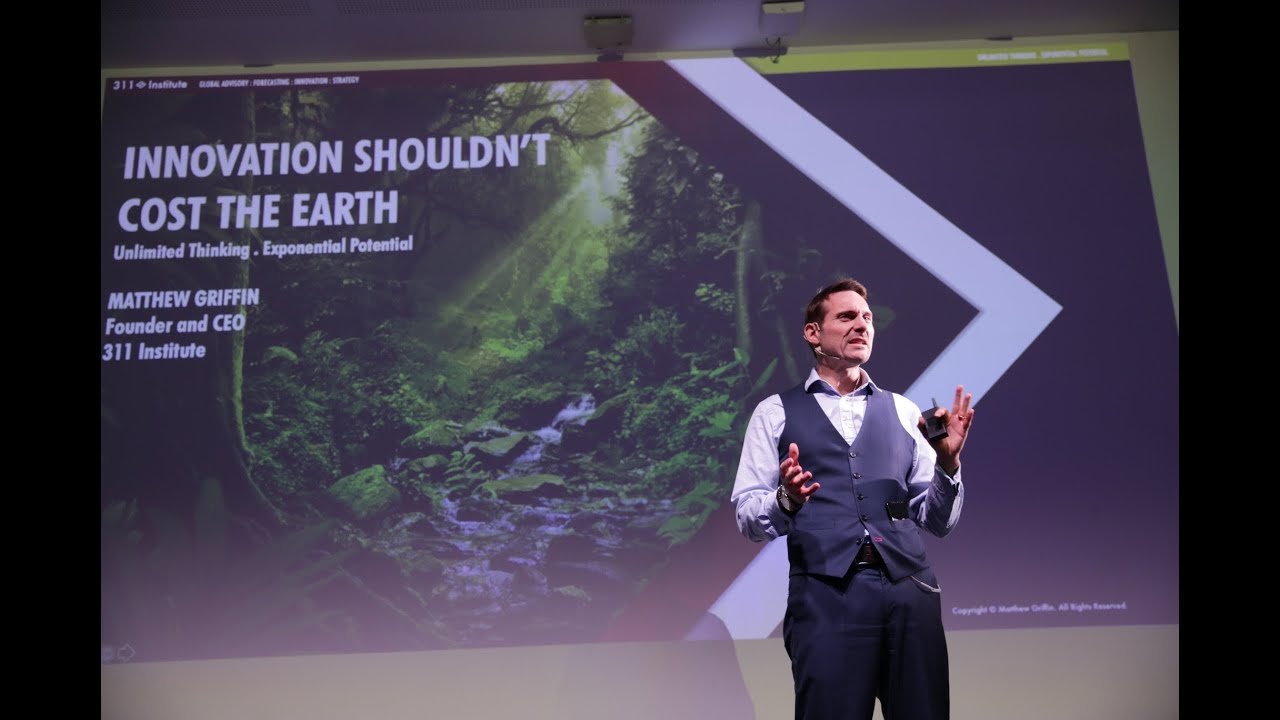
The team at Accountancy Age asked Matthew to keynote their annual summit in Belgium on a subject close to his heart: the environmental cost of innovation, and how to build a future with sustainability at the heart of everything we do, on a planet that is still habitable.
Looking at today's world, he said, people could be forgiven for thinking we are on a one way road to a planet where half is on fire and the other half is underwater and being battered by the elements. But that future isn't set in stone, and we already have powerful tools to change the narrative and create a brighter future for our children. Whether we use them is down to us.
"The future is in our hands, and what kind of planet we all live on in 2050 is down to us."Matthew Griffin, Brussels, December 2019
Matthew examined the environmental cost of AI and blockchain and the new tools available to mitigate it, then the breakthroughs that together offer a path to cutting global greenhouse gas emissions by over sixty percent in the long run, though he admitted it is never that straightforward. They included the electrification of transport, new ways to produce food without animals or farms, new construction techniques and materials, and new green energy generation and storage, plus a tongue in cheek look at NASA's new green rocket fuel.
His closing message was simple: the future is in our hands, and what kind of planet we live on in 2050 is down to us.
311 Intelligence
What this means for your leadership team
Innovation now carries a carbon bill.
Matthew looked at the environmental cost of AI and blockchain, then at the tools that can reduce it. For a leadership team, the cost of a new technology is no longer only financial. Blockchain is one tool where that question now needs an answer before adoption.
The emissions path runs through many sectors.
The breakthroughs Matthew described could together cut global greenhouse gas emissions by over sixty percent in the long run. They span transport, food, construction and energy. He admitted it is never that straightforward, so plans need to cover several fronts at once.
Energy and buildings are the practical start.
Green energy generation and storage sit at the centre of this path, and the green energy transition is a trend to act on now. Construction is shifting too, and green construction is one to prepare for. Even rocket fuel is changing, which shows how far the idea reaches.
Three questions for your next leadership meeting
What is the environmental cost of the technology we are about to adopt?
Which of our emissions could change through energy, construction or transport choices?
Who owns the decision on sustainability when we innovate?
The trends and technologies behind this session
From the 311 Starburst, the 311 Strategic Intelligence Unit’s map of the technologies and trends shaping the next 50 years.
It means innovation and sustainability should be planned together. Matthew's message was that the future is in our hands, and the planet we live on in 2050 depends on the choices made now.
How does the green energy transition relate to this keynote?
Green energy generation and storage were among the breakthroughs Matthew named as a path to lower emissions. Renewables now out-generate coal, and 311 rates this trend as one to act on now.
How does blockchain relate to this keynote?
Matthew examined the environmental cost of blockchain alongside AI, and the new tools that can mitigate it. Leaders weighing blockchain should ask about its energy footprint before they commit.
How can 311 brief our leadership team on this?
Through a private executive briefing or leadership workshop, tailored to your sector, in person first.
Bring this to your leadership teamA private executive briefing or leadership workshop, tailored to your sector. In person first, anywhere in the world.
Analysis by the 311 Strategic Intelligence Unit, from Matthew Griffin’s session and 311 data.
If Matthew gave this session today
Emerging technologies are reshaping culture, industry and society.
The codex explores hundreds of emerging technologies and their implications for global culture, industry and society, including the energy, food and materials breakthroughs Matthew highlighted as a path to lower emissions.