Matthew GriffinFounder, President and Futurist, 311 Institute
G7 · G20governments advised
850+keynotes
102countries
17codexes
Future of work sessions forPepsiCoWinchester CollegeUniversity of GreenwichDiscoverGovernment of BahrainUnleashed
Featured inBloombergThe Wall Street JournalThe Telegraph
About this keynote
Firstly, a big thank you to Kathrin and the team for inviting me to be the keynote at this years RWE Leadership meeting in Dusseldorf, Germany to present on "Life in 2030" to over 300 of RWE’s leadership team, including their CEO Martin Schmitz, and host the dozen or so open innovation workshops where we discussed what the changes we see today and on the horizon will mean for the energy sector, the company and their future strategy.
During the keynote I shone a light on the underlying trends accelerating the pace of change and disruption at a global scale, which today is fast, but that will be even faster tomorrow, and which are helping revolutionise every industry in the world, from entertainment and retail, to energy and transportation, and beyond. I also discussed the often hidden impacts these trends are having on industry at large, such as the decentralisation and democratisation of services, and how, when combined, they can change the economics of an entire industry within a relatively short timeframe.
Watch the keynote
I broke the keynote essentially into four parts, the future of life from a personal, professional and domestic perspective, and then the way in which all industries, not just the energy sector, are being transformed and up ended.
While you can watch the video for yourself, from a personal perspective technology is not just democratising access to information, it’s also democratising access to creativity and expertise in the form of new Creative Machine and Artificial Intelligence (AI) based services, such as Robo-Doctors, Robo-Innovators, and Robo-Lawyers to name but three. But as technology becomes more pervasive within society there will also be a privacy cost, so I discussed the nascent rise of new Self-Soverign Identity programs, like those from IBM and the Sovrin Foundation, whose objectives are, in short, to help us reclaim reclaim control of our information and our online identities from the large platforms we all use today.
Moving across then into the professional world where we’re seeing AI increasingly take on and take over more cognitive roles, across a variety of industries, and the gradual rise of fully distributed autonomous organisations, I discussed how organisations and governments can tackle the challenges these present head on. And then crossing over to the home I touched on Connected Home, behavioural computing, and the rise of urban farming and the reality of an increasingly decentralised energy generation and supply system, based on renewable energy technologies, that’s helping push the cost of electricity at the point of consumption to zero.
All of which was just for starters, so if you’d like to know more about Life in 2030 then grab a coffee, and hit the play button above. I hope you enjoy the experience, and maybe next time I’ll see you at one of the events…
311 Intelligence
What this means for your leadership team
Change compounds across industries.
The keynote showed that trends such as decentralisation and democratisation work together. Combined, they can change the economics of an entire industry in a short time. Leaders should plan for stacked effects, not single shifts.
Energy moves to the edge.
Decentralised renewable generation is pushing the cost of electricity at the point of consumption towards zero. Autonomous energy grids, where power networks start to run themselves, point the same way. Energy firms need a clear view of where value sits when supply is local.
Work and identity are being redrawn.
Machines are taking on more cognitive roles, and autonomous organisations are being tested with few or no human staff. At the same time, people want control of their own data. Organisations need rules for both before they are forced to write them.
Three questions for your next leadership meeting
Where does our value sit if electricity costs near zero at the point of use?
Which cognitive roles in our business could machines take over first?
How would we earn trust if customers control their own identity data?
The trends and technologies behind this session
From the 311 Starburst, the 311 Strategic Intelligence Unit’s map of the technologies and trends shaping the next 50 years.
What does the Life in 2030 session mean for organisations?
It means change will arrive from several directions at once. Decentralised energy, machine expertise, new identity models and autonomous organisations can each shift costs and trust. Leadership teams should test their strategy against all of them together.
How do autonomous energy grids relate to this keynote?
The keynote described a decentralised energy system built on renewables. Autonomous energy grids are the next step, with grids that balance millions of solar panels, batteries and EVs themselves. 311 rates this as Explore, with wide use expected around 2035.
How do autonomous organisations relate to this keynote?
Matthew discussed machines taking over more cognitive roles and the rise of fully distributed autonomous organisations. Autonomous organisations are being tested with software agents as workforce and management. 311 rates this as Explore, with wide use expected around 2035.
How can 311 brief our leadership team on this?
Through a private executive briefing or leadership workshop, tailored to your sector, in person first.
Bring this to your leadership teamA private executive briefing or leadership workshop, tailored to your sector. In person first, anywhere in the world.
Analysis by the 311 Strategic Intelligence Unit, from Matthew Griffin’s session and 311 data.
If Matthew gave this session today
One heavy AI user directs about 18 people's work.
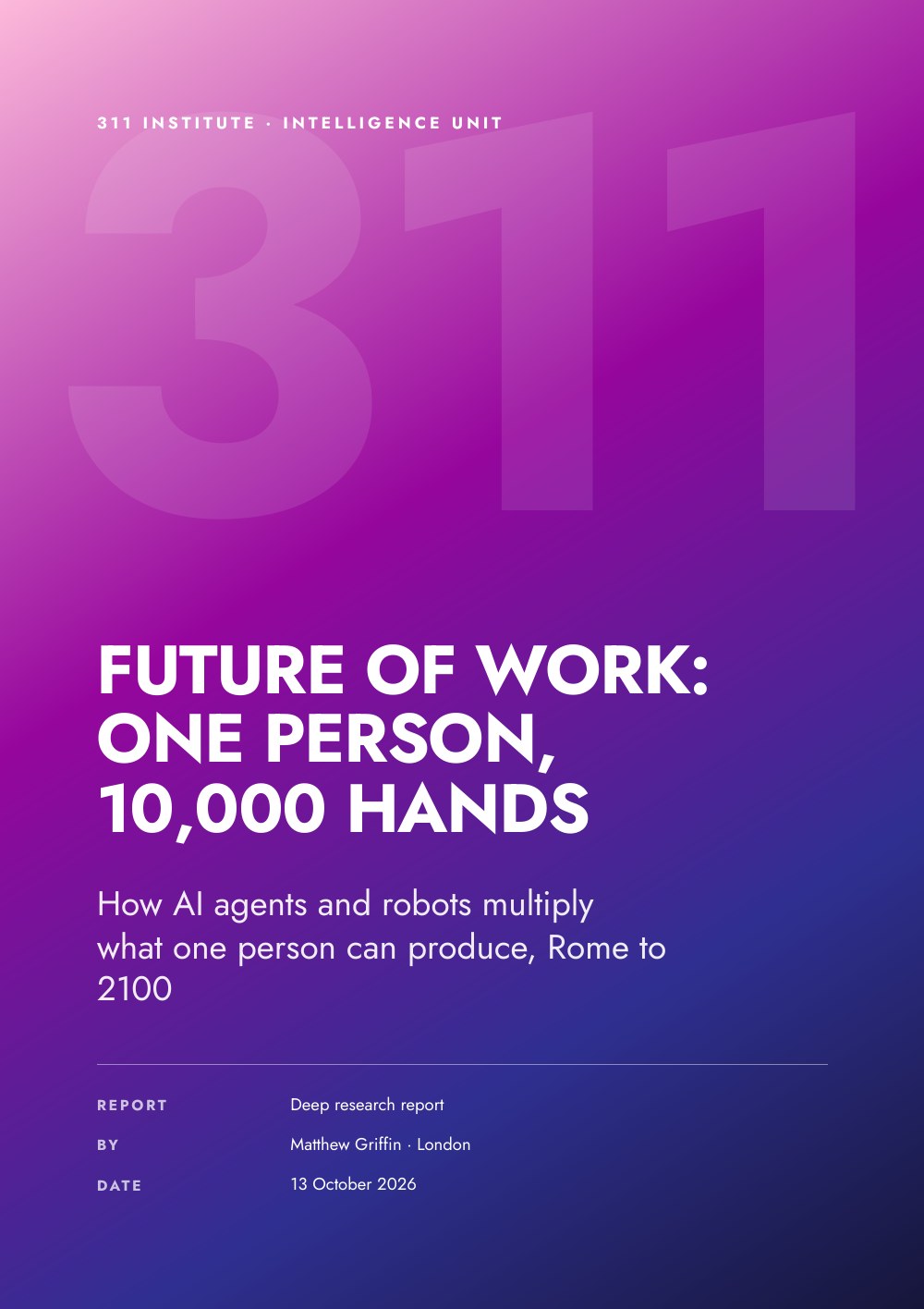
311 Institute's Future of Work report finds a heavy AI user already directs the work of about 18 people for $180 a month. It takes the productivity question this session raised and measures what one person can now make and direct.