Featured inBloombergThe Wall Street JournalThe Telegraph
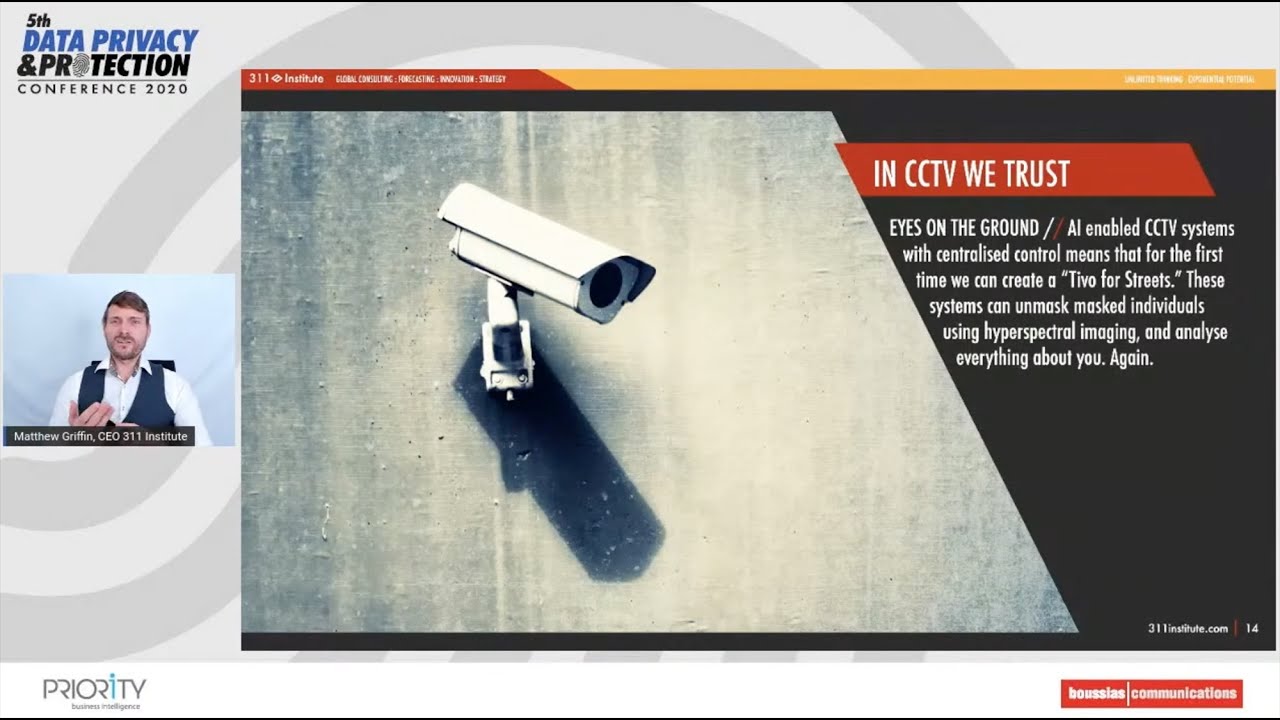
Vicky asked Matthew to give this year's keynote at Boussias' annual Data Privacy and Protection conference, due to be held in person in Greece but moved online as COVID-19 disrupted plans. His subject was the Future of Privacy, a topic he finds both intriguing, for the benefits it could bring, and worrying, as exponential technologies are commercialised with little regard for people's right to privacy and weaponised by dystopian rogue states as a means of suppression.
He explained that today's exponential technologies, from AI and machine vision to new imaging and sensing technologies, are combining to give companies an incredibly powerful and sophisticated 'surveillance apparatus'. How we feel about our right to privacy often depends on the purpose and intentions of those collecting the data.
"In both of these examples I'm stripping away your privacy, but my purpose and intentions influence how you feel about that privacy invasion."Matthew Griffin, Virtual, August 2020
His example made the point. If data from your wearable or a smartphone conversation predicts a heart attack and an ambulance is dispatched to save your life, you would probably be grateful. If the same data is used to adjust or cancel your health insurance before the attack, you would not. Both strip away your privacy, but the purpose changes how it feels. The same applies to mortgages, job applications, protecting a family or suppressing freedom.
Matthew showed how far online and offline privacy have already been eroded, often in surprising ways. As sensing systems become millions of times more sensitive and able to pull secrets directly out of people's heads, this is only the beginning. He closed by arguing that governments must understand the path we are on and put the right regulations and policies in place, because most policy makers are far behind and organisations everywhere will be watching.
311 Intelligence
What this means for your leadership team
Purpose decides trust.
People accept the loss of privacy when the purpose helps them and reject it when it works against them. The same data can save a life or cancel an insurance policy. Your organisation will be judged on why it collects data, not only on how it stores it.
Sensing is getting more powerful.
Machine vision, imaging and sensing tools are combining into a capable surveillance apparatus. Sensing systems are becoming millions of times more sensitive and may reach secrets inside people's heads. Data you consider harmless today may become far more revealing.
Regulation will lag, then arrive.
Most policy makers are far behind the technology, and organisations everywhere will be watching what they do. Privacy laws already cover most countries, and brain data may be next. Build your data practices now for rules that are still being written.
Three questions for your next leadership meeting
Why do we collect each type of personal data we hold?
Would our customers still approve if they saw how we use it?
Which sensing technologies could soon reveal more than we intend?
The trends and technologies behind this session
From the 311 Starburst, the 311 Strategic Intelligence Unit’s map of the technologies and trends shaping the next 50 years.
Privacy is now a question of purpose and trust as well as compliance. Sensing capability is growing fast and policy is behind. Organisations that set clear limits on data use early will be better placed when rules tighten.
How does the demise of anonymity and privacy relate to this keynote?
The trend describes cameras, data trails and analytics making it harder to stay anonymous. Matthew showed how far online and offline privacy have already been eroded, often in surprising ways. He warned that this is only the beginning.
How do global privacy laws relate to the call for regulation?
GDPR-style laws now cover most countries, so the rules are spreading. Matthew argued that governments must still understand the path we are on, because most policy makers are far behind. Expect more change, and plan for it.
How can 311 brief our leadership team on this?
311 offers a private executive briefing or leadership workshop. It is tailored to your sector and delivered in person first.
Bring this to your leadership teamA private executive briefing or leadership workshop, tailored to your sector. In person first, anywhere in the world.
Analysis by the 311 Strategic Intelligence Unit, from Matthew Griffin’s session and 311 data.
If Matthew gave this session today
Emerging technologies carry implications for culture, industry and society.
311 Institute's Future of Exponential Technology Codex explores hundreds of emerging technologies and their implications for global culture, industry and society, including the sensing and AI capabilities Matthew showed eroding privacy.