Scientists created a new type of solar panel that produces electricity and clean water
Water purification systems traditionally use huge amounts of energy, but now researchers have managed to re-purpose waste heat from solar panels instead to do the same job.

Key takeaways
- A new device created by researchers at the King Abdullah University of Science and Technology in Saudi Arabia can purify water through solar power.
- Water scarcity is increasing throughout a variety of places on the planet, from South Africa to India.
- Silicon solar panels take in around 20 percent of the light they absorb, converting them into electricity.
Cite or link to this article
Griffin, M. (2019) 'Scientists created a new type of solar panel that produces electricity and clean water', 311 Institute, 10 December. Available at: https://www.311institute.com/scientists-created-a-new-type-of-solar-panel-that-produces-electricity-and-clean-water/ (Accessed: 1 October 2026).
A new device created by researchers at the King Abdullah University of Science and Technology in Saudi Arabia can purify water through solar power. While there have been previous attempts to merge solar power and clean water, the scientists say they have developed a new three-stage system that radically increases efficiency and could help provide countries and farmers with both unlimited energy and pure water.
The need to combine water purification through clean means is a growing one, giving the rise in man-made climate change. Water scarcity is increasing throughout a variety of places on the planet, from South Africa to India.
"The water-energy nexus is one of the main issues threatening sustainable global development," says Wenbin Wang, a Ph.D. student at the University's Water Desalination and Reuse Center, in a press statement.
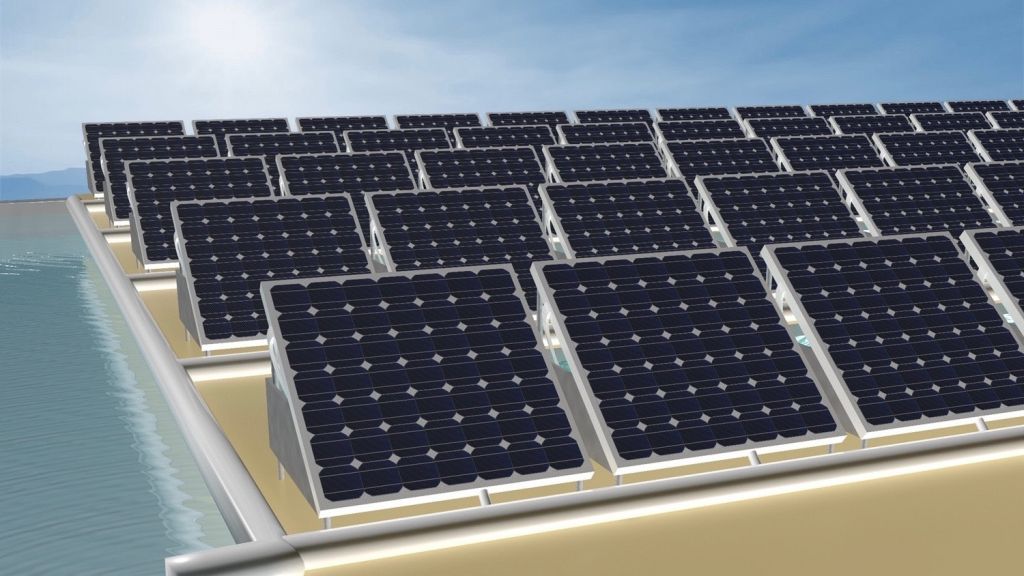
Future PV farm might produce water as well as electricity. Courtesy: Wenbing Wang
To combat the problem, the KAUST team looked at solar panels holistically. Silicon solar panels take in around 20 percent of the light they absorb, converting them into electricity. While that number is increasing, in some cases with a pathway to a staggering 80 percent efficiency, scientists predict that no photovoltaic (PV) panel will be able to absorb more than around 27 percent of the light in their current format. That leaves a significant amount of light being reflected, which generates heat.
The team, led by Professor Peng Wang of the Reuse Center, looked to put that heat to work.
"The PV panel generates a lot of heat, and the heat is considered a headache in PV,” Wang tells Cosmos. "The uniqueness of the device lies in its smart and effective use of the waste heat of the PV as a resource, which leads to its high efficiency in both electricity and fresh water production."
To capture the heat, the team built out a stack of water channels, separated by porous hydrophobic membranes and heat conduction layers. These layers were attached to the bottom of a commercial PV panel. Heat from the panel would vaporize seawater in the top channel, cross through the porous membrane, and then finally condense as fresh water in the third channel.
The team also put the vapor of the seawater to use. A thermal conduction layer to the next seawater channel would collect its heat, allowing the machine to recycle that energy and create even more fresh water.
In tests, the team was able to generate up to 1.64 liters of water per square meter of solar panel surface every hour.
“In a sense, it utilizes solar energy to a much fuller capacity,” Wang tells Cosmos.
The next step for the team is to try and expand its project to the extent that it would be viable for agriculture. Many innovations in agriculture, like vertical farming, attempt to save water. Being able to use saltwater for farms could radically change how water is consumed around the world. In the US alone, farming represents approximately 80 percent of the country's consumptive water use.
"Raising sheep in the field of PV farms is feasible because grass grows well using the fresh water from solar-panel washing," Wenbin says in the press statement. "A PV farm with sheep grazing while seawater is desalinated using our device could be ideal in arid regions near the coast."
FAQ
Why does this matter?
Water purification systems traditionally use huge amounts of energy, but now researchers have managed to re-purpose waste heat from solar panels instead to do the same job.

About the author
Matthew Griffin Founder, 311 Institute
Matthew Griffin is a multi-award winning Futurist and expert in Disruption and Innovation, Geopolitics, Leadership, and Technology, who NASA have described as a "walking encyclopaedia of the future" and a "futurist Polymath."
Read full bio
Matthew Griffin is a multi-award winning Futurist and expert in Disruption and Innovation, Geopolitics, Leadership, and Technology, who NASA have described as a "walking encyclopaedia of the future" and a "futurist Polymath." 15-time best selling author of the "Codex of the Future" series, Matthew is the Founder and Futurist in Chief of the 311 Institute, a global Futures and Deep Futures advisory firm working with royal households, world leaders, G7, G20, and G77 governments, NGOs, and multi-national mid and mega cap firms to help them explore, shape, and lead the next 50 years of business and society.
An award-winning YouTube creator with over a million followers, with an unrivalled global reach and impact, Matthew is a highly sought-after international keynote speaker, lecturer, and mentor who collaborates with global leaders through the United Nations Alliance of Civilizations (UNAOC) and United Nations General Assembly (UNGA) to shape pivotal initiatives such as the UN’s AI for Humanity program, the United Nations Conference of the Parties (UN COP), and the World Economic Forum in Davos.
As the former Global Head of Cloud, National Security, and Enterprise Sales for companies including Atos, Dell-EMC, and IBM, Matthew has a proven track record of building multi-billion dollar business units and turning failing divisions into market leaders. His ability to identify, analyse, and communicate the implications of hundreds of emerging technologies and trends is unparalleled, and his insights are trusted by many of the world’s most respected organisations, including ABB, Accenture, Adidas, AON, ARM, BCG, Centrica, Citi, Coca-Cola, Dentons, Deloitte, Dow Jones, EY, Google, KPMG, Lego, Legal & General, LinkedIn, Microsoft, PepsiCo, Qualcomm, RWE, Samsung, Siemens AG and Siemens Energy, T-Mobile, UBS, VISA, Walmart, Workday, Worldpay and many others.
Regularly featured in the global media including the AP, BBC, Bloomberg, CNBC, Discovery, Forbes, Khaleej Times, Telegraph, TIME, ViacomCBS, WIRED, and the WSJ, Matthews mission is to help organisations create a fair and sustainable future whose benefits are shared by everyone irrespective of their ability, background, or circumstances.
What future do you need to see?
Choose one to get started on earth and energy and the future of your organisation.
Sources and further reading
- South Africa citylab.com
- Satellite images reveal extent chennais water shortage 180972565 smithsonianmag.com
- Water Desalination and Reuse Center wdrc.kaust.edu.sa
- Solar power with a free side of drinking water phys.org
- Irrigation water use ers.usda.gov
Source: first published by the 311 Institute on 10 December 2019. Cite as: Griffin, M. (2019). Scientists created a new type of solar panel that produces electricity and clean water. 311 Institute. https://www.311institute.com/scientists-created-a-new-type-of-solar-panel-that-produces-electricity-and-clean-water/
You are welcome to quote this article with credit and a link to the original.