Australian designer uses 3D printing and AI to create amazing butterfly inspired fashion line
3D printing is helping the fashion industry re-invent itself and fashion itself.

Key takeaways
- Setae Jacket forms a part of the Chro-Morpho collection sponsored by 3D printing firm Stratasys, an American manufacturer of 3D printers, and is designed to demonstrate how technology can work in harmony with textiles.
- The stunning jacket which pushes the boundaries of what’s possible with the technology was made using microscopic photos of Madagascan Sunset Butterfly wings, which were digitised into an algorithm.
- Courtesy: Körner Each bristle is intended to resemble setae, a stiff structure resembling a hair, found on the butterfly wings.
Cite or link to this article
Griffin, M. (2021) 'Australian designer uses 3D printing and AI to create amazing butterfly inspired fashion line', 311 Institute, 22 May. Available at: https://www.311institute.com/australian-fashion-designer-uses-3d-printing-and-ai-to-create-amazing-butterfly-inspired-fashion-line/ (Accessed: 1 October 2026).
3D printed clothes are starting to get fashionable, and hot on the heels of one of the top Miami designers who uses the technology to print stunning fashion lines Julia Körner, another new designer in the space, has married fashion with 3D printing to design the Setae Jacket, which takes its cues from butterfly wings.
Setae Jacket forms a part of the Chro-Morpho collection sponsored by 3D printing firm Stratasys, an American manufacturer of 3D printers, and is designed to demonstrate how technology can work in harmony with textiles.
The stunning jacket which pushes the boundaries of what’s possible with the technology was made using microscopic photos of Madagascan Sunset Butterfly wings, which were digitised into an algorithm. This algorithm then translated the colour pixels in the photos into bristles that were then 3D printed onto denim to form the garment.
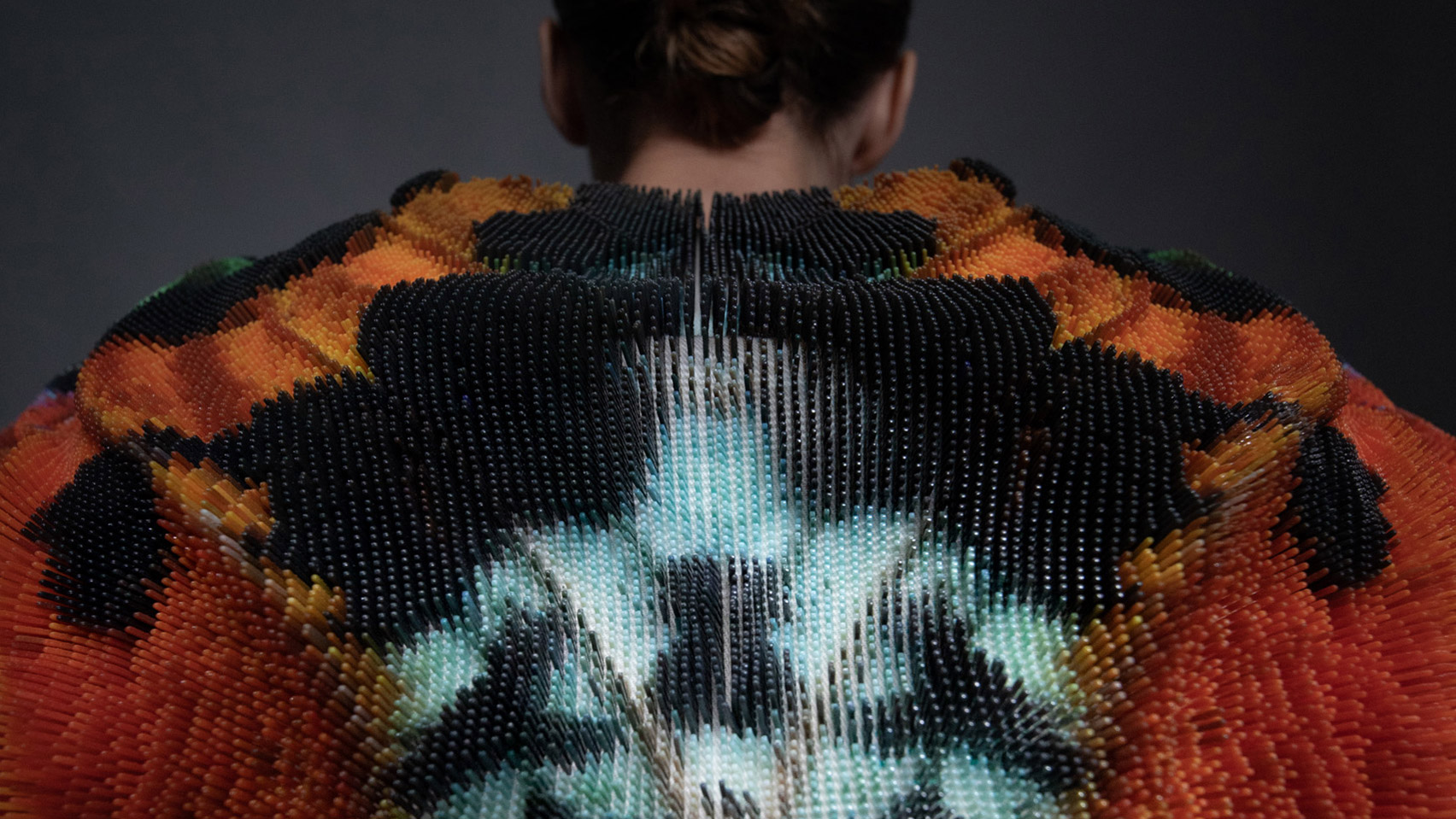
Courtesy: Körner
Each bristle is intended to resemble setae, a stiff structure resembling a hair, found on the butterfly wings. When the jacket is in use, they move with the wearer to create what Körner describes as an "enigmatic visual effect."
Körner is one of 15 designers who have been selected by the Austrianfashion.net, a platform that promotes designers from Austria, to exhibit work at Virtual Design Festival.
"[Körner's] work on the future of 3D, as well as on its current applications, can be seen as revolutionary practice," Austrianfashion.net explained. "Strongly believing that the future of fashion is 3D Körner is making sure she is at the forefront of the revolution."
What this means for your organisation
Nature supplies the design.
Microscopic images of butterfly wings were translated by algorithm into printed bristles. Biological structures are a cheap source of design that competitors cannot easily copy.
Printing adds to existing fabric.
The bristles were printed onto denim rather than replacing it. That makes the technique usable with current materials and supply chains.
Suppliers fund the experiments.
Stratasys sponsored the collection. Firms wanting to test new production methods should look for equipment makers willing to share the cost.
Three questions for your next leadership meeting
- Could printing add features to materials we already use?
- Which natural structures could inspire our product design?
- Would an equipment supplier co-fund our experiments?
The trends and technologies behind this story
From the 311 Starburst, the 311 Strategic Intelligence Unit’s map of the technologies and trends shaping the next 50 years.
Analysis by the 311 Strategic Intelligence Unit, from Matthew Griffin’s article and 311 data. First published on Fanatical Futurist.
FAQ
Why does this matter?
3D printing is helping the fashion industry re-invent itself and fashion itself.

About the author
Matthew Griffin Founder, President and Futurist, 311 Institute
Matthew Griffin is a multi-award winning Futurist and expert in Disruption and Innovation, Geopolitics, Leadership, and Technology, who NASA have described as a "walking encyclopaedia of the future" and a "futurist Polymath."
Read full bio
Matthew Griffin is a multi-award winning Futurist and expert in Disruption and Innovation, Geopolitics, Leadership, and Technology, who NASA have described as a "walking encyclopaedia of the future" and a "futurist Polymath." 17-time best selling author of the "Codex of the Future" series, Matthew is the Founder, President and Futurist of the 311 Institute, a global Futures and Deep Futures advisory firm working with royal households, world leaders, G7, G20, and G77 governments, NGOs, and multi-national mid and mega cap firms to help them explore, shape, and lead the next 50 years of business and society.
An award-winning YouTube creator with over a million followers, with an unrivalled global reach and impact, Matthew is a highly sought-after international keynote speaker, lecturer, and mentor who collaborates with global leaders through the United Nations Alliance of Civilizations (UNAOC) and United Nations General Assembly (UNGA) to shape pivotal initiatives such as the UN’s AI for Humanity programme, the United Nations Conference of the Parties (UN COP), and the World Economic Forum in Davos.
As the former Global Head of Cloud, National Security, and Enterprise Sales for companies including Atos, Dell-EMC, and IBM, Matthew has a proven track record of building multi-billion dollar business units and turning failing divisions into market leaders. His ability to identify, analyse, and communicate the implications of hundreds of emerging technologies and trends is unparalleled, and his insights are trusted by many of the world’s most respected organisations, including ABB, Accenture, Adidas, AON, ARM, BCG, Centrica, Citi, Coca-Cola, Dentons, Deloitte, Dow Jones, EY, Google, KPMG, Lego, Legal & General, LinkedIn, Microsoft, PepsiCo, Qualcomm, RWE, Samsung, Siemens AG and Siemens Energy, T-Mobile, UBS, VISA, Walmart, Workday, Worldpay and many others.
Regularly featured in the global media including the AP, BBC, Bloomberg, CNBC, Discovery, Forbes, Khaleej Times, Telegraph, TIME, ViacomCBS, WIRED, and the WSJ, Matthews mission is to help organisations create a fair and sustainable future whose benefits are shared by everyone irrespective of their ability, background, or circumstances.
What future do you need to see?
Choose one to get started on industry and manufacturing and the future of your organisation.
Sources and further reading
- Austrianfashion.net austrianfashion.net
Source: first published by the 311 Institute on 22 May 2021. Cite as: Griffin, M. (2021). Australian designer uses 3D printing and AI to create amazing butterfly inspired fashion line. 311 Institute. https://www.311institute.com/australian-fashion-designer-uses-3d-printing-and-ai-to-create-amazing-butterfly-inspired-fashion-line/
You are welcome to quote this article with credit and a link to the original.