Samsung shows off a new stretchable display perfect for wearables
Fixed rigid screens and displays are becoming a thing of the past and that's opening up a world of new applications ...

Key takeaways
- The company’s researchers recently created an OLED display that can be stretched by up to 30 percent while operating as normal.
- The design of the heart rate monitor, sitting flush to the patient’s skin, allowed it to pick up a signal 2.4 times stronger than an ordinary sensor.
- Although the technology is only in the early stages of development, Samsung suggests it could be used to support an array of health-monitoring systems in the future.
Cite or link to this article
Griffin, M. (2021) 'Samsung shows off a new stretchable display perfect for wearables', 311 Institute, 12 June. Available at: https://www.311institute.com/samsung-shows-off-a-new-stretchable-display-perfect-for-wearables/ (Accessed: 1 October 2026).
We’ve had curved displays for a while now, as well as rollable and even transparent displays, but what about stretchy ones? Well, now Samsung says it’s making progress building screens “that can be stretched in all directions like rubber bands,” and that the first applications for this material could be in building flexible health tech, smart tattoos, and other wearables with built in skin tight displays.
The company’s researchers recently created an OLED display that can be stretched by up to 30 percent while operating as normal. As a proof of concept, engineers integrated this display into a stretchable heart rate monitor that can be stuck onto the skin like a Band-Aid.
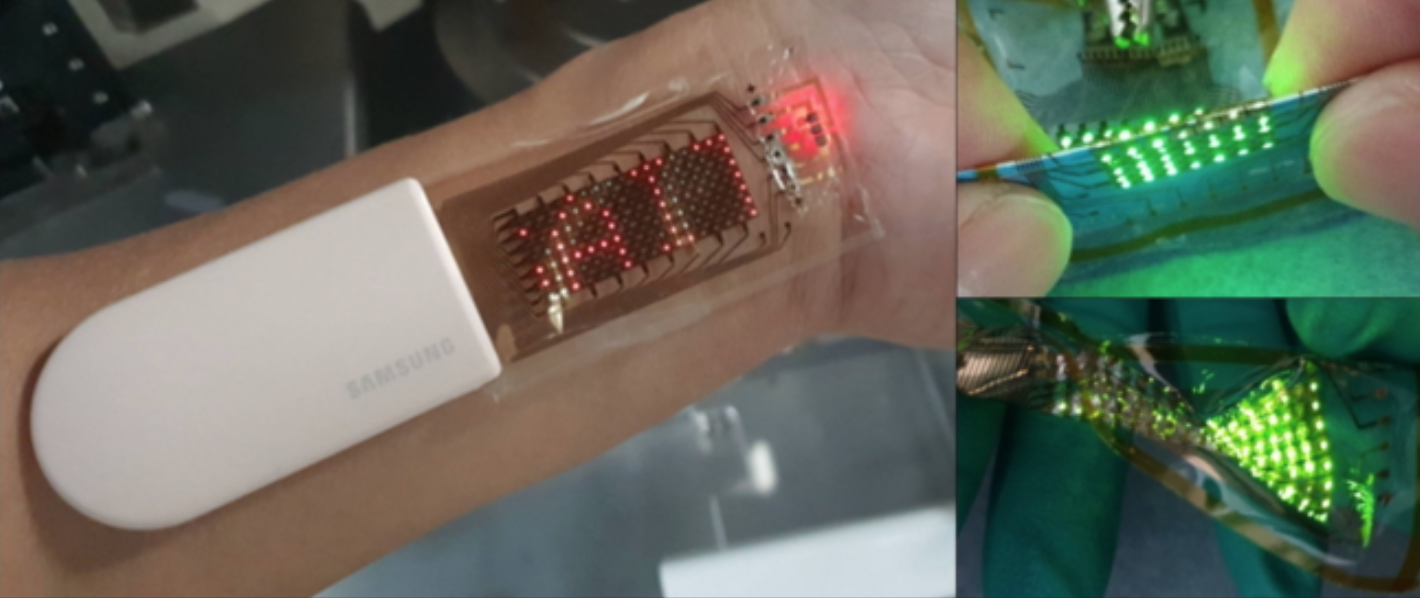
Courtesy: Samsung
“The strength of this technology is that it allows you to measure your biometric data for a longer period without having to remove the solution when you sleep or exercise, since the patch feels like part of your skin,” Samsung’s Youngjun Yun said of the prototype technology in a press statement. “You can also check your biometric data right away on the screen without having to transfer it to an external device.”
The display is rudimentary, but it worked as normal after being stretched 1,000 times, say Samsung’s engineers. The design of the heart rate monitor, sitting flush to the patient’s skin, allowed it to pick up a signal 2.4 times stronger than an ordinary sensor.
Although the technology is only in the early stages of development, Samsung suggests it could be used to support an array of health-monitoring systems in the future.
“The technology can also be expanded to use in wearable healthcare products for adults, children and infants, as well as patients with certain diseases,” says Yun.
Details of the research have been published in the journal Science Advances.
The display can be stretched because it’s built from a specially designed flexible material known as elastomer. This elastomer has been treated to resist the heat of the integrated electronics by Samsung’s engineers and has a particular grid-like “island” structure.
FAQ
Why does this matter?
Fixed rigid screens and displays are becoming a thing of the past and that's opening up a world of new applications ...

About the author
Matthew Griffin Founder, 311 Institute
Matthew Griffin is a multi-award winning Futurist and expert in Disruption and Innovation, Geopolitics, Leadership, and Technology, who NASA have described as a "walking encyclopaedia of the future" and a "futurist Polymath."
Read full bio
Matthew Griffin is a multi-award winning Futurist and expert in Disruption and Innovation, Geopolitics, Leadership, and Technology, who NASA have described as a "walking encyclopaedia of the future" and a "futurist Polymath." 15-time best selling author of the "Codex of the Future" series, Matthew is the Founder and Futurist in Chief of the 311 Institute, a global Futures and Deep Futures advisory firm working with royal households, world leaders, G7, G20, and G77 governments, NGOs, and multi-national mid and mega cap firms to help them explore, shape, and lead the next 50 years of business and society.
An award-winning YouTube creator with over a million followers, with an unrivalled global reach and impact, Matthew is a highly sought-after international keynote speaker, lecturer, and mentor who collaborates with global leaders through the United Nations Alliance of Civilizations (UNAOC) and United Nations General Assembly (UNGA) to shape pivotal initiatives such as the UN’s AI for Humanity program, the United Nations Conference of the Parties (UN COP), and the World Economic Forum in Davos.
As the former Global Head of Cloud, National Security, and Enterprise Sales for companies including Atos, Dell-EMC, and IBM, Matthew has a proven track record of building multi-billion dollar business units and turning failing divisions into market leaders. His ability to identify, analyse, and communicate the implications of hundreds of emerging technologies and trends is unparalleled, and his insights are trusted by many of the world’s most respected organisations, including ABB, Accenture, Adidas, AON, ARM, BCG, Centrica, Citi, Coca-Cola, Dentons, Deloitte, Dow Jones, EY, Google, KPMG, Lego, Legal & General, LinkedIn, Microsoft, PepsiCo, Qualcomm, RWE, Samsung, Siemens AG and Siemens Energy, T-Mobile, UBS, VISA, Walmart, Workday, Worldpay and many others.
Regularly featured in the global media including the AP, BBC, Bloomberg, CNBC, Discovery, Forbes, Khaleej Times, Telegraph, TIME, ViacomCBS, WIRED, and the WSJ, Matthews mission is to help organisations create a fair and sustainable future whose benefits are shared by everyone irrespective of their ability, background, or circumstances.
What future do you need to see?
Choose one to get started on industry and manufacturing and the future of your organisation.
Sources and further reading
- Samsung researchers prove the viability of commercialized stretchable devices news.samsung.com
- published in the journal advances.sciencemag.org
Source: first published by the 311 Institute on 12 June 2021. Cite as: Griffin, M. (2021). Samsung shows off a new stretchable display perfect for wearables. 311 Institute. https://www.311institute.com/samsung-shows-off-a-new-stretchable-display-perfect-for-wearables/
You are welcome to quote this article with credit and a link to the original.