3D Bio-Printing robot prints human tissue within the body to treat internal injuries
Surgery shouldn't always be the only option when it comes to helping treat internal injuries, so now there's a robot that can heal them for you - from the inside.

Key takeaways
- Open wounds on the stomach wall can be serious if left untreated, sometimes requiring surgery, and this is where the new robots come into play.
- Tao Xu, working at China's Tsinghua University, is changing that.
- Collaborating with PhD student Wenxiang Zhao he’s developed a prototype snake-like robot that could be endoscopically inserted into a patient's stomach.
Cite or link to this article
Griffin, M. (2020) '3D Bio-Printing robot prints human tissue within the body to treat internal injuries', 311 Institute, 25 August. Available at: https://www.311institute.com/chinas-new-3d-bio-printing-robot-heals-internal-injuries-from-inside-the-human-body/ (Accessed: 8 October 2026).
Recently I reported on a new 3D Bio-Printing technology that lets doctors and surgeons print human organs and tissue directly into the human body which many people found astounding in itself. But now a new innovation has emerged from China that makes even that science fiction like capability appear mundane after researchers there unveiled prototype mini robots, equipped with 3D Bio-Printers that can heal wounds from within the human body itself.
Open wounds on the stomach wall can be serious if left untreated, sometimes requiring surgery, and this is where the new robots come into play. While we have already heard about bio-printers designed to help heal wounds, the devices are usually fairly large, and thus are limited to use on external injuries, but now Prof. Tao Xu, working at China's Tsinghua University, is changing that.

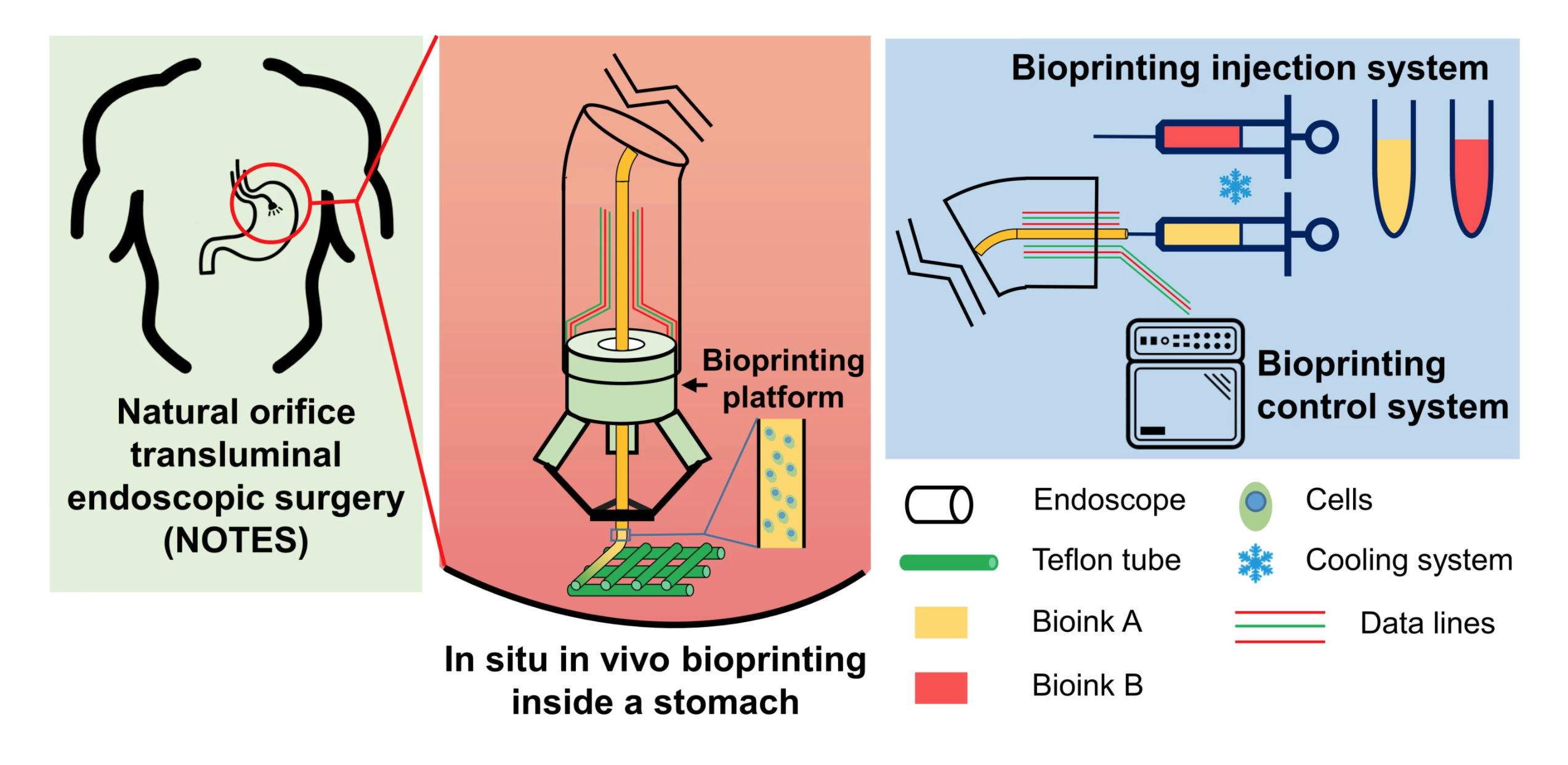
This Bio-Printing robot can print new tissue within the human body.
Collaborating with PhD student Wenxiang Zhao he’s developed a prototype snake-like robot that could be endoscopically inserted into a patient's stomach. It's a delta robot, meaning that its head consists of a rigid base surrounded by three independently moving arms, and it folds down to be extra-skinny while being inserted, then opens up upon reaching the wound site.
Once it's done so, its arms autonomously guide a tube that extrudes two types of hydrogel bio-ink – one of those contains human gastric epithelial cells, while the other contains human gastric smooth muscle cells. These are then deposited in two separate layers, forming a scaffold that covers the patients wound.
"We tested the system in two ways," says Zhao. "First, with a biological model of a human stomach and an endoscope to mimic the insertion and printing operation elements of the process. Second, we carried out a bio-printing test in a cell culture dish to test how effective the device was at bio-printing viable cells and repairing wounds. A 10 day cell culture showed that printed cells remained at a high viability and a steady proliferation, which indicated good biological function of the cells in printed tissue scaffolds,” he said.
Xu adds that more work still needs to be done, however, such as further miniaturising the robot's printing platform, and refining the bioinks, but as we continue to see this type of technology develop and get more compact one has to wonder when we’re going to see nanobots equipped with this kind of functionality that, like these prototypes I showed off last year, are then able to perform in vivo human surgery – something that needless to say won’t only change medicine, but will also change the human condition and take us another step closer to the Singularity.
The research is described in a paper that was recently published in the journal Biofabrication.
Source: IOP Publishing
FAQ
Why does this matter?
Surgery shouldn't always be the only option when it comes to helping treat internal injuries, so now there's a robot that can heal them for you - from the inside.

About the author
Matthew Griffin Founder, 311 Institute
Matthew Griffin is a multi-award winning Futurist and expert in Disruption and Innovation, Geopolitics, Leadership, and Technology, who NASA have described as a "walking encyclopaedia of the future" and a "futurist Polymath."
Read full bio
Matthew Griffin is a multi-award winning Futurist and expert in Disruption and Innovation, Geopolitics, Leadership, and Technology, who NASA have described as a "walking encyclopaedia of the future" and a "futurist Polymath." 15-time best selling author of the "Codex of the Future" series, Matthew is the Founder and Futurist in Chief of the 311 Institute, a global Futures and Deep Futures advisory firm working with royal households, world leaders, G7, G20, and G77 governments, NGOs, and multi-national mid and mega cap firms to help them explore, shape, and lead the next 50 years of business and society.
An award-winning YouTube creator with over a million followers, with an unrivalled global reach and impact, Matthew is a highly sought-after international keynote speaker, lecturer, and mentor who collaborates with global leaders through the United Nations Alliance of Civilizations (UNAOC) and United Nations General Assembly (UNGA) to shape pivotal initiatives such as the UN’s AI for Humanity program, the United Nations Conference of the Parties (UN COP), and the World Economic Forum in Davos.
As the former Global Head of Cloud, National Security, and Enterprise Sales for companies including Atos, Dell-EMC, and IBM, Matthew has a proven track record of building multi-billion dollar business units and turning failing divisions into market leaders. His ability to identify, analyse, and communicate the implications of hundreds of emerging technologies and trends is unparalleled, and his insights are trusted by many of the world’s most respected organisations, including ABB, Accenture, Adidas, AON, ARM, BCG, Centrica, Citi, Coca-Cola, Dentons, Deloitte, Dow Jones, EY, Google, KPMG, Lego, Legal & General, LinkedIn, Microsoft, PepsiCo, Qualcomm, RWE, Samsung, Siemens AG and Siemens Energy, T-Mobile, UBS, VISA, Walmart, Workday, Worldpay and many others.
Regularly featured in the global media including the AP, BBC, Bloomberg, CNBC, Discovery, Forbes, Khaleej Times, Telegraph, TIME, ViacomCBS, WIRED, and the WSJ, Matthews mission is to help organisations create a fair and sustainable future whose benefits are shared by everyone irrespective of their ability, background, or circumstances.
What future do you need to see?
Choose one to get started on robotics and the future of your organisation.
Sources and further reading
- Delta robot en.wikipedia.org
- Epithelium en.wikipedia.org
- Aba4ff iopscience.iop.org
- New microrobot with in situ in vivo bioprinting offers promise for gastric wound treatment ioppublishing.org
Source: first published by the 311 Institute on 25 August 2020. Cite as: Griffin, M. (2020). 3D Bio-Printing robot prints human tissue within the body to treat internal injuries. 311 Institute. https://www.311institute.com/chinas-new-3d-bio-printing-robot-heals-internal-injuries-from-inside-the-human-body/
You are welcome to quote this article with credit and a link to the original.