Scientists gene hacked lizards to make them albino
As gene editing tools become more powerful scientists are starting to push the boundaries by modifying the genes of more complex animals.

Key takeaways
- Georgia’s solution though - rather than gene-editing a fertilised egg as a CRISPR scientist might with a mammal or other animal, the scientists injected unfertilised eggs and waited for nature to run its eventual course.
- After 146 injections into 21 female lizards, the scientists ended up with four mutant albinos.
- The discovery that CRISPR proteins are more resilient and long-lasting than previously thought could lead to new human treatments, such as using the technology to cure blindness, and even as a cancer vaccine.
Cite or link to this article
Griffin, M. (2019) 'Scientists gene hacked lizards to make them albino', 311 Institute, 29 April. Available at: https://www.311institute.com/scientists-gene-hacked-lizards-to-make-them-albino/ (Accessed: 8 October 2026).
For the first time reptiles, which are comparatively complex organisms, have been gene-edited with CRISPR technology after scientists at University of Georgia in the US bred four brown Anole Lizards to be albino pink instead of their typical brown, according to New Atlas. And the findings show that CRISPR gene-editing tech is more resilient and robust than scientists previously thought.
So far geneticists have shied away from gene-editing lizards, as well as more complex organisms, because their eggs are particularly fragile - the process of introducing new genes into them is likely to kill them instead. Georgia’s solution though - rather than gene-editing a fertilised egg as a CRISPR scientist might with a mammal or other animal, the scientists injected unfertilised eggs and waited for nature to run its eventual course.
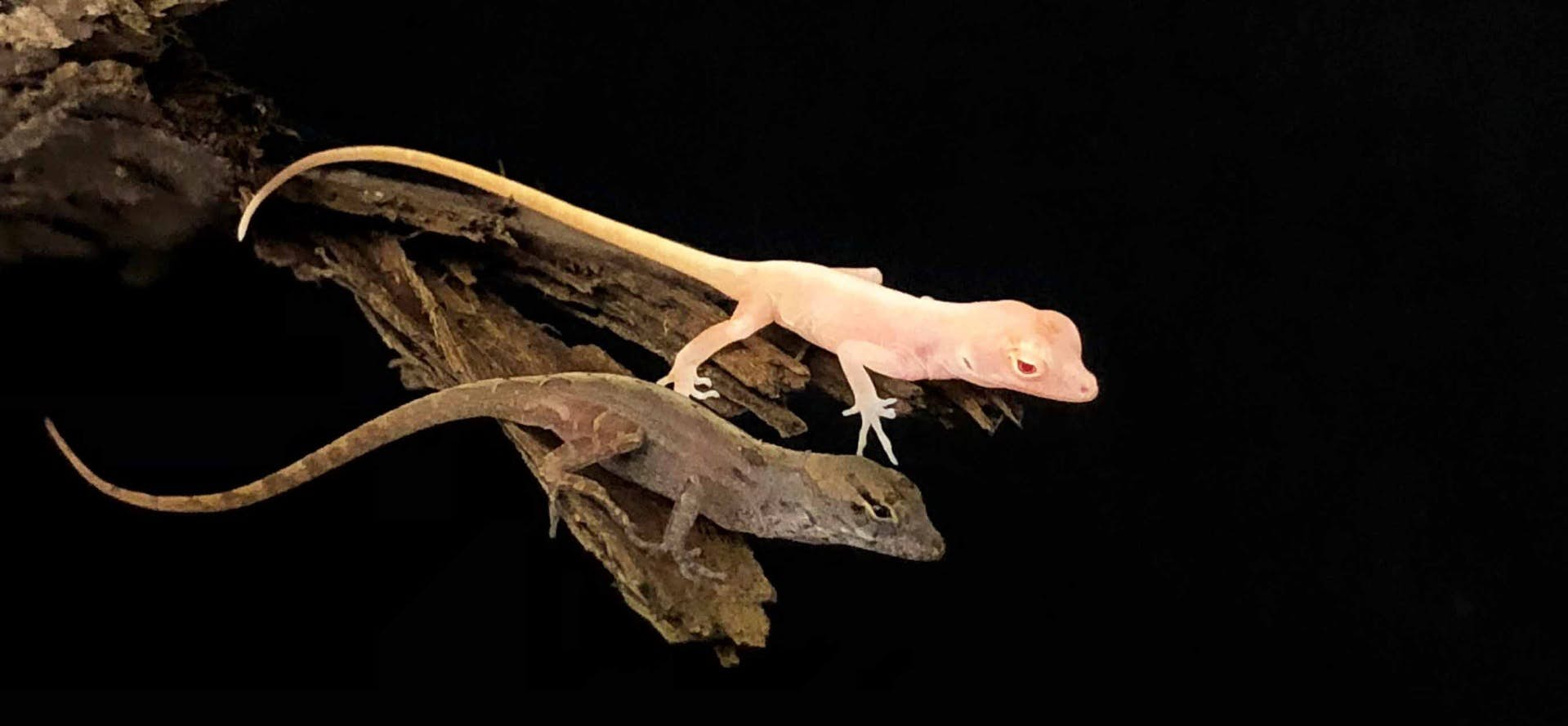

After 146 injections into 21 female lizards, the scientists ended up with four mutant albinos. But the albino lizards had CRISPR-induced mutations not only in the genes they got from their mothers, but also those from their fathers, meaning the CRISPR proteins that caused the gene edits stuck around long enough to also interact with the fathers’ sperm.
The discovery that CRISPR proteins are more resilient and long-lasting than previously thought could lead to new human treatments, such as using the technology to cure blindness, and even as a cancer vaccine.
“That was a surprise,” said lead researcher Douglas Menke. “It enabled us to see the functional requirements of the gene without having to breed mutated animals to produce offspring who inherit the mutated gene from both parents. It’s a big time-saver.”
And it’s just another “positive” step in humanity’s race to gene edit animals and plants for a wide variety of reasons – from using them to create living sensor networks, through to creating plants that generate electricity, and many more weird applications besides.
FAQ
Why does this matter?
As gene editing tools become more powerful scientists are starting to push the boundaries by modifying the genes of more complex animals.

About the author
Matthew Griffin Founder, 311 Institute
Matthew Griffin is a multi-award winning Futurist and expert in Disruption and Innovation, Geopolitics, Leadership, and Technology, who NASA have described as a "walking encyclopaedia of the future" and a "futurist Polymath."
Read full bio
Matthew Griffin is a multi-award winning Futurist and expert in Disruption and Innovation, Geopolitics, Leadership, and Technology, who NASA have described as a "walking encyclopaedia of the future" and a "futurist Polymath." 15-time best selling author of the "Codex of the Future" series, Matthew is the Founder and Futurist in Chief of the 311 Institute, a global Futures and Deep Futures advisory firm working with royal households, world leaders, G7, G20, and G77 governments, NGOs, and multi-national mid and mega cap firms to help them explore, shape, and lead the next 50 years of business and society.
An award-winning YouTube creator with over a million followers, with an unrivalled global reach and impact, Matthew is a highly sought-after international keynote speaker, lecturer, and mentor who collaborates with global leaders through the United Nations Alliance of Civilizations (UNAOC) and United Nations General Assembly (UNGA) to shape pivotal initiatives such as the UN’s AI for Humanity program, the United Nations Conference of the Parties (UN COP), and the World Economic Forum in Davos.
As the former Global Head of Cloud, National Security, and Enterprise Sales for companies including Atos, Dell-EMC, and IBM, Matthew has a proven track record of building multi-billion dollar business units and turning failing divisions into market leaders. His ability to identify, analyse, and communicate the implications of hundreds of emerging technologies and trends is unparalleled, and his insights are trusted by many of the world’s most respected organisations, including ABB, Accenture, Adidas, AON, ARM, BCG, Centrica, Citi, Coca-Cola, Dentons, Deloitte, Dow Jones, EY, Google, KPMG, Lego, Legal & General, LinkedIn, Microsoft, PepsiCo, Qualcomm, RWE, Samsung, Siemens AG and Siemens Energy, T-Mobile, UBS, VISA, Walmart, Workday, Worldpay and many others.
Regularly featured in the global media including the AP, BBC, Bloomberg, CNBC, Discovery, Forbes, Khaleej Times, Telegraph, TIME, ViacomCBS, WIRED, and the WSJ, Matthews mission is to help organisations create a fair and sustainable future whose benefits are shared by everyone irrespective of their ability, background, or circumstances.
What future do you need to see?
Choose one to get started on biotech and enhanced humans and the future of your organisation.
Sources and further reading
- according to New Atlas newatlas.com
Source: first published by the 311 Institute on 29 April 2019. Cite as: Griffin, M. (2019). Scientists gene hacked lizards to make them albino. 311 Institute. https://www.311institute.com/scientists-gene-hacked-lizards-to-make-them-albino/
You are welcome to quote this article with credit and a link to the original.