The web is broken so it’s founder is re-inventing it
The internet was supposed to empower people, but so far most of that power is being concentrated in big centralised platform companies instead.

Key takeaways
- The founder of the World Wide Web thinks it’s broken and has a plan to fix it.
- Tim Berners-Lee, the British computer scientist credited with inventing the web in 1989, announced a new project today that he hopes will radically change his creation - by giving people full control over their data.
- Berners-Lee’s open source software is called Solid and it's being built in conjunction with MIT, and it allows developers to create decentralized apps that run on data that its users fully own.
Cite or link to this article
Griffin, M. (2018) 'The web is broken so it’s founder is re-inventing it', 311 Institute, 23 October. Available at: https://www.311institute.com/the-web-is-broken-so-its-founder-is-trying-to-re-invent-it/ (Accessed: 1 October 2026).
The founder of the World Wide Web thinks it’s broken and has a plan to fix it. Tim Berners-Lee, the British computer scientist credited with inventing the web in 1989, announced a new project today that he hopes will radically change his creation - by giving people full control over their data. Something that in today’s world, despite the fact that we’re already seeing the emergence, albeit the very slow emergence, of so called blockchain Self-Sovreign ID systems, like Sovrin, which IBM just joined, and the UN backed ID2020 scheme, is a novelty.
Berners-Lee’s open source software is called Solid and it's being built in conjunction with MIT, and it allows developers to create decentralized apps that run on data that its users fully own. And if Solid becomes widely adopted, and it’s a big if, then all your apps could talk to each other using the same set of data, which you and only you control.
“A screenshot from Fast Company showing one app that Berners-Lee built on Solid is “like a mashup of Google Drive, Microsoft Outlook, Slack, Spotify, and WhatsApp,” writes Katrina Brooker.
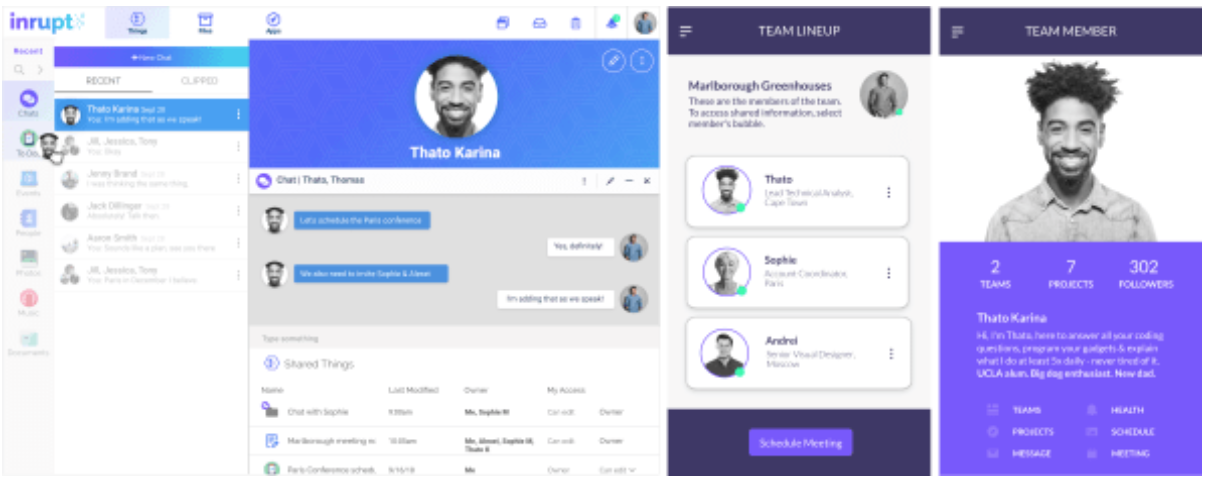
A preview of the new app
Berners-Lee also announced the launch of a company called Inrupt, an obvious gesture to the Silicon Valley cliché “disrupt,” but which sounds a bit closer to “erupt” whose goal is “to provide commercial energy and an ecosystem to help protect the integrity and quality of the new web built on Solid,” writes Berners-Lee - which is to say, it will be a company that provides resources to the theoretically free innovation happening over at Solid.
The new project is a clear rebuke of the tech giants whose opaque use of personal data is core to their businesses success, and whose guardianship of said data recently, with numerous hacks and other scandals catching the headlines recently, has been called into question by everyone from the US and European governments, as well as individuals and multi-nationals.
Facebook’s notorious grip, for example, follows people around the web, even if they’ve signed out or have actually deleted their accounts, and Google’s Android phones track people’s movements, far beyond just their coordinates.
Indeed, Berners-Lee’s antipathy to centralized tech control goes way back. In 1998 he said, “The decision to make the Web an open system was necessary for it to be universal. You can’t propose that something be a universal space and at the same time keep control of it.”
So here’s hoping that, in Berners-Lee’s own words, he “fixes” the internet he helped design and build.
FAQ
Why does this matter?
The internet was supposed to empower people, but so far most of that power is being concentrated in big centralised platform companies instead.

About the author
Matthew Griffin Founder, 311 Institute
Matthew Griffin is a multi-award winning Futurist and expert in Disruption and Innovation, Geopolitics, Leadership, and Technology, who NASA have described as a "walking encyclopaedia of the future" and a "futurist Polymath."
Read full bio
Matthew Griffin is a multi-award winning Futurist and expert in Disruption and Innovation, Geopolitics, Leadership, and Technology, who NASA have described as a "walking encyclopaedia of the future" and a "futurist Polymath." 15-time best selling author of the "Codex of the Future" series, Matthew is the Founder and Futurist in Chief of the 311 Institute, a global Futures and Deep Futures advisory firm working with royal households, world leaders, G7, G20, and G77 governments, NGOs, and multi-national mid and mega cap firms to help them explore, shape, and lead the next 50 years of business and society.
An award-winning YouTube creator with over a million followers, with an unrivalled global reach and impact, Matthew is a highly sought-after international keynote speaker, lecturer, and mentor who collaborates with global leaders through the United Nations Alliance of Civilizations (UNAOC) and United Nations General Assembly (UNGA) to shape pivotal initiatives such as the UN’s AI for Humanity program, the United Nations Conference of the Parties (UN COP), and the World Economic Forum in Davos.
As the former Global Head of Cloud, National Security, and Enterprise Sales for companies including Atos, Dell-EMC, and IBM, Matthew has a proven track record of building multi-billion dollar business units and turning failing divisions into market leaders. His ability to identify, analyse, and communicate the implications of hundreds of emerging technologies and trends is unparalleled, and his insights are trusted by many of the world’s most respected organisations, including ABB, Accenture, Adidas, AON, ARM, BCG, Centrica, Citi, Coca-Cola, Dentons, Deloitte, Dow Jones, EY, Google, KPMG, Lego, Legal & General, LinkedIn, Microsoft, PepsiCo, Qualcomm, RWE, Samsung, Siemens AG and Siemens Energy, T-Mobile, UBS, VISA, Walmart, Workday, Worldpay and many others.
Regularly featured in the global media including the AP, BBC, Bloomberg, CNBC, Discovery, Forbes, Khaleej Times, Telegraph, TIME, ViacomCBS, WIRED, and the WSJ, Matthews mission is to help organisations create a fair and sustainable future whose benefits are shared by everyone irrespective of their ability, background, or circumstances.
What future do you need to see?
Choose one to get started on connected society and the future of your organisation.
Sources and further reading
- a new project medium.com
- Sovrin sovrin.org
- Solid solid.mit.edu
- writes Katrina Brooker fastcompany.com
- Inrupt inrupt.com
- track people’s movements qz.com
- In 1998 he said w3.org
Source: first published by the 311 Institute on 23 October 2018. Cite as: Griffin, M. (2018). The web is broken so it’s founder is re-inventing it. 311 Institute. https://www.311institute.com/the-web-is-broken-so-its-founder-is-trying-to-re-invent-it/
You are welcome to quote this article with credit and a link to the original.