World first as scientists re-grow a frogs amputated leg using a “silk bioreactor”
Some of us are unfortunate enough to loose a limb, or multiple limbs, and one day this technology, and technologies like it, could help us regrow them.

Key takeaways
- Just in the US alone for example there are 2.1 million people living with the loss of a limb or limbs.
- According to the Tufts researchers there’s a unique species of African frog that has weak regenerating abilities, and this was the subject of the their work.
Cite or link to this article
Griffin, M. (2018) 'World first as scientists re-grow a frogs amputated leg using a “silk bioreactor”', 311 Institute, 26 November. Available at: https://www.311institute.com/world-first-as-scientists-re-grow-a-frogs-amputed-leg-using-a-silk-bioreactor/ (Accessed: 1 October 2026).
Like something, out of a science fiction movie or everyone’s favourite “Merc with a mouth”, Deadpool, researchers at Tufts University in the US may have discovered a way to regrow human amputated limbs. Furthermore though their breakthrough means we may one day be able to re-grow lost limbs using little more than a silk bandage and some very, very fancy science. Yes, you heard that right. As you probably already know, there are countless animals in the animal kingdom, that have no problem re-growing various body parts after they’ve been injured or severed.
Creatures like spiders, starfish, lizards, flatworms, and sea cucumbers can regrow body parts at will, and as humans, let’s face it we’re crazy envious. Nevertheless though there are only a few mammals that actually have this superpower, and humans aren’t one of them - yet - even though we're working on it under the auspices of bioelectronic and regenerative medicine.
Like loosing change down the back of the sofa, somewhere along the long evolutionary road we stupid mammals lost our ability to regrow our body parts. But with the right hormone and chemical cocktail scientists may have just managed to resurrect the process.
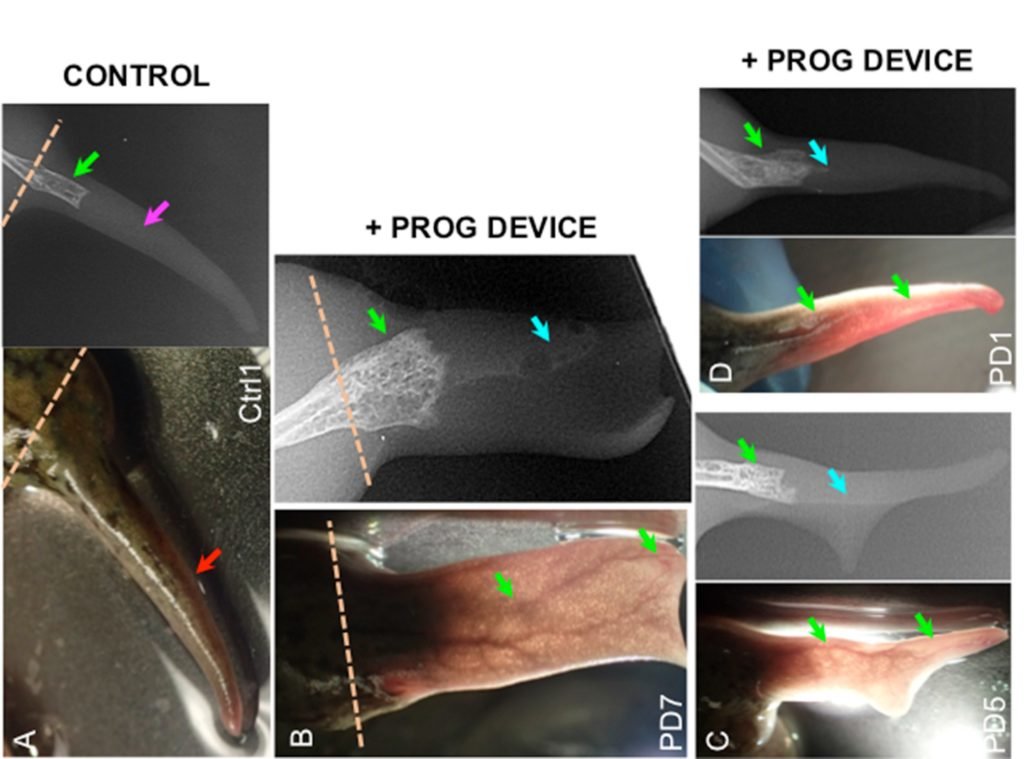
Results with control, and the new bioreactor treatment
The horrendous event of losing a limb is also far more common than you might think and its numbers are growing across the globe. Just in the US alone for example there are 2.1 million people living with the loss of a limb or limbs.
According to the Tufts researchers there’s a unique species of African frog that has weak regenerating abilities, and this was the subject of the their work. When the frog is injured, the amphibian grows a thin spike, shaped piece of cartilage, and using a hormone called progesterone, and Tuft University’s Michael Levin and his research team were able to take that same frog and regrow a larger, footless, paddle-like structure that hosted bones, nerves and blood vessels.
“We looked at progesterone because it showed promise for promoting nerve repair and regeneration,” said Celia Herrera-Rincon, a post-doctoral fellow at Tufts and lead author of the study. “It also modulates the immune response to promote healing, and triggers the re-growth of blood vessels and bone.
“Progesterone can also regulate the bioelectric state of cells, caused by cells passing ions across their outer membranes, which is known to drive regeneration and body pattern formation,” she added.
To regrow the limb the researchers used a small box, a bioreactor, whose bigger cousins are now also being used to grow meat, like chicken, duck, steak, and turkey, without the animals, containing a progesterone loaded gel that was sewn over the wound immediately after amputation.
The wearable bioreactor, which could also one day be 3D printed for the perfect fit, contained a silk protein-based hydrogel that was applied directly to the wound and was capable of delivering small molecule compounds to the affected site, and after 24 hours the process of tissue regrowth began quickly, lasting 9 months compared to the other amphibian test subjects who grew the normal spikes.
Also by adding more “complex cocktails” to new tests, the team discovered that their process created even better limbs that include partial toes, and using this as a foundation, Levin and his team believe if they discover the right “scaled-up bioreactor” it could one day be applied to humans.
“Now we’ll be using the bioreactor model as a new platform for finding ‘master regulator’ control points in the frogs, activated by drugs which, after a very brief treatment, trigger a long programme of tissue growth and remodelling – as well as other factors that support the entire process of regeneration,” Levin said, before adding, “The fact that the model applies treatments locally, which can also be varied over time and location on the wound, makes this a powerful tool for discovering regeneration therapeutics that we could one day hopefully apply to humans.”
It seems that Deadpool is ahead of his time, but one day who knows, all of us might have his superpowers, even if we don’t have his all too colourful language... And if you, like many, are against animal testing of any kind then there's hope on the horizon there too with the announcement of new "labs on chips" products that I've written about at length previously.
Source: Cell Reports
FAQ
Why does this matter?
Some of us are unfortunate enough to loose a limb, or multiple limbs, and one day this technology, and technologies like it, could help us regrow them.

About the author
Matthew Griffin Founder, 311 Institute
Matthew Griffin is a multi-award winning Futurist and expert in Disruption and Innovation, Geopolitics, Leadership, and Technology, who NASA have described as a "walking encyclopaedia of the future" and a "futurist Polymath."
Read full bio
Matthew Griffin is a multi-award winning Futurist and expert in Disruption and Innovation, Geopolitics, Leadership, and Technology, who NASA have described as a "walking encyclopaedia of the future" and a "futurist Polymath." 15-time best selling author of the "Codex of the Future" series, Matthew is the Founder and Futurist in Chief of the 311 Institute, a global Futures and Deep Futures advisory firm working with royal households, world leaders, G7, G20, and G77 governments, NGOs, and multi-national mid and mega cap firms to help them explore, shape, and lead the next 50 years of business and society.
An award-winning YouTube creator with over a million followers, with an unrivalled global reach and impact, Matthew is a highly sought-after international keynote speaker, lecturer, and mentor who collaborates with global leaders through the United Nations Alliance of Civilizations (UNAOC) and United Nations General Assembly (UNGA) to shape pivotal initiatives such as the UN’s AI for Humanity program, the United Nations Conference of the Parties (UN COP), and the World Economic Forum in Davos.
As the former Global Head of Cloud, National Security, and Enterprise Sales for companies including Atos, Dell-EMC, and IBM, Matthew has a proven track record of building multi-billion dollar business units and turning failing divisions into market leaders. His ability to identify, analyse, and communicate the implications of hundreds of emerging technologies and trends is unparalleled, and his insights are trusted by many of the world’s most respected organisations, including ABB, Accenture, Adidas, AON, ARM, BCG, Centrica, Citi, Coca-Cola, Dentons, Deloitte, Dow Jones, EY, Google, KPMG, Lego, Legal & General, LinkedIn, Microsoft, PepsiCo, Qualcomm, RWE, Samsung, Siemens AG and Siemens Energy, T-Mobile, UBS, VISA, Walmart, Workday, Worldpay and many others.
Regularly featured in the global media including the AP, BBC, Bloomberg, CNBC, Discovery, Forbes, Khaleej Times, Telegraph, TIME, ViacomCBS, WIRED, and the WSJ, Matthews mission is to help organisations create a fair and sustainable future whose benefits are shared by everyone irrespective of their ability, background, or circumstances.
What future do you need to see?
Choose one to get started on biotech and enhanced humans and the future of your organisation.
Sources and further reading
- Progesterone en.wikipedia.org
- S2211 1247(18)31573 0.pdf cell.com
Source: first published by the 311 Institute on 26 November 2018. Cite as: Griffin, M. (2018). World first as scientists re-grow a frogs amputated leg using a “silk bioreactor”. 311 Institute. https://www.311institute.com/world-first-as-scientists-re-grow-a-frogs-amputed-leg-using-a-silk-bioreactor/
You are welcome to quote this article with credit and a link to the original.