Book direct with Matthew’s team: we reply within one working day.
Matthew GriffinFounder, President and Futurist, 311 Institute
G7 · G20governments advised
850+keynotes
102countries
17codexes
Finance and banking sessions forAfricaONEShawbrook BankStandard Chartered BankThe Institute of Internal AuditorsWolters KluwerCrown Prince Court
Featured inBloombergThe Wall Street JournalThe Telegraph
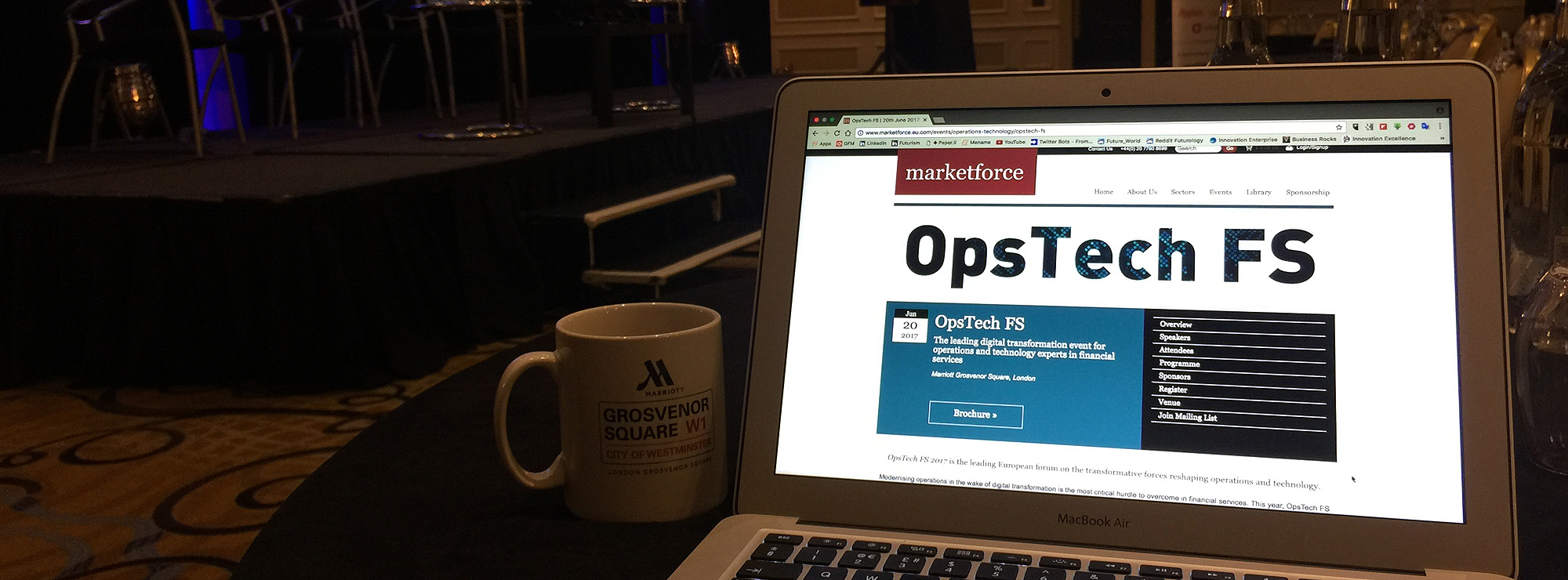
Marketforce invited Matthew to be Chairman for the day and MC of its OpsTechFS 2017 event at the Marriott Grosvenor Square Hotel in London. Around three hundred people attended, with over a hundred corporates and fintechs discussing digital transformation, automation, security, the evolution of the workforce, analytics and connected devices.
Matthew opened the day with the future of financial services, covering the rise of fully autonomous organisations on Wall Street and quantitative trading. To make a point about biometric security, he took a photo of the audience, explaining how criminals can steal facial, fingerprint and iris data from photos and voice recordings, and how tools such as Google RAISR could one day sharpen even a poor image.
"Automation will continue to displace sectors of the workforce, but communication, leadership and workforce re-education and re-tasking ahead of time are becoming especially important as we race into the future."Matthew Griffin, London, June 2017
Speakers included Sebastian Antony, Director of Transformation at Barclaycard, on automating Barclaycard's services; Dr Michael Natusch, Global Head of AI at Prudential; and Anthony Macey, Head of Blockchain R&D at Barclays. Two startups followed: Zonafide, using blockchain to counter fraud, and Taqanu Bank, which aims to bank the 2 billion people without proof of ID.
Matthew also chaired panels on blockchain, with Barclays, Prudential and Rob King, formerly of LV, on where, why and how to start, and on the evolution of the workforce with Elliot Biggs of Ageas, Paul Titterton of Barclays Premier Distribution and Will Beeson of CivilisedBank. With programmes at JP Morgan and Goldman Sachs automating back and middle office tasks, and even CEOs in the firing line, this was the most contentious topic.
The panel concluded that cognitive automation and robotic process automation will keep growing and displacing parts of the workforce, and that communication, leadership and re-educating and re-tasking people ahead of time are becoming especially important.
311 Intelligence
What this means for your leadership team
Autonomy is already in trading.
Wall Street and quantitative trading are already home to fully autonomous organisations. Our data shows autonomous organisations are still at the Explore stage, with firms testing software agents as both staff and management. Leaders should decide now which functions could run with few or no people.
Your biometric data is exposed.
Faces, fingerprints and irises can be lifted from photos and voice recordings. Tools such as Google RAISR could one day sharpen even a poor image. Biometrics sit at Act now in our data, so security teams should treat every public image as a possible attack source.
Prepare people before the machines.
Programmes at JP Morgan and Goldman Sachs are automating back and middle office tasks, and even CEOs are in the firing line. The panel expects cognitive automation and robotic process automation to keep displacing work. Early communication, leadership and re-tasking will decide who adapts well.
Three questions for your next leadership meeting
Which of our back and middle office tasks could be automated first?
Could someone rebuild our customers' biometric data from public photos?
Who owns the plan to re-task staff before roles disappear?
The trends and technologies behind this session
From the 311 Starburst, the 311 Strategic Intelligence Unit’s map of the technologies and trends shaping the next 50 years.
What does this session mean for financial services organisations?
It shows three pressures arriving together: autonomous firms, stolen biometric data and displaced work. Organisations that plan for all three early, and talk openly with staff, will be better placed than those that treat each one separately.
How does biometrics relate to this session?
Matthew used a photo of the audience to show how criminals can copy facial, fingerprint and iris data. Biometrics checks who you are by your body or behaviour. Our data rates it Act now, so firms should review how much they trust it alone.
How does cognitive automation relate to this session?
The workforce panel concluded that cognitive automation will keep displacing parts of the workforce. Our data describes it as software taking over office and thinking tasks, and rates it Act now. Leaders should map which roles are exposed and plan re-tasking ahead of time.
How can 311 brief our leadership team on this?
311 offers a private executive briefing or leadership workshop, tailored to your sector. Sessions are held in person first.
Bring this to your leadership teamA private executive briefing or leadership workshop, tailored to your sector. In person first, anywhere in the world.
Analysis by the 311 Strategic Intelligence Unit, from Matthew Griffin’s session and 311 data.
If Matthew gave this session today
One heavy AI user directs about 18 people's work.
311 Institute's Future of Work research finds a heavy AI user already directs the work of about 18 people for $180 a month, which sharpens this panel's point about re-tasking people ahead of automation.