Harvard’s new multi-material 3D printer makes printing soft robots faster and easier
Many 3D printers still only print one material, or at best switch between different materials very slowly, this new printer therefore opens up a host of new use cases.

Key takeaways
- The length of the ink channels can also be adjusted to account for materials that have different viscosities and yield stresses, and thus flow more quickly or slowly than other inks.
- The hinges withstood over 1,000 folding cycles before failing, indicating the high quality of the transitions between the stiff and flexible materials achieved during printing.
- MM3D printing can also be used to create more complex objects, including actuating robots.
Cite or link to this article
Griffin, M. (2019) 'Harvard’s new multi-material 3D printer makes printing soft robots faster and easier', 311 Institute, 2 December. Available at: https://www.311institute.com/harvards-new-multi-material-3d-printer-makes-printing-soft-robots-faster-and-easier/ (Accessed: 8 October 2026).
3D printers are revolutionising manufacturing by allowing users to create any physical shape they can imagine on demand – everything from Adidas sneakers and satellites 3D printed in orbit through to parts for jet engines and even interplanetary rovers. But as advanced as all this sounds the fact remains that most commercial 3D printers can only print products made out of a single material and inkjet printers that are capable of multi-material printing are limited by the physics of droplet formation – something that researchers recently tried to solve by creating a 3D printed that printed using sound.
Now though researchers at Harvard University have 3D printed a bunch of soft robots using a new 3D printing technique that they’ve catchily called Multi-Material Multi-Nozzle 3D (MM3D) printing which uses high speed pressure valves that let the printers nozzles rapidly switch between up to eight different printing materials up to 50 times a minute that lets them print complex shapes in a fraction of the time using conventional printheads. The research is reported in Nature. The breakthrough could also help speed up the development of 3D printed electronic devices aswell as the manufacturing of flexible and soft electronics, for example, for use in wearables and other applications - something that would really catch the eye of manufacturers and product designers all around the world.
The key to MM3D printing’s speedy ink-switching is a series of Y-shaped junctions inside the printhead where multiple ink channels come together at a single output nozzle. The shape of the nozzle, printing pressure, and ink viscosity are all precisely calculated and tuned so that when pressure is applied to one of the “arms” of the junction, the ink that flows down through that arm does not cause the static ink in the other arm to flow backwards, which prevents the inks from mixing and preserves the quality of the printed object.

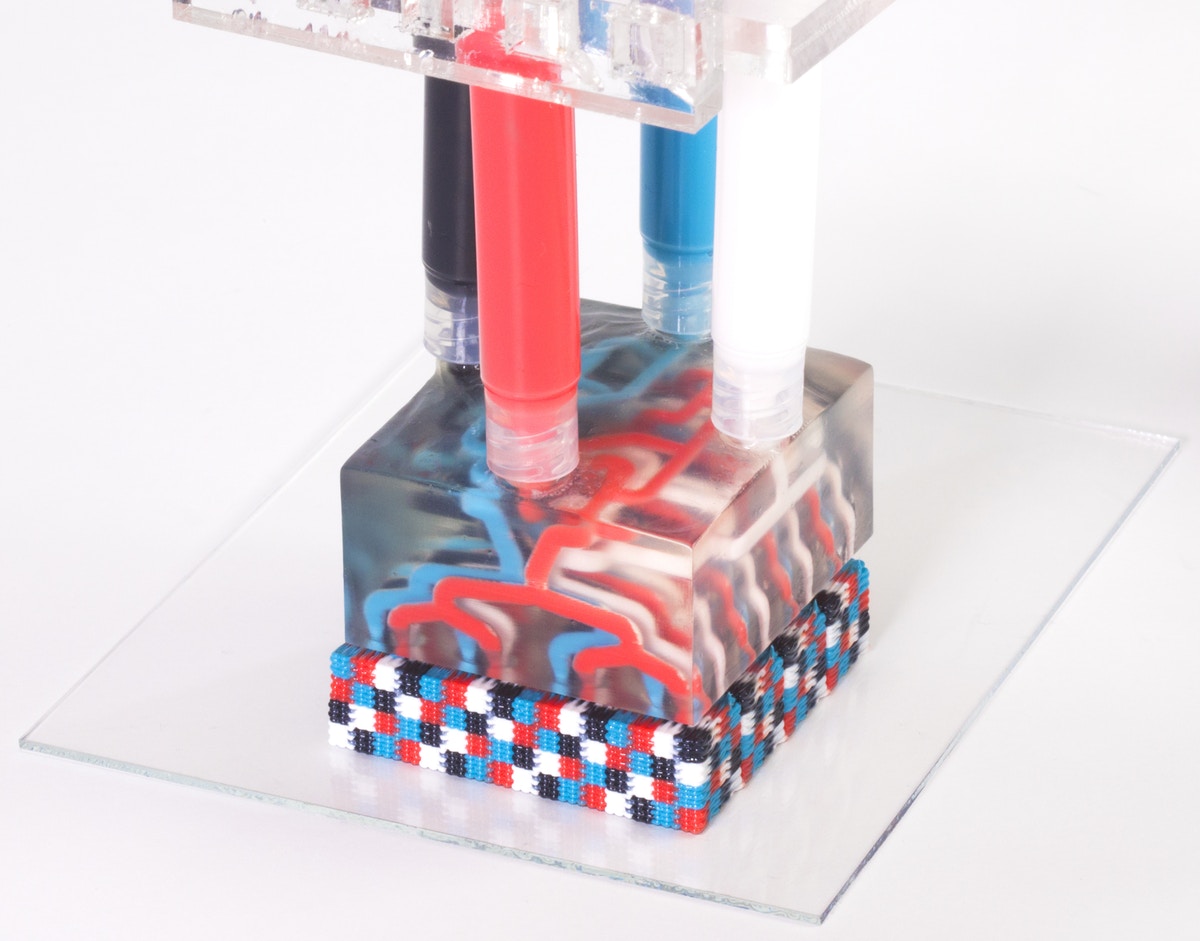

By operating the printheads using a bank of fast pneumatic valves, this one way flow behaviour allows the rapid assembly of multi-material filaments that flow continuously out from each nozzle, and enables the construction of a 3D multi-material part. The length of the ink channels can also be adjusted to account for materials that have different viscosities and yield stresses, and thus flow more quickly or slowly than other inks.
“Because MM3D printing can produce objects so quickly, one can use reactive materials whose properties change over time, such as epoxies, silicones, polyurethanes, or bio-inks,” said co-first author Jochen Mueller. “One can also readily integrate materials with disparate properties to create origami-like architectures or soft robots that contain both stiff and flexible elements.”
To demonstrate their technique, the researchers printed a Miura origami structure composed of stiff “panel” sections connected by highly flexible “hinge” sections.
Previous methods of building such a structure require manually assembling them together into stacked layers – the MM3D printhead was able to print the entire object in a single step by using eight nozzles to continuously extrude two alternating epoxy inks whose stiffnesses differed by four orders of magnitude after being cured. The hinges withstood over 1,000 folding cycles before failing, indicating the high quality of the transitions between the stiff and flexible materials achieved during printing.
MM3D printing can also be used to create more complex objects, including actuating robots. The research team designed and printed a soft robot composed of rigid and soft elastomers in a millipede-like pattern that included embedded pneumatic channels that enable the soft “muscles” to be compressed sequentially by a vacuum, making the robot “walk.” The robot was able to move at nearly half an inch per second while carrying a load eight times its own weight, and could be connected to other robots to carry heavier loads.
“This method enables the rapid design and fabrication of voxelated matter, which is an emerging paradigm in our field,” said Mueller. “Using our broad palette of functional, structural, and biological inks, different materials can now be seamlessly integrated into 3D printed objects on demand.”
FAQ
Why does this matter?
Many 3D printers still only print one material, or at best switch between different materials very slowly, this new printer therefore opens up a host of new use cases.

About the author
Matthew Griffin Founder, 311 Institute
Matthew Griffin is a multi-award winning Futurist and expert in Disruption and Innovation, Geopolitics, Leadership, and Technology, who NASA have described as a "walking encyclopaedia of the future" and a "futurist Polymath."
Read full bio
Matthew Griffin is a multi-award winning Futurist and expert in Disruption and Innovation, Geopolitics, Leadership, and Technology, who NASA have described as a "walking encyclopaedia of the future" and a "futurist Polymath." 15-time best selling author of the "Codex of the Future" series, Matthew is the Founder and Futurist in Chief of the 311 Institute, a global Futures and Deep Futures advisory firm working with royal households, world leaders, G7, G20, and G77 governments, NGOs, and multi-national mid and mega cap firms to help them explore, shape, and lead the next 50 years of business and society.
An award-winning YouTube creator with over a million followers, with an unrivalled global reach and impact, Matthew is a highly sought-after international keynote speaker, lecturer, and mentor who collaborates with global leaders through the United Nations Alliance of Civilizations (UNAOC) and United Nations General Assembly (UNGA) to shape pivotal initiatives such as the UN’s AI for Humanity program, the United Nations Conference of the Parties (UN COP), and the World Economic Forum in Davos.
As the former Global Head of Cloud, National Security, and Enterprise Sales for companies including Atos, Dell-EMC, and IBM, Matthew has a proven track record of building multi-billion dollar business units and turning failing divisions into market leaders. His ability to identify, analyse, and communicate the implications of hundreds of emerging technologies and trends is unparalleled, and his insights are trusted by many of the world’s most respected organisations, including ABB, Accenture, Adidas, AON, ARM, BCG, Centrica, Citi, Coca-Cola, Dentons, Deloitte, Dow Jones, EY, Google, KPMG, Lego, Legal & General, LinkedIn, Microsoft, PepsiCo, Qualcomm, RWE, Samsung, Siemens AG and Siemens Energy, T-Mobile, UBS, VISA, Walmart, Workday, Worldpay and many others.
Regularly featured in the global media including the AP, BBC, Bloomberg, CNBC, Discovery, Forbes, Khaleej Times, Telegraph, TIME, ViacomCBS, WIRED, and the WSJ, Matthews mission is to help organisations create a fair and sustainable future whose benefits are shared by everyone irrespective of their ability, background, or circumstances.
What future do you need to see?
Choose one to get started on AI and intelligence and the future of your organisation.
Sources and further reading
- S41586 019 1736 8 nature.com
Source: first published by the 311 Institute on 2 December 2019. Cite as: Griffin, M. (2019). Harvard’s new multi-material 3D printer makes printing soft robots faster and easier. 311 Institute. https://www.311institute.com/harvards-new-multi-material-3d-printer-makes-printing-soft-robots-faster-and-easier/
You are welcome to quote this article with credit and a link to the original.