Scientists have visualised stress in plants for the first time
As these sensors become more powerful one day we'll be able to visualise the stress crops are under at scale and intervene to save them.

Key takeaways
- Today, thanks in part to climate change, plants everywhere are under a lot of stress which can not only reduce crop yields and stunt their growth, and in extreme circumstances it can kill them.
- Plant biologists have long sought a deeper understanding of foundational processes involving kinases, enzymes that catalyze key biological activities in proteins.
- The researchers describe using SNACS to provide new evidence about longstanding questions about SnRK2 and foundational interactions with carbon dioxide.
Cite or link to this article
Griffin, M. (2020) 'Scientists have visualised stress in plants for the first time', 311 Institute, 8 June. Available at: https://www.311institute.com/scientists-have-visualised-stress-in-plants-for-the-first-time/ (Accessed: 1 October 2026).
Today, thanks in part to climate change, plants everywhere are under a lot of stress which can not only reduce crop yields and stunt their growth, and in extreme circumstances it can kill them. While organisations like DARPA in the US are trying to find new ways to bring plants back from the dead and revive them there’s no doubt that being able to measure and monitor the amount of stress plants are under would be useful, and now scientists in the US have found a way to do just that.
Plant biologists have long sought a deeper understanding of foundational processes involving kinases, enzymes that catalyze key biological activities in proteins. Analysing the processes underlying kinases in plants takes on greater urgency in today's environment increasingly altered by climate warming.
Certain "SnRK2" kinases are essential since they are known to be activated in response to drought conditions, triggering the protective closure of small pores on leaf surfaces known as stoma. These pores allow carbon dioxide to enter leaves, but plants also lose more than 90 percent of their water by evaporation through them. Pore opening and closing functions help optimize growth and drought tolerance in response to changes in the environment.
Now, plant biologists at the University of California San Diego have developed a new nano-sensor that allows researchers to monitor SnRK2 protein kinase activity in live plant cells. The SnRK2 activity sensor, or "SNACS," is described in the journal eLife.
Prior efforts to dissect protein kinase activities involved a tedious process of grinding up plant tissues and measuring kinase activities through cell extracts. More than 100 leaves were required per experiment for analyses of the stomatal pore forming "guard cells." SNACS now allows researchers to analyse changes in real time as they happen.
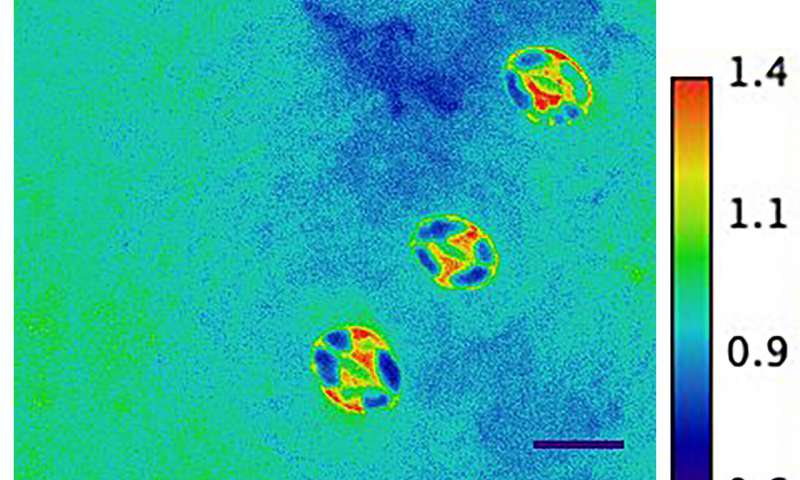
For the first time we can see stress in plants.
"Previously, it was not possible to investigate time-resolved SnRK2 activity in living plant cells," said Biological Sciences Distinguished Professor Julian Schroeder, a member of the Section of Cell and Developmental Biology and senior author of the new paper. "The SNACS sensor reports direct real-time visualisation of SnRK2 kinase activity in single live plant cells or tissues."
The new biosensor is already paying dividends. The researchers describe using SNACS to provide new evidence about longstanding questions about SnRK2 and foundational interactions with carbon dioxide. The researchers show that abscisic acid, a drought stress hormone in plants, activates the kinases, but that elevated carbon dioxide does not, resolving a recently debated question.
"Our findings could benefit researchers investigating environmental stress responses in plants and analysing how different signalling pathways interact with one another in plant cells," said Yohei Takahashi, a UC San Diego project scientist and co-corresponding author of the study. "The ability to investigate time-resolved SnRK2 kinase regulation in live plants is of particular importance for understanding environmental stress responses of plant cells."
The new nanosensor was developed using an approach pioneered by the late UC San Diego Professor Roger Tsien, in part for which he was awarded a Nobel Prize.
FAQ
Why does this matter?
As these sensors become more powerful one day we'll be able to visualise the stress crops are under at scale and intervene to save them.

About the author
Matthew Griffin Founder, 311 Institute
Matthew Griffin is a multi-award winning Futurist and expert in Disruption and Innovation, Geopolitics, Leadership, and Technology, who NASA have described as a "walking encyclopaedia of the future" and a "futurist Polymath."
Read full bio
Matthew Griffin is a multi-award winning Futurist and expert in Disruption and Innovation, Geopolitics, Leadership, and Technology, who NASA have described as a "walking encyclopaedia of the future" and a "futurist Polymath." 15-time best selling author of the "Codex of the Future" series, Matthew is the Founder and Futurist in Chief of the 311 Institute, a global Futures and Deep Futures advisory firm working with royal households, world leaders, G7, G20, and G77 governments, NGOs, and multi-national mid and mega cap firms to help them explore, shape, and lead the next 50 years of business and society.
An award-winning YouTube creator with over a million followers, with an unrivalled global reach and impact, Matthew is a highly sought-after international keynote speaker, lecturer, and mentor who collaborates with global leaders through the United Nations Alliance of Civilizations (UNAOC) and United Nations General Assembly (UNGA) to shape pivotal initiatives such as the UN’s AI for Humanity program, the United Nations Conference of the Parties (UN COP), and the World Economic Forum in Davos.
As the former Global Head of Cloud, National Security, and Enterprise Sales for companies including Atos, Dell-EMC, and IBM, Matthew has a proven track record of building multi-billion dollar business units and turning failing divisions into market leaders. His ability to identify, analyse, and communicate the implications of hundreds of emerging technologies and trends is unparalleled, and his insights are trusted by many of the world’s most respected organisations, including ABB, Accenture, Adidas, AON, ARM, BCG, Centrica, Citi, Coca-Cola, Dentons, Deloitte, Dow Jones, EY, Google, KPMG, Lego, Legal & General, LinkedIn, Microsoft, PepsiCo, Qualcomm, RWE, Samsung, Siemens AG and Siemens Energy, T-Mobile, UBS, VISA, Walmart, Workday, Worldpay and many others.
Regularly featured in the global media including the AP, BBC, Bloomberg, CNBC, Discovery, Forbes, Khaleej Times, Telegraph, TIME, ViacomCBS, WIRED, and the WSJ, Matthews mission is to help organisations create a fair and sustainable future whose benefits are shared by everyone irrespective of their ability, background, or circumstances.
What future do you need to see?
Choose one to get started on industry and manufacturing and the future of your organisation.
Sources and further reading
- Drought+conditions phys.org
- Plants phys.org
Source: first published by the 311 Institute on 8 June 2020. Cite as: Griffin, M. (2020). Scientists have visualised stress in plants for the first time. 311 Institute. https://www.311institute.com/scientists-have-visualised-stress-in-plants-for-the-first-time/
You are welcome to quote this article with credit and a link to the original.