US Navy puts AI brains into its 3D printers to make them “creative and intelligent”
By combining the power of AI with 3D printing the US military hopes to revolutionise how products are designed and made everywhere.

Key takeaways
- Picture an intelligent, laser-wielding robot that can analyse the damage to a part and 3D print the needed titanium alloy parts from an onboard supply of metallic dust.
- Not so with 3D printed metal, which is made layer-by-layer on the spot.
- The data will create predictive models that will enable 3D printing machines to create parts with foundry consistency, but from anywhere.
Cite or link to this article
Griffin, M. (2018) 'US Navy puts AI brains into its 3D printers to make them “creative and intelligent”', 311 Institute, 26 October. Available at: https://www.311institute.com/us-navy-puts-ai-brains-into-its-3d-printers-to-make-them-creative-and-intelligent/ (Accessed: 25 October 2026).
One thing about aircraft, especially ones that fly from aircraft carriers, that are increasingly being turned into floating factories and flying fortresses, where they’re battered by saltwater and tough deck landings, is that they need lots of spare parts that aren’t always on hand. But instead of flying in new parts, though, future US Navy ships may be able to make new ones to order on demand by 3D printing them, but these parts won’t just be printed by any old 3D printer, they’ll be printed by the US Military’s new smart 3D printers that are monitored by robot arms heavily infused with powerful AI capabilities that do everything from design the parts, fine tune the materials and control the end to end process. And that could be a game changer, not just for the US military, but for the manufacturing industry as a whole.
Picture an intelligent, laser-wielding robot that can analyse the damage to a part and 3D print the needed titanium alloy parts from an onboard supply of metallic dust. This is one glimpse of the future proposed by the Office of Naval Research (ONR), which today announced a two year, $5.8 million contract to create a new generation of “super smart 3D printers.” The printers would not only make parts on order wherever they are needed, but can “observe, learn and make decisions by themselves,” according to Lockheed Martin who are running the project.
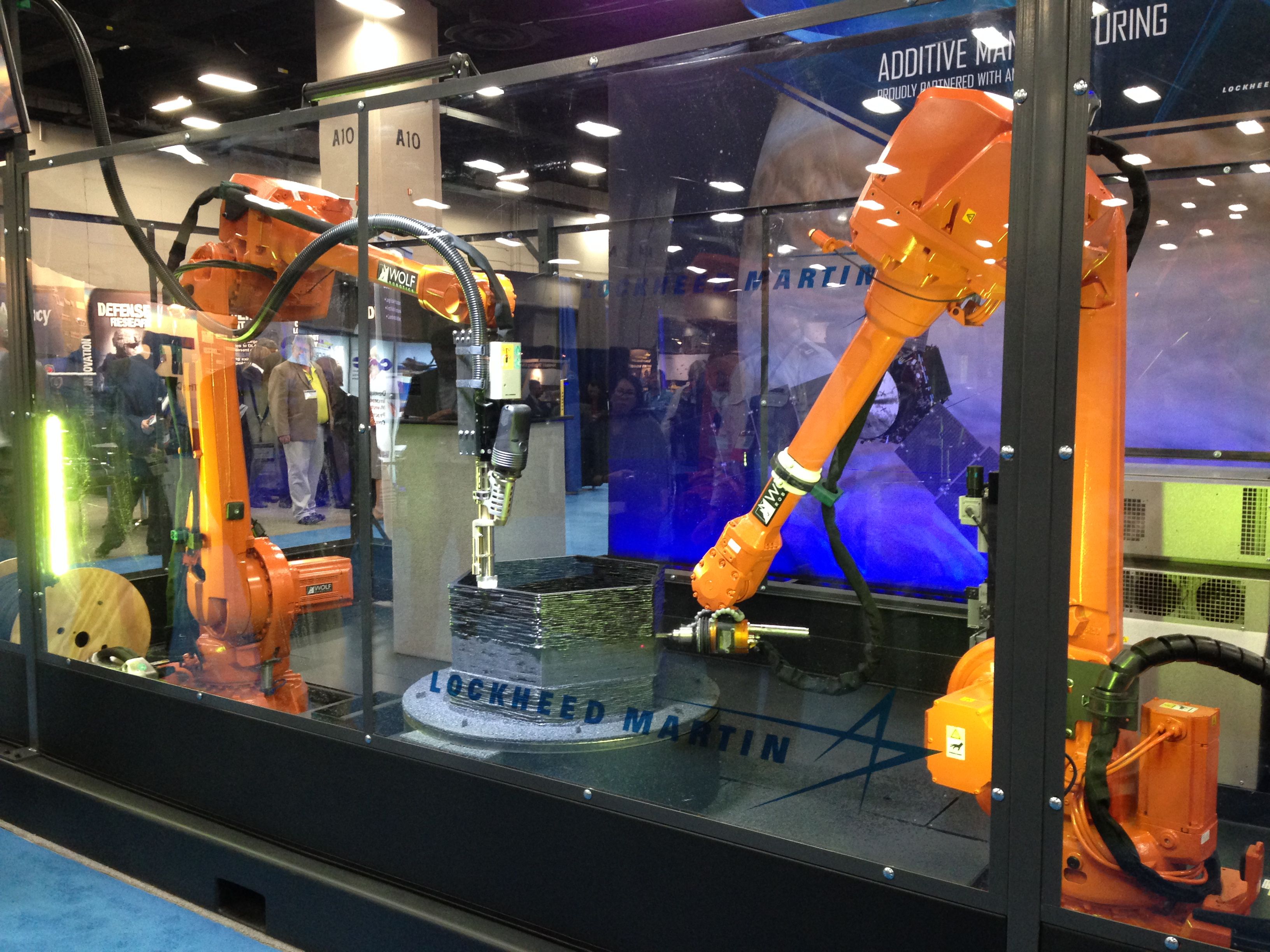
Two of the prototypes
The project is a collaborative effort between Lockheed Martin, Oak Ridge National Labs, Carnegie Mellon University, and four other partners, and the team is starting with Ti-6AI-4V, a common titanium alloy used in aerospace. If the project succeeds, it could demonstrate how Artificial Intelligence (AI) could change everything you know about advanced manufacturing.
It’s easy to see how manufacturing new parts on the spot could change the game for the US Navy. But there’s a dirty little secret about 3D printing that limits its use with machines that endure extreme stress, like spacecraft and airplanes, and this is what the new project is setting out to fix, and where AI comes into the equation.
Consider the materials themselves. Aerospace grade metals, including several recipes of titanium alloy, are supplied by foundries and have well known characteristics. This raw metal comes with guaranteed strength, porosity, and thermal tolerance characteristics. Not so with 3D printed metal, which is made layer-by-layer on the spot.
What engineers call the microstructure of the metal, meaning the size, shape, and orientation of the grains, for example, is not guaranteed from a 3D printed metal part, and this is a major issue especially when you want your new parts to be reliable and robust, after all, the part could look identical to a traditionally manufactured one but perform very differently.
“With traditional, subtractive manufacturing you have the same properties in the final part,” says Glynn Adams, a 25-year welding veteran who works for Lockheed in Michaud, LA . “But with additive manufacturing the material and mechanical properties are not as well understood.”
ONR has a plan, though. By outfitting the 3D printing robot arms with commercial sensors, the lab is hoping to create a database that ties 3D printing processes and conditions with the resulting microstructure. The data will create predictive models that will enable 3D printing machines to create parts with foundry consistency, but from anywhere.
“We have to build quality into the part,” Griffith says.
This is where AI comes into play. Machine learning algorithms allow these 3D printers make adjustments on their own to match the material qualities the military is looking for. It’s manufacturing by wire: Simply provide the shape and needed performance properties of the metal, and the 3D printer will take it from there. In other words, the printers will train themselves to make decisions on how to build things.
“When you can trust a robotic system to make a quality part, that opens the door to who can build usable parts and where you build them,” says Zach Loftus, Lockheed Martin Fellow for additive manufacturing.
A fleet of future Navy ships or spacecraft could learn from each other’s experience via a hive mind, the likes of which we’ve already seen elsewhere in the robotics world, by feeding the data from each robot back to a central brain.
“The project with ONR is at the inception of this,” Griffith says. After all, he works within Lockheed’s space systems group, opening up another vista for 3D printed parts. Intelligent 3D printers open up new ways of building things in space, saving money on launch costs and nearly impossible quality control.
“It could enable on-orbit manufacturing,” Griffith says, like the type Jeff Bezos, Amazon's founder, is envisaging. “Think about the freedom additive manufacturing might enable when you can trust the material properties.”
What this means for your organisation
Quality is the barrier to printed parts.
Printed metal can look identical to a forged part but perform very differently. Without a guaranteed microstructure, it cannot be trusted in aircraft and other high-stress machines. Solving this opens printing to safety-critical uses.
Data builds the quality in.
Sensors on the print arms will link process conditions to the finished metal. Machine learning then adjusts each print to match the needed properties. Manufacturers should start capturing this kind of process data now.
Inventory becomes a file.
If parts can be printed to order at the point of need, fewer spares must be stocked and shipped. This matters most where supply lines are long or fragile. Review which parts could move from warehouse to printer.
Three questions for your next leadership meeting
- Which of our spare parts could be printed on demand?
- Do we capture enough process data to certify printed parts?
- How would printing at the point of need change our supply chain?
The trends and technologies behind this story
From the 311 Starburst, the 311 Strategic Intelligence Unit’s map of the technologies and trends shaping the next 50 years.
Analysis by the 311 Strategic Intelligence Unit, from Matthew Griffin’s article and 311 data. First published on Fanatical Futurist.
FAQ
Why does this matter?
By combining the power of AI with 3D printing the US military hopes to revolutionise how products are designed and made everywhere.

About the author
Matthew Griffin Founder, President and Futurist, 311 Institute
Matthew Griffin is a multi-award winning Futurist and expert in Disruption and Innovation, Geopolitics, Leadership, and Technology, who NASA have described as a "walking encyclopaedia of the future" and a "futurist Polymath."
Read full bio
Matthew Griffin is a multi-award winning Futurist and expert in Disruption and Innovation, Geopolitics, Leadership, and Technology, who NASA have described as a "walking encyclopaedia of the future" and a "futurist Polymath." 17-time best selling author of the "Codex of the Future" series, Matthew is the Founder, President and Futurist of the 311 Institute, a global Futures and Deep Futures advisory firm working with royal households, world leaders, G7, G20, and G77 governments, NGOs, and multi-national mid and mega cap firms to help them explore, shape, and lead the next 50 years of business and society.
An award-winning YouTube creator with over a million followers, with an unrivalled global reach and impact, Matthew is a highly sought-after international keynote speaker, lecturer, and mentor who collaborates with global leaders through the United Nations Alliance of Civilizations (UNAOC) and United Nations General Assembly (UNGA) to shape pivotal initiatives such as the UN’s AI for Humanity program, the United Nations Conference of the Parties (UN COP), and the World Economic Forum in Davos.
As the former Global Head of Cloud, National Security, and Enterprise Sales for companies including Atos, Dell-EMC, and IBM, Matthew has a proven track record of building multi-billion dollar business units and turning failing divisions into market leaders. His ability to identify, analyse, and communicate the implications of hundreds of emerging technologies and trends is unparalleled, and his insights are trusted by many of the world’s most respected organisations, including ABB, Accenture, Adidas, AON, ARM, BCG, Centrica, Citi, Coca-Cola, Dentons, Deloitte, Dow Jones, EY, Google, KPMG, Lego, Legal & General, LinkedIn, Microsoft, PepsiCo, Qualcomm, RWE, Samsung, Siemens AG and Siemens Energy, T-Mobile, UBS, VISA, Walmart, Workday, Worldpay and many others.
Regularly featured in the global media including the AP, BBC, Bloomberg, CNBC, Discovery, Forbes, Khaleej Times, Telegraph, TIME, ViacomCBS, WIRED, and the WSJ, Matthews mission is to help organisations create a fair and sustainable future whose benefits are shared by everyone irrespective of their ability, background, or circumstances.
What future do you need to see?
Choose one to get started on industry and manufacturing and the future of your organisation.