In a world first patent officials in South Africa credited an AI as an inventor
Humans are no longer the only inventors in town and this marks the start of a new AI driven innovation revolution.

Key takeaways
- While patent law in many jurisdictions is very specific in how it defines an inventor, the DABUS team is arguing that the status quo is not fit for purpose in the Fourth Industrial Revolution.
- The DABUS team has similar cases moving through UK, European, US and other court systems.
Cite or link to this article
Griffin, M. (2021) 'In a world first patent officials in South Africa credited an AI as an inventor', 311 Institute, 10 September. Available at: https://www.311institute.com/in-a-world-first-patent-officials-in-south-africa-credited-an-ai-as-an-inventor/ (Accessed: 1 October 2026).
Artificial Intelligence (AI) has been getting creative for some time now and inventing new things, including everything from new kinds of batteries, computer chips, furniture, and rocket engines, all the way through to new kinds of vehicles and sports apparel, for companies as diverse as Airbus, Amazon, GM, NASA, and Under Armour. But despite this quantum leap recently the US Patent Office declined to credit AI for its inventions.
Now that’s changed, and in what seems to be a world first Intellectual property (IP) officials in South Africa have made history in a landmark decision to award a patent that names an AI as the inventor.
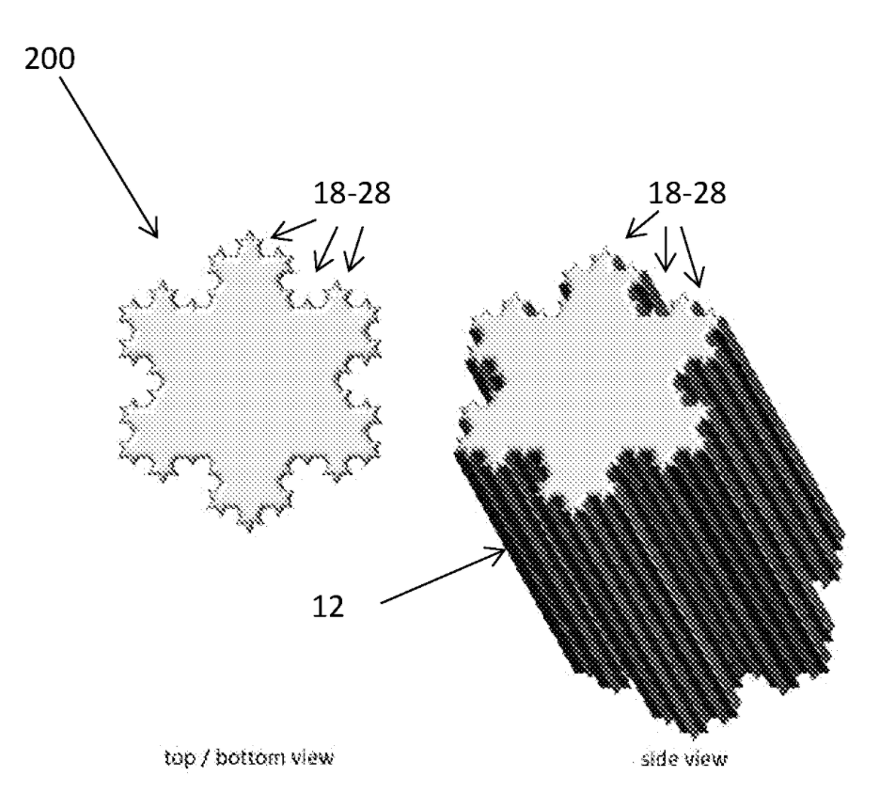
The new AI invented container system
The patent - which was filed by an international team of lawyers and researchers led by the University of Surrey's, Professor of Law and Health Sciences, Ryan Abbott - is for a food container based on fractal geometry. This container was designed and created by an AI called DABUS, or Device for the Autonomous Bootstrapping of Unified Sentience. Catchy …
Historically, an "inventor" of a patent had to be a human being, although the ownership of that patent is commonly given to the company that employs the inventor. While patent law in many jurisdictions is very specific in how it defines an inventor, the DABUS team is arguing that the status quo is not fit for purpose in the Fourth Industrial Revolution.
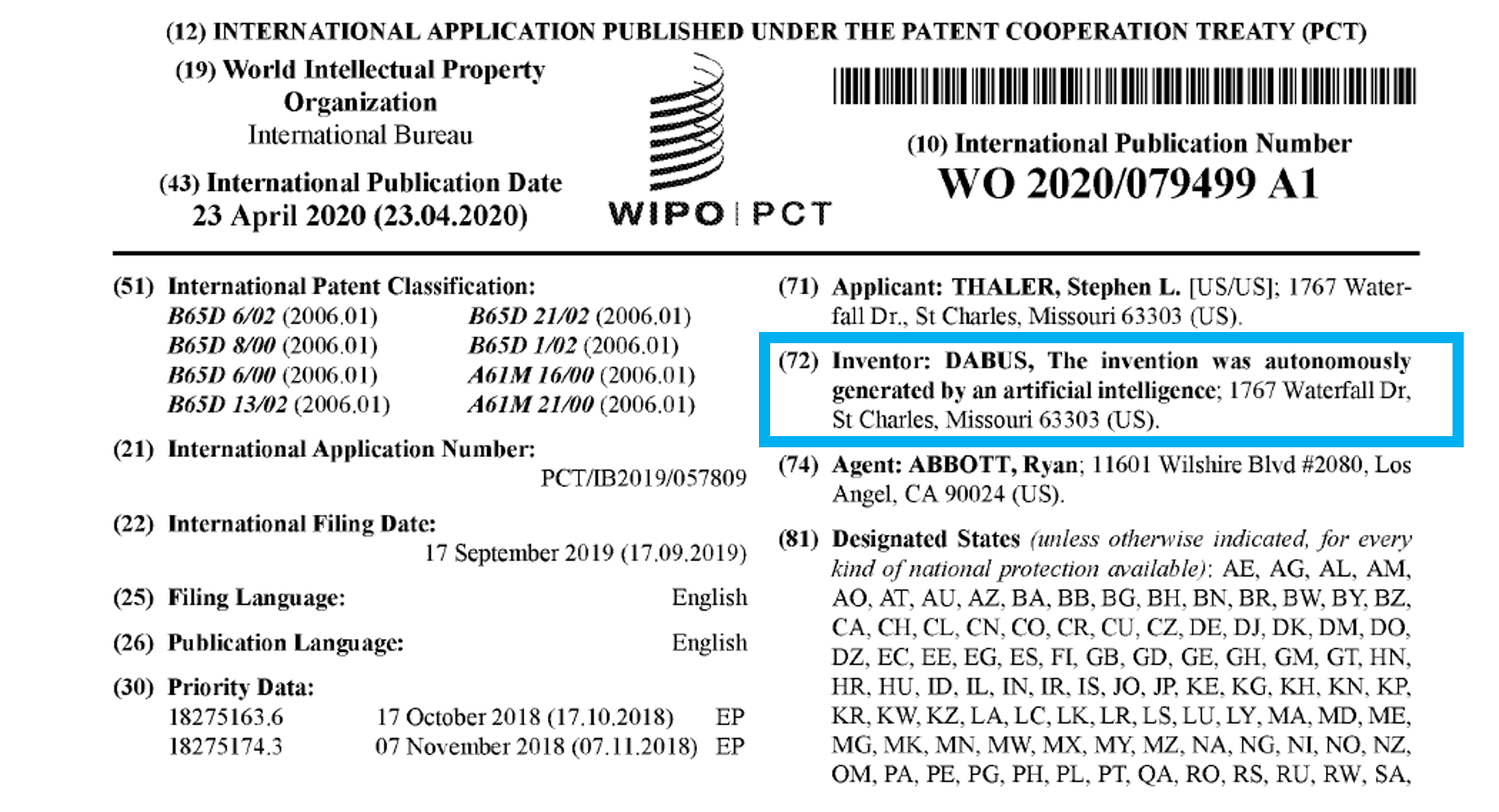
As AI plays an ever-increasing role in the design of ideas needless to say the DABUS case could have significant repercussions on intellectual property law. The DABUS team has similar cases moving through UK, European, US and other court systems.
Earlier this year, the president of the European Patent Office, António Campinos intervened in the European case on the basis that it was “of high importance and general interest.”
Professor Adrian Hilton, Director of the Institute for People-Centred AI at the University of Surrey, said: “This is a truly historic case that recognises the need to change how we attribute invention. We are moving from an age in which invention was the preserve of people to an era where machines are capable of realising the inventive step, unleashing the potential of AI-generated inventions for the benefit of society.
“The School of Law at the University of Surrey has taken a leading role in asking important philosophical questions such as whether innovation can only be a human phenomenon, and what happens legally when AI behaves like a person. We are delighted our staff and students are at the forefront of these deeply significant debates, and now realities.”
And while this is the first award of its kind it certainly won’t be the last, and bearing in mind that AI can design new products in the blink of an eye and at immense speed, to say that this moment is game changing is vastly underestimating its global impact – it’s nothing less than world and society changing.
FAQ
Why does this matter?
Humans are no longer the only inventors in town and this marks the start of a new AI driven innovation revolution.

About the author
Matthew Griffin Founder, 311 Institute
Matthew Griffin is a multi-award winning Futurist and expert in Disruption and Innovation, Geopolitics, Leadership, and Technology, who NASA have described as a "walking encyclopaedia of the future" and a "futurist Polymath."
Read full bio
Matthew Griffin is a multi-award winning Futurist and expert in Disruption and Innovation, Geopolitics, Leadership, and Technology, who NASA have described as a "walking encyclopaedia of the future" and a "futurist Polymath." 15-time best selling author of the "Codex of the Future" series, Matthew is the Founder and Futurist in Chief of the 311 Institute, a global Futures and Deep Futures advisory firm working with royal households, world leaders, G7, G20, and G77 governments, NGOs, and multi-national mid and mega cap firms to help them explore, shape, and lead the next 50 years of business and society.
An award-winning YouTube creator with over a million followers, with an unrivalled global reach and impact, Matthew is a highly sought-after international keynote speaker, lecturer, and mentor who collaborates with global leaders through the United Nations Alliance of Civilizations (UNAOC) and United Nations General Assembly (UNGA) to shape pivotal initiatives such as the UN’s AI for Humanity program, the United Nations Conference of the Parties (UN COP), and the World Economic Forum in Davos.
As the former Global Head of Cloud, National Security, and Enterprise Sales for companies including Atos, Dell-EMC, and IBM, Matthew has a proven track record of building multi-billion dollar business units and turning failing divisions into market leaders. His ability to identify, analyse, and communicate the implications of hundreds of emerging technologies and trends is unparalleled, and his insights are trusted by many of the world’s most respected organisations, including ABB, Accenture, Adidas, AON, ARM, BCG, Centrica, Citi, Coca-Cola, Dentons, Deloitte, Dow Jones, EY, Google, KPMG, Lego, Legal & General, LinkedIn, Microsoft, PepsiCo, Qualcomm, RWE, Samsung, Siemens AG and Siemens Energy, T-Mobile, UBS, VISA, Walmart, Workday, Worldpay and many others.
Regularly featured in the global media including the AP, BBC, Bloomberg, CNBC, Discovery, Forbes, Khaleej Times, Telegraph, TIME, ViacomCBS, WIRED, and the WSJ, Matthews mission is to help organisations create a fair and sustainable future whose benefits are shared by everyone irrespective of their ability, background, or circumstances.
What future do you need to see?
Choose one to get started on AI and intelligence and the future of your organisation.
Source: first published by the 311 Institute on 10 September 2021. Cite as: Griffin, M. (2021). In a world first patent officials in South Africa credited an AI as an inventor. 311 Institute. https://www.311institute.com/in-a-world-first-patent-officials-in-south-africa-credited-an-ai-as-an-inventor/
You are welcome to quote this article with credit and a link to the original.