The short answer
Is the dead internet theory true?
Partly. Bots now make 53% of web traffic and about half of new web articles are written mainly by AI. But there is no evidence that most people online are fake. People still do most of the reading, watching and buying, and most bots never see a paid ad.
The dead internet theory is the idea that most of the internet is now bots and AI-made content talking to each other, with few real people left. It began as a forum post in January 2021. Our verdict: it is right about the direction and wrong about the size. Reaching real customers gets dearer, but by about 1.3x by 2040, not several times more.
By Matthew Griffin, 311 Institute ·
Key facts
- 53%of all web traffic was bots in 2025, up from 49.6% in 2023. Thales Imperva Bad Bot Report 2026
- 57.2%of requests for web pages on Cloudflare's network came from bots on 8 June 2026. Cloudflare Radar, 2026
- ~50%of new web articles have been written mainly by AI since November 2024. Graphite, 2025
- 0.7%fraud on ad campaigns bought with protection, against 10.9% without. IAS Media Quality Report, 2025
- 1.3xthe real cost of reaching today's customers on trusted platforms by 2040, after inflation. 311 Institute model, October 2026
- 20%of all ads shown in 2040 will be seen by no person: 48% on the open web, 9% on trusted platforms. 311 Institute model, October 2026
The main finding
Right about the direction. Wrong about the size.
The obvious read is that bots and AI have taken over the web, so real people will become rare online and reaching them will cost many times more.
The fuller picture is different. Bots make up much of web traffic, but they see far fewer of the ads advertisers pay for, and AI lets big platforms build more ad space for the real people they already have. So costs rise, but slowly: about 2% a year above inflation.
Five things to know
The internet is not dead. It is crowded.
Most traffic is machines. Most buying is not.
Bots passed humans in 2024. Yet AI music is more than half of new Deezer uploads and only 1–3% of what people stream. Making is not the same as using.
Shown is not paid for.
Most bots read pages to scrape or train AI and are filtered out. Protected ad buys show 0.7% fraud. Unchecked open-web buys run at about 10–20% invalid.
The open web is shrinking from both ends.
Google Search traffic to publishers fell 40.2% in a year as AI answers took the clicks, and over 92% of automated ad spend now goes through private deals.
Proof of being human is the new scarce asset.
AI now passes the old CAPTCHA tests. Platforms that already know their users are real, through logins and passkeys, become more valuable to advertisers.
The next customer may be software.
AI shopping agents could handle 10–25% of US online shopping by 2030. When an agent makes the choice, the ad money follows it there.
Why trust the numbers?
Our first answer was 2.9x. Three reviews cut it to 1.3x.
87 sources, each marked primary, corroborated, single-source, unverified or foresight, so you can see how much weight each number can bear.
Our model has 20 factors and 2 one-off events. Ranges show where 8 in 10 runs landed: 1.0x to 1.8x by 2040, above 2x in about 4 in 100 runs.
Three rounds of review checked the maths, the evidence and our view of the future, including an independent review of the model's code.
Predictions on the record
Five calls you can hold us to.
Most commentary on the dead internet theory makes no testable claims. Each of ours has a date, a confidence level and an early warning sign that it is going wrong.
-
By 202739% confidence
The groups that set ad-counting rules accept a digital proof that a viewer is human.
-
By 203055% confidence
Ads inside AI assistants are one of the five biggest ad channels by spend.
-
By 203161% confidence
Reaching one real person on the open web costs at least 1.2x what it did in 2026, after inflation.
-
By 203658% confidence
Reaching as many real customers on trusted platforms as in 2026 costs at least 1.2x as much, after inflation.
-
By 203656% confidence
An ad on a trusted platform costs more than 1.8x an open-web ad, up from about 1.6x today.
Inside the report
Ten parts, from the evidence to the moves.
Parts I to VI look at the evidence today. Parts VII to IX turn it into a forecast to 2040 and test it. Part X sets out what to do.
What advertisers really buy
A $1.34tn market and three markets for attention.
The dead internet theory, tested
How much traffic is bots and how much content AI makes.
The open web is shrinking
AI answers take the clicks and money moves to private deals.
Who really sees the ads
A short history of ad fraud, and why shown is not paid for.
AI agents become shoppers
How big agentic commerce could get, and ads inside AI assistants.
Proving you are human
The broken CAPTCHA, stronger checks and deepfakes.
The price of reaching people
The forecast to 2040 and what moves the price.
Who sees your ads by 2040
Ads seen by no person, on the open web and trusted platforms.
Testing the numbers
Three rounds of review and what the model cannot see.
What to do now
Six moves for advertisers, plus publishers, platforms and investors.
Bring the report to your organisation
Book Matthew Griffin to explain what this means for you.
Matthew will turn the findings into a clear session about your customers, your media spend and your exposure to bots and AI agents, then help your leaders decide what to do next.
Keynote
Give leaders, teams or event audiences a clear, evidence-based view of the dead internet theory and what it means for marketing.
Executive briefing
Give your board or marketing leaders a private session on where your ad spend reaches real people, and the decisions to take now.
Leadership workshop
Turn the six moves into a plan: pay for sales, reach trusted buyers, get ready for AI agents and budget for verification.
Tell us who the session is for and what you want it to achieve. We will suggest the right format.
Questions
The dead internet theory, answered
What is the dead internet theory?+
The dead internet theory is the idea that most of the internet is now bots and AI-generated content, made by machines for other machines, with few real people left. It began as a conspiracy theory on an online forum in January 2021, with no real evidence at the time.
Is the dead internet theory true?+
Partly. Bots made 53% of web traffic in 2025 and about half of new web articles are written mainly by AI, so the machines have arrived. But there is no evidence that most people online are fake. People still do most of the reading, watching and buying.
When did the dead internet theory start?+
It started with a forum post titled 'Dead Internet Theory: Most Of The Internet Is Fake' in January 2021. The Atlantic covered it later that year, and by 2025 even OpenAI's Sam Altman said there were now a lot of LLM-run accounts online.
How much of the internet is bots?+
Bots made 53% of all web traffic in 2025, including 40% from bad bots such as scrapers and fraud tools, according to Thales Imperva. Cloudflare measured bots making 57.2% of requests for web pages on its network on 8 June 2026.
How much online content is AI-generated?+
AI-written articles overtook human-written ones in November 2024 and have stayed near half of new articles since. About 35% of new websites published by mid-2025 were made or helped by AI. The widely quoted claim that 90% of content would be AI-made by 2026 was an expert estimate, not a measurement.
Do bots see the ads that advertisers pay for?+
Far fewer than the traffic figures suggest. Fraud was 0.7% on protected ad campaigns in 2024, against 10.9% on unprotected ones. Our model puts the share of ads seen by no person at about 10% today, rising to about 20% by 2040: 48% on the open web and about 9% on trusted platforms.
Will the dead internet make advertising more expensive?+
A little. Reaching as many real customers as today on trusted platforms costs about 1.3x today's price by 2040, after inflation, or about 2% a year. In 8 out of 10 of our 5,000 test runs it lands between 1.0x and 1.8x. The cost of each sale stays near today's level.
What should advertisers do about bots and AI agents?+
Pay for sales, not views. Move spend to trusted platforms and your own customer lists. Test ads inside AI assistants now. Make your products easy for AI shopping agents to find. And budget for checking that viewers are real: about 2% of ad spend today, about 8% by 2040.
Can Matthew present the findings?+
Yes. The research can be turned into a keynote, board briefing or workshop for your audience, your markets and your media plans.
Cite this report
Using these findings?
You are welcome to quote the findings with a link to this page. Please cite the report as:
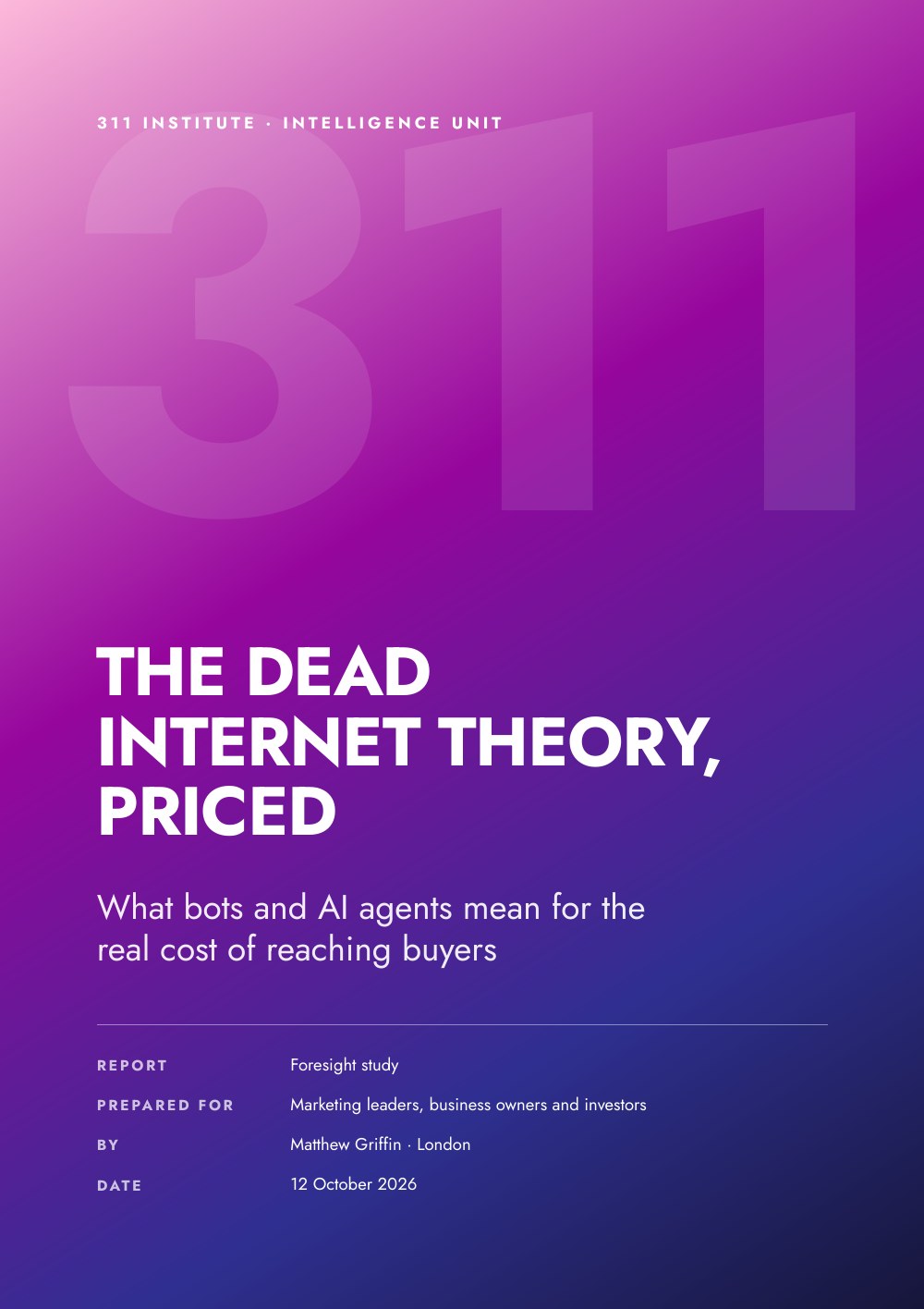
Griffin, M. (2026). The Dead Internet Theory, Priced. 311 Institute. https://www.311institute.com/the-dead-internet-theory-priced/
More 311 Institute research
Keep reading.
 RiskRogue AI and The Unkillable MachineCan you actually switch off a rogue AI?
 RankingThe Global AI Power Index 2026Which countries lead AI, and why?
 Market reportThe State of Global ICT InfrastructureHow big is the ICT infrastructure market, and what really limits it?
The libraryAll 311 Institute reports and codexesBrowse the full research library.
Market reportThe State of Global ICT InfrastructureHow big is the ICT infrastructure market, and what really limits it?
The libraryAll 311 Institute reports and codexesBrowse the full research library.
See the full picture.
Download the complete 84-page report, The Dead Internet Theory, Priced, with every source dated and tiered.
Download the report