Matthew GriffinFounder, President and Futurist, 311 Institute
G7 · G20governments advised
850+keynotes
102countries
17codexes
AI sessions forBytes PlcSlovakiaTech1BusinessWorldRe:CommICEEFestLoopMe
Featured inBloombergThe Wall Street JournalThe Telegraph
Guy Hocking, MD of London-based system integrator Utilize Plc, invited Matthew back to share his insights into the near and deep future. This time the focus was one of the hottest technologies on the planet: artificial intelligence, in all its weird and wonderful forms.
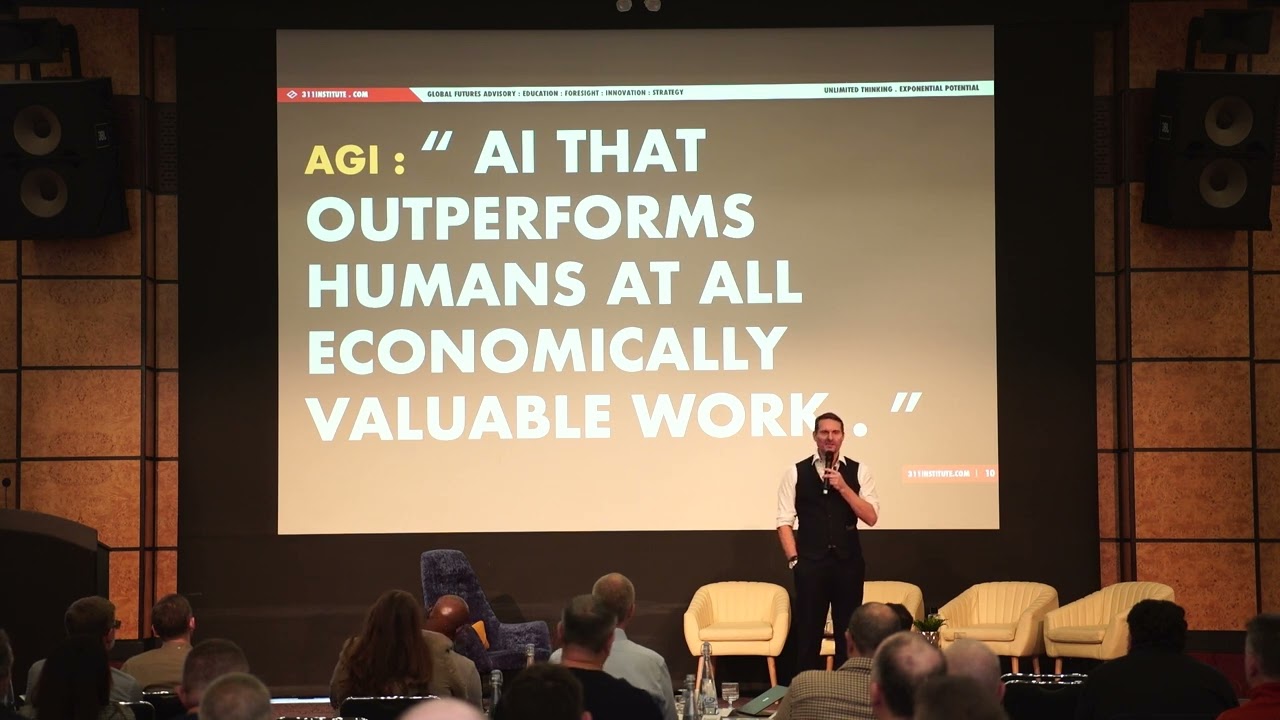
Many people see the future of AI as broadly linear: after generative AI and agentic AI comes Artificial General Intelligence (AGI), then Artificial Super Intelligence (ASI). Matthew argued that the future of an exponential technology whose power and capability is now doubling every six months is anything but linear, and that is what he and the audience explored.
"AI is the first ever self-developing technology that is capable of designing, optimising, and replicating itself, with each new generation being significantly better than the last."Matthew Griffin, United Kingdom, March 2025
He pointed out that AI is the first ever self-developing technology, able to design, optimise and replicate itself, with each new generation significantly better than the last. Until now, human-made technologies have largely been dumb, little more than prosthetics. Looking further ahead, things get stranger, with the development of Quantum AI, Neuromorphic AI, biological and DNA neural networks, and even the first Liquid and Meta AIs created inside ionic computers and game engines such as Minecraft.
Moving beyond the generic conversations that dominate so much of the AI debate, Matthew closed with the problems of AI ethics and regulation and the future of AI computing platforms.
311 Intelligence
What this means for your leadership team
Stop planning for a straight line.
Matthew argued that AI will not move neatly from generative AI to AGI and then superintelligence. Strategies built on one expected path will miss the turns.
Treat AI as a moving target.
A technology that designs and improves itself changes what is possible every year. Leadership teams need to revisit their AI plans far more often than other technology plans.
Watch the strange edges.
Quantum AI, liquid AI and biological networks sound distant, but they show where computing could go. Tracking them early avoids being surprised later.
Three questions for your next leadership meeting
Which of our AI plans assume a single, predictable path?
How often do we revisit what AI can now do for our business?
Who in our organisation tracks the technologies beyond agentic AI?
The trends and technologies behind this session
From the 311 Starburst, the 311 Strategic Intelligence Unit’s map of the technologies and trends shaping the next 50 years.
What does the deep future of AI mean for organisations?
It means planning for an AI path with many turns. Agentic AI is close, while AGI, quantum AI and liquid AI sit further out, and each changes what businesses can automate and how they compete.
When does 311 expect Agentic Artificial Intelligence to be in wide use?
The 311 Starburst expects agentic AI, which decides and acts on its own to reach a goal, to reach wide use around 2028.
When does 311 expect Artificial General Intelligence?
The 311 Starburst places wide use of artificial general intelligence, a machine that could do any thinking task a person can, around 2033.
How can 311 brief our leadership team on this?
Through a private executive briefing or leadership workshop, tailored to your sector, in person first.
Bring this to your leadership teamA private executive briefing or leadership workshop, tailored to your sector. In person first, anywhere in the world.
Analysis by the 311 Strategic Intelligence Unit, from Matthew Griffin’s session and 311 data.
If Matthew gave this session today
When AI slips beyond human control, leaders must act.
Rogue AI and The Unkillable Machine looks at what happens when AI systems slip beyond human control, and what leaders need to do about it, the natural next question once AI can design and replicate itself.