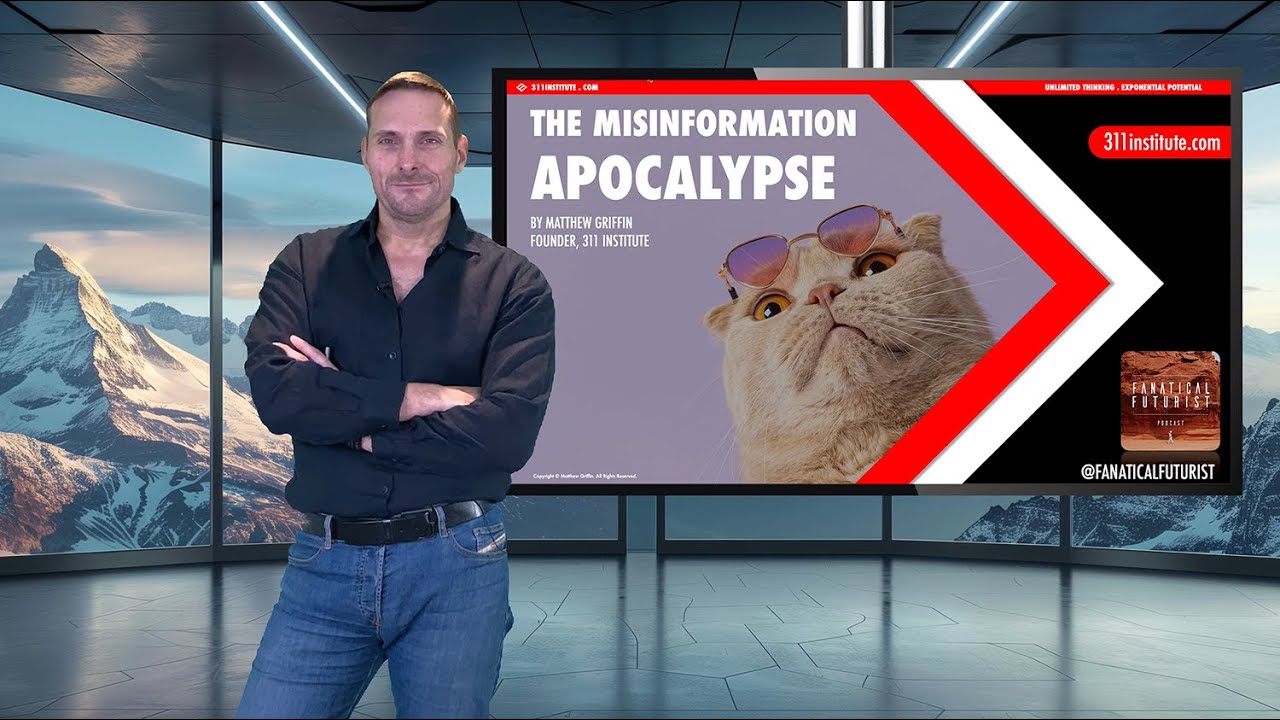

Chad, Microsoft's European CTO for AI and Copilot, invited Matthew to give the opening keynote at a closed-door event in Geneva, where a small, select group of Microsoft clients met to explore the future of AI, and in particular deepfakes, disinformation, misinformation and synthetic content.
It was familiar ground. Matthew has tracked the space for over a decade, was one of the first to identify the generative AI and deepfake trend in 2016, and wrote a book on it in 2019, three years before ChatGPT made the topic top of mind for everyone.
"I don't believe we will ever be able to catch all of the AI generated or manipulated content, even with the best tools. From here on in we should not believe anything behind a glass screen."Matthew Griffin, Geneva, March 2025
In a twenty-minute talk, followed by an hours-long fireside chat, he set out the fundamentals: the cost, resources and skill needed to create authentic-looking, high-quality fake content are all dropping to zero. In the coming years, the only thing holding back a flood of deepfakes and malicious synthetic content will be detection tools like those Microsoft is developing. He also drew a clear line between deepfakes, which manipulate original content with AI, and synthetic content, which AI generates from scratch, whether audio, images, VFX, video, text or virtual reality assets. The two have distinct upsides, downsides, characteristics and ecosystems.
Matthew closed by arguing that, from a disinformation perspective, we will never catch all AI-generated or manipulated content, even with the best tools. He demonstrated the point live, using simple techniques to evade Microsoft's own AI deepfake detection tools. His conclusion for society: from here on, we should not believe anything behind a glass screen.