China unveils its Mach 4 drone prototype to challenge the US
When it comes to hypersonic systems China has proven time and time again that it's beaten the US, and the commercialisation of this might be no exception.

Key takeaways
- A Chinese start-up is aiming to develop a supersonic drone capable of reaching speeds four times the speed of sound.
- In October 2024, Lingkong Tianxing tested a prototype commercial plane capable of nearly double the speed of the Concorde’s supersonic performance.
- The Chinese firm’s supersonic drone is claimed to be capable of reaching Mach 4.2 at an altitude of 12.4 miles (20 kilometers), more than twice the speed of Concorde.
Cite or link to this article
Griffin, M. (2025) 'China unveils its Mach 4 drone prototype to challenge the US', 311 Institute, 27 March. Available at: https://www.311institute.com/china-unveils-its-mach-4-drone-prototype-to-challenge-the-us/ (Accessed: 1 October 2026).
Over the years I’ve seen plenty of supersonic and hypersonic drone and aircraft protoypes and mash ups like this one, this one, this one, and of course, not forgetting this one. But so far, while they have all progressed – mostly – it’s taken ages to see any meaningful progress. And now China, who wants to create the first hypersonic drone swarms for warfare, has thrown yet another of its hats in the ring and this latest Mach 4 drone – which is an interesting choice of words, rather than an aircraft as you might expect – has shown its face. And what a design.
A Chinese start-up is aiming to develop a supersonic drone capable of reaching speeds four times the speed of sound. Lingkong Tianxing Technology, the company behind the project, unveiled the Unmanned Aerial Vehicle (UAV), named Cuantianhou or “Soaring Stone Monkey,” at a news conference in Chengdu, the capital city of Southwest China’s Sichuan Province.
The Future of Aviation, by Aviation speaker Matthew Griffin
The model’s development marks a significant step in adapting military hypersonic technology for commercial use. Cuantianhou’s design is part of the firm’s broader ambitions to create a supersonic passenger jet, reports a Chinese online media outlet.
The UAV’s first test flight is scheduled for next year, signalling China’s growing advancements in supersonic technology and its potential civilian applications. In October 2024, Lingkong Tianxing tested a prototype commercial plane capable of nearly double the speed of the Concorde’s supersonic performance.
The Chinese firm’s supersonic drone is claimed to be capable of reaching Mach 4.2 at an altitude of 12.4 miles (20 kilometers), more than twice the speed of Concorde.
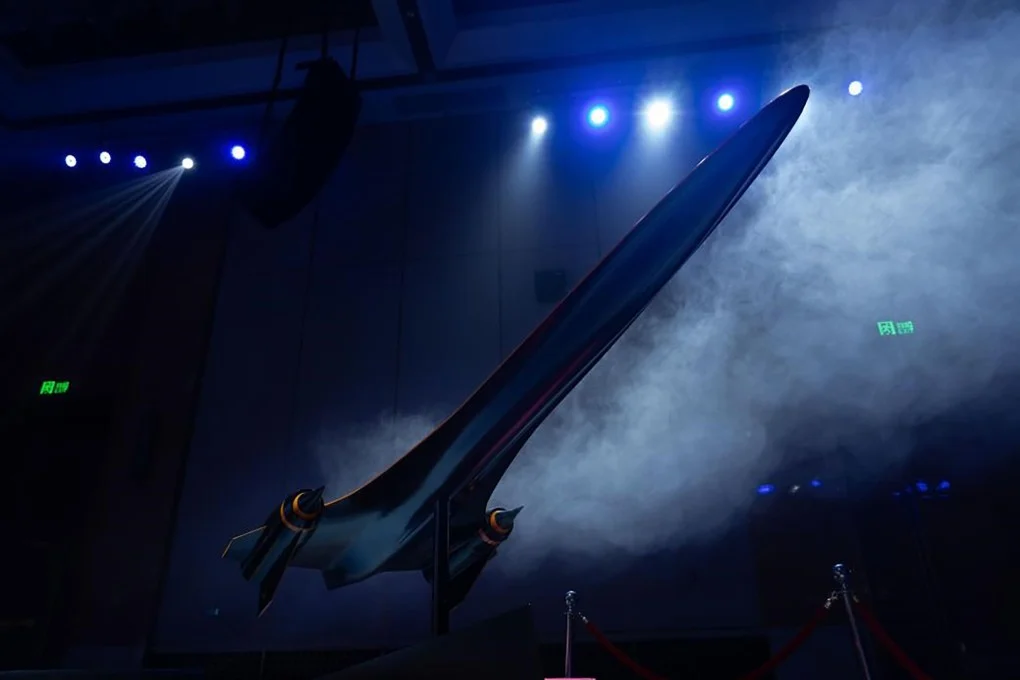
Magnificent. And Mach capable.
According to the South China Morning Post (SCMP), weighing 1.5 tonnes and measuring seven meters long, the unmanned aerial vehicle is powered by two detonation engines. Its first flight is scheduled for next year as part of a larger initiative to develop a high-speed passenger jet, projected for prototype testing by 2030.
Supersonic technology, traditionally a military asset, is now being adapted for commercial use. Several international start-ups, including ventures in the United States and Switzerland, are exploring similar advancements. The Chinese drone and its related projects signal growing competition in hypersonic innovation, reflecting broader efforts to bridge military and civilian applications.
In October, Lingkong Tianxing Technology tested a prototype commercial plane capable of nearly double the speed of the Concorde’s supersonic performance.
Lingkong Tianxing is accelerating its research and development in supersonic aircraft.
In October, the company successfully completed test flights of its Yunxing supersonic aircraft, evaluating key technologies like aerodynamics, heat resistance, and control systems. Initially scheduled for a full prototype flight in 2027, the Yunxing UAV’s timeline has been advanced to 2026 due to significant progress.
The company’s Cuantianhou UAV incorporates optimized aerodynamics compared to Yunxing, eliminating the front canard and adjusting components for a more efficient angle of attack.
According to SCMP, recent tests demonstrated the UAV’s capabilities, including a climb of 6.21 miles (10 kilometers) with speeds from Mach 3.3 to Mach 4.1 and dynamic pressure ranges of 39 to 114 kPa. The UAV showcased impressive fuel efficiency, consuming just 13.2 pounds (6 kilograms) of fuel to cover 31 miles (50 kilometers).
Lingkong Tianxing has also introduced its next-generation Jindou-400S detonation engine, an upgraded version of its predecessor. The new engine features multiple ignitions, weighs 100kg - down from 300kg - and produces 4,000 Newtons of thrust, an improvement from 2,500 Newtons. With a reduced length of 1.9 meters, the engine supports speeds up to Mach 4.2 while improving power-to-weight ratio and thrust.
The UAV series’ rapid iteration stems from extensive testing, including 88 test flights over six years, and the use of advanced supercomputing simulations. The company’s proprietary 3D printing technology has further enhanced the airframe design, reports SCMP.
According to the firm, with advancements in noise suppression, materials science, and flight control systems, the development of supersonic passenger flights is becoming increasingly feasible.
FAQ
Why does this matter?
When it comes to hypersonic systems China has proven time and time again that it's beaten the US, and the commercialisation of this might be no exception.

About the author
Matthew Griffin Founder, 311 Institute
Matthew Griffin is a multi-award winning Futurist and expert in Disruption and Innovation, Geopolitics, Leadership, and Technology, who NASA have described as a "walking encyclopaedia of the future" and a "futurist Polymath."
Read full bio
Matthew Griffin is a multi-award winning Futurist and expert in Disruption and Innovation, Geopolitics, Leadership, and Technology, who NASA have described as a "walking encyclopaedia of the future" and a "futurist Polymath." 15-time best selling author of the "Codex of the Future" series, Matthew is the Founder and Futurist in Chief of the 311 Institute, a global Futures and Deep Futures advisory firm working with royal households, world leaders, G7, G20, and G77 governments, NGOs, and multi-national mid and mega cap firms to help them explore, shape, and lead the next 50 years of business and society.
An award-winning YouTube creator with over a million followers, with an unrivalled global reach and impact, Matthew is a highly sought-after international keynote speaker, lecturer, and mentor who collaborates with global leaders through the United Nations Alliance of Civilizations (UNAOC) and United Nations General Assembly (UNGA) to shape pivotal initiatives such as the UN’s AI for Humanity program, the United Nations Conference of the Parties (UN COP), and the World Economic Forum in Davos.
As the former Global Head of Cloud, National Security, and Enterprise Sales for companies including Atos, Dell-EMC, and IBM, Matthew has a proven track record of building multi-billion dollar business units and turning failing divisions into market leaders. His ability to identify, analyse, and communicate the implications of hundreds of emerging technologies and trends is unparalleled, and his insights are trusted by many of the world’s most respected organisations, including ABB, Accenture, Adidas, AON, ARM, BCG, Centrica, Citi, Coca-Cola, Dentons, Deloitte, Dow Jones, EY, Google, KPMG, Lego, Legal & General, LinkedIn, Microsoft, PepsiCo, Qualcomm, RWE, Samsung, Siemens AG and Siemens Energy, T-Mobile, UBS, VISA, Walmart, Workday, Worldpay and many others.
Regularly featured in the global media including the AP, BBC, Bloomberg, CNBC, Discovery, Forbes, Khaleej Times, Telegraph, TIME, ViacomCBS, WIRED, and the WSJ, Matthews mission is to help organisations create a fair and sustainable future whose benefits are shared by everyone irrespective of their ability, background, or circumstances.
What future do you need to see?
Choose one to get started on transport and mobility and the future of your organisation.
Sources and further reading
Source: first published by the 311 Institute on 27 March 2025. Cite as: Griffin, M. (2025). China unveils its Mach 4 drone prototype to challenge the US. 311 Institute. https://www.311institute.com/china-unveils-its-mach-4-drone-prototype-to-challenge-the-us/
You are welcome to quote this article with credit and a link to the original.