Foresight methods
The latest strategic foresight and scenario planning methods.
311 Institute codex · Foresight and scenario planning
How do you plan for a future you cannot predict?
Explore the latest strategic foresight methods, develop your own scenarios and turn them into strategy with this single-source codex. As disruption accelerates, foresight and scenario planning are now must-haves, not nice-to-haves.
In short
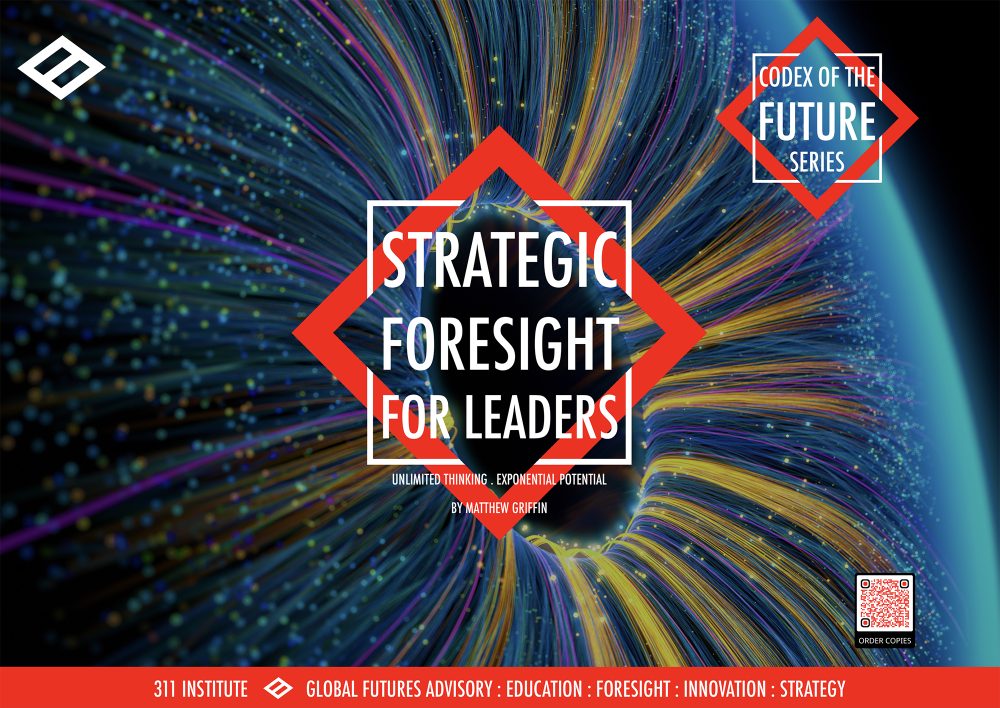
Strategic Foresight for Leaders is a 137-page codex by Matthew Griffin, Founder, President and Futurist of the 311 Institute, that shows you how to run your own strategic foresight programmes. The fourth edition, published in March 2024, covers the Anchoring Constants Model, the Deep Foresight Framework and its six models, and three Horizon programmes for any team size or skill level.
Who it is for: It is for boards, executive teams, strategy and innovation leaders, and foresight practitioners who need to turn future scenarios into actionable strategy.
Foresight is now a must-have
At the 311 Institute our mission is to democratise access to the future, and to support the people who create change for good.
This codex gives you the methods and tools to envision and plan for the future and deep future, and to re-imagine your business.
What you will explore
The latest strategic foresight and scenario planning methods.
Develop scenarios for the future and the deep future.
Re-imagine your business and act on what you find.
Key findings
Bring the codex to your organisation
Book a keynote session, executive briefing or foresight workshop session built on the Strategic Foresight codex and its Deep Foresight Framework. Or start with a free 15-minute expert call.
Questions and answers
Strategic foresight is the practice of envisioning and analysing the many plausible, possible, preferred, probable and preposterous futures, then adapting ahead of time. In the codex, Matthew Griffin describes it as being about three things: saving you time, minimising future surprises and preparing you for what is coming. It gives teams a safe space to develop scenarios and test how they could help or harm the organisation.
Strategic foresight helps leaders make better, faster decisions and design resilient strategies. The codex cites surveys by Deloitte and Aarhus School of Business and Social Sciences showing organisations with dedicated corporate foresight teams achieve a 200% higher market cap on average, and that future prepared organisations are 33% more profitable than their peers.
VUCA-MAX is the 311 Institute's way of describing how the world is changing. It extends VUCA (Volatile, Uncertain, Complex and Ambiguous) by adding that changes are increasingly Massive, Accelerating and eXponential. The codex argues this makes it harder than ever for organisations to predict disruption and spot new opportunities, which is why strategic foresight has become a must-have.
A workshop is a single event, while a programme runs over time. The codex explains that after one-off scenario workshops it is easy to lose momentum, see participants return to their day jobs and shelve the outputs. Running a programme keeps the team, consistency and momentum together, and makes it more likely the results become actionable initiatives.
Strategic Foresight for Leaders was written by Matthew Griffin, Founder, President and Futurist of the 311 Institute, a global futures and deep futures advisory. It is part of his Codex of the Future series. The fourth edition was published in March 2024 and runs to 137 pages, including the Deep Foresight Framework and the Horizon LITE, Pro and ELITE programmes.
The codex is free to download as a PDF after a short form on this page. If you want to put it to work, the 311 Institute runs keynote sessions, executive briefings and foresight workshops on strategic foresight, built around the Deep Foresight Framework, so your leadership team can explore scenarios together and turn them into strategy.
Keep exploring