DeepMind’s AI learns the rules as it goes so it can conquer the real world
The real world doesn't always have rules, so if we want to create AGI then we need AI's that can learn things as they go along.

Key takeaways
- While there would likely be a staggering number of potential moves in complex games such as chess, MuZero prioritizes the most relevant and most likely manoeuvres, learning from successful gambits and avoiding ones that failed.
- Pac-Man, MuZero was restricted to considering only six or seven potential future moves, yet still performed admirably, according to researchers.
- In fact, the US Air Force had tapped early research papers covering MuZero that were made public last year and used the information to design an AI system that could launch missiles from a U-2 spy plane against specified targets.
Cite or link to this article
Griffin, M. (2021) 'DeepMind’s AI learns the rules as it goes so it can conquer the real world', 311 Institute, 13 January. Available at: https://www.311institute.com/deepminds-ai-learns-the-rules-as-it-goes-so-it-can-conquer-the-real-world/ (Accessed: 1 October 2026).
Albert Einstein once said, "You have to learn the rules of the game, and then you have to play better than anyone else." That could well be the motto at DeepMind, Google’s world class Artificial Intelligence (AI) company that last year burned through over $1.3 Billion in research cash, as a new report from the company reveals they’ve developed a program that can master complex games without even knowing the rules, something that’s a major step forward in how AI learns new knowledge and acquires new skills and capabilities.
DeepMind has previously made ground breaking strides using reinforcement learning that help it's AI's make all the right decisions, aswell as help them master the Chinese board game Go and the Japanese strategy game Shogi, as well as chess and challenging Atari video games. In all those instances their AI’s were given the rules of the game.
But Nature recently reported that DeepMind's MuZero has accomplished the same feats, and in some instances beaten the earlier programs, without first learning the rules.
Programmers at DeepMind relied on a principle called "Look-Ahead Search." With that approach, MuZero assesses a number of potential moves based on how an opponent would respond. While there would likely be a staggering number of potential moves in complex games such as chess, MuZero prioritizes the most relevant and most likely manoeuvres, learning from successful gambits and avoiding ones that failed.
When performing against Atari's Ms. Pac-Man, MuZero was restricted to considering only six or seven potential future moves, yet still performed admirably, according to researchers.
"For the first time, we actually have a system that is able to build its own understanding of how the world works and use that understanding to do this kind of sophisticated look-ahead planning that you've previously seen for games like chess," said DeepMind's principal research scientist David Silver. MuZero can "start from nothing, and just through trial and error, both discover the rules of the world and use those rules to achieve kind of superhuman performance."
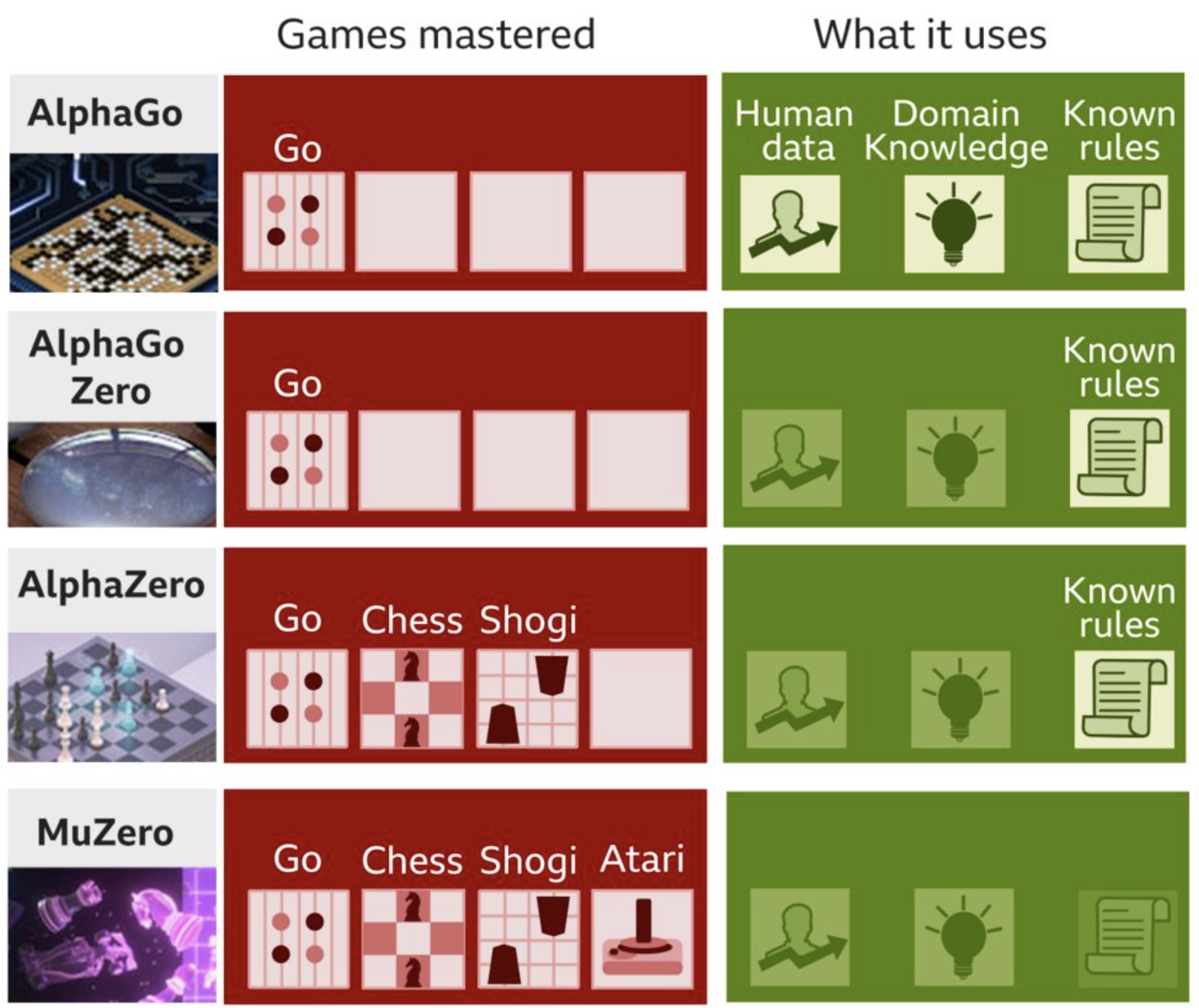
The evolution of DeepMind's AI. Courtesy: BBC
Silver envisions greater applications for MuZero than mere games. Progress has already been made on video compression, a challenging task considering the huge number of varying video formats and numerous modes of compression. So far, they have achieved a 5 percent improvement in compression, no small feat for the company owned by Google, which also handles the gigantic cache of videos on the world's second-most popular web site, YouTube, where a billion hours of content are viewed daily.
Silver says the laboratory is also looking into robotics programming and protein architecture design, which holds promise for personalised production of drugs.
It is a "significant step forward," according to Wendy Hall, professor of computer science at the University of Southampton and a member of England's AI council. "The results of DeepMind's work are quite astounding and I marvel at what they are going to be able to achieve in the future given the resources they have available to them," she said.
But she also raised a concern about the potential of abuse.
"My worry is that whilst constantly striving to improve the performance of their algorithms and apply the results for the benefit of society, the teams at DeepMind are not putting as much effort into thinking through potential unintended consequences of their work," she said.
In fact, the US Air Force had tapped early research papers covering MuZero that were made public last year and used the information to design an AI system that could launch missiles from a U-2 spy plane against specified targets. When asked by Wired what he thought of such military applications, Silver left no doubt about his concerns.
"I oppose the use of AI in any deadly weapon, and I wish we had made more progress toward a ban on lethal autonomous weapons," he said. He added that DeepMind and its co-founders have all signed the Lethal Autonomous Weapons Pledge, which asserts the belief that deadly technology should always remain under human control, and not AI-based algorithms.
Silver says the challenges ahead are to understand and implement algorithms as effective and powerful as the human brain, and to help advance the development of another form of revolutionary AI, Artificial General Intelligence (AGI).
"We should be aiming to achieve that. The first step in taking that journey is to try to understand what it even means to achieve intelligence," he said.
"We think this really matters for enriching what AI can actually do because the world is a messy place. It's unknown, no one gives us this amazing rulebook that says, ‘Oh, this is exactly how the world works.’" Silver said. "If we want our AI to go out there into the world and be able to plan and look ahead in problems where no one gives us the rulebook, we really, really need this."
What this means for your organisation
The real world has no rulebook.
Earlier systems were given the rules of each game, which is why they could not be aimed at messy problems. Silver says this one starts from nothing and discovers the rules through trial and error. Leaders should ask which of their problems were set aside because the rules could not be written down.
Selection beats brute force.
Faced with a staggering number of possible moves, the system prioritises the most relevant ones, and performed well on one game while considering only six or seven moves ahead. Narrowing the search is the skill. Teams should look at how their systems choose what to evaluate.
Small gains at scale pay.
A 5 percent improvement in video compression matters enormously for a company serving a billion hours of content a day. The same method serves games and infrastructure. Leaders should look for places where a few percent compounds across huge volume.
Three questions for your next leadership meeting
- Which problems did we set aside because the rules were unclear?
- How do our systems decide what is worth evaluating?
- Where would a few percent compound across our volume?
The trends and technologies behind this story
From the 311 Starburst, the 311 Strategic Intelligence Unit’s map of the technologies and trends shaping the next 50 years.
Analysis by the 311 Strategic Intelligence Unit, from Matthew Griffin’s article and 311 data. First published on Fanatical Futurist.
FAQ
Why does this matter?
The real world doesn't always have rules, so if we want to create AGI then we need AI's that can learn things as they go along.

About the author
Matthew Griffin Founder, 311 Institute
Matthew Griffin is a multi-award winning Futurist and expert in Disruption and Innovation, Geopolitics, Leadership, and Technology, who NASA have described as a "walking encyclopaedia of the future" and a "futurist Polymath."
Read full bio
Matthew Griffin is a multi-award winning Futurist and expert in Disruption and Innovation, Geopolitics, Leadership, and Technology, who NASA have described as a "walking encyclopaedia of the future" and a "futurist Polymath." 17-time best selling author of the "Codex of the Future" series, Matthew is the Founder and Futurist in Chief of the 311 Institute, a global Futures and Deep Futures advisory firm working with royal households, world leaders, G7, G20, and G77 governments, NGOs, and multi-national mid and mega cap firms to help them explore, shape, and lead the next 50 years of business and society.
An award-winning YouTube creator with over a million followers, with an unrivalled global reach and impact, Matthew is a highly sought-after international keynote speaker, lecturer, and mentor who collaborates with global leaders through the United Nations Alliance of Civilizations (UNAOC) and United Nations General Assembly (UNGA) to shape pivotal initiatives such as the UN’s AI for Humanity program, the United Nations Conference of the Parties (UN COP), and the World Economic Forum in Davos.
As the former Global Head of Cloud, National Security, and Enterprise Sales for companies including Atos, Dell-EMC, and IBM, Matthew has a proven track record of building multi-billion dollar business units and turning failing divisions into market leaders. His ability to identify, analyse, and communicate the implications of hundreds of emerging technologies and trends is unparalleled, and his insights are trusted by many of the world’s most respected organisations, including ABB, Accenture, Adidas, AON, ARM, BCG, Centrica, Citi, Coca-Cola, Dentons, Deloitte, Dow Jones, EY, Google, KPMG, Lego, Legal & General, LinkedIn, Microsoft, PepsiCo, Qualcomm, RWE, Samsung, Siemens AG and Siemens Energy, T-Mobile, UBS, VISA, Walmart, Workday, Worldpay and many others.
Regularly featured in the global media including the AP, BBC, Bloomberg, CNBC, Discovery, Forbes, Khaleej Times, Telegraph, TIME, ViacomCBS, WIRED, and the WSJ, Matthews mission is to help organisations create a fair and sustainable future whose benefits are shared by everyone irrespective of their ability, background, or circumstances.
What future do you need to see?
Choose one to get started on AI and intelligence and the future of your organisation.
Source: first published by the 311 Institute on 13 January 2021. Cite as: Griffin, M. (2021). DeepMind’s AI learns the rules as it goes so it can conquer the real world. 311 Institute. https://www.311institute.com/deepminds-ai-learns-the-rules-as-it-goes-so-it-can-conquer-the-real-world/
You are welcome to quote this article with credit and a link to the original.