Future formats
What smartphones and smart devices could look like.
311 Institute codex · A 50-year horizon
What will replace the smartphone?
A 50-year horizon report, used by the world's largest smartphone manufacturers, on the future of the platform, what it could look like and what comes next.
In short
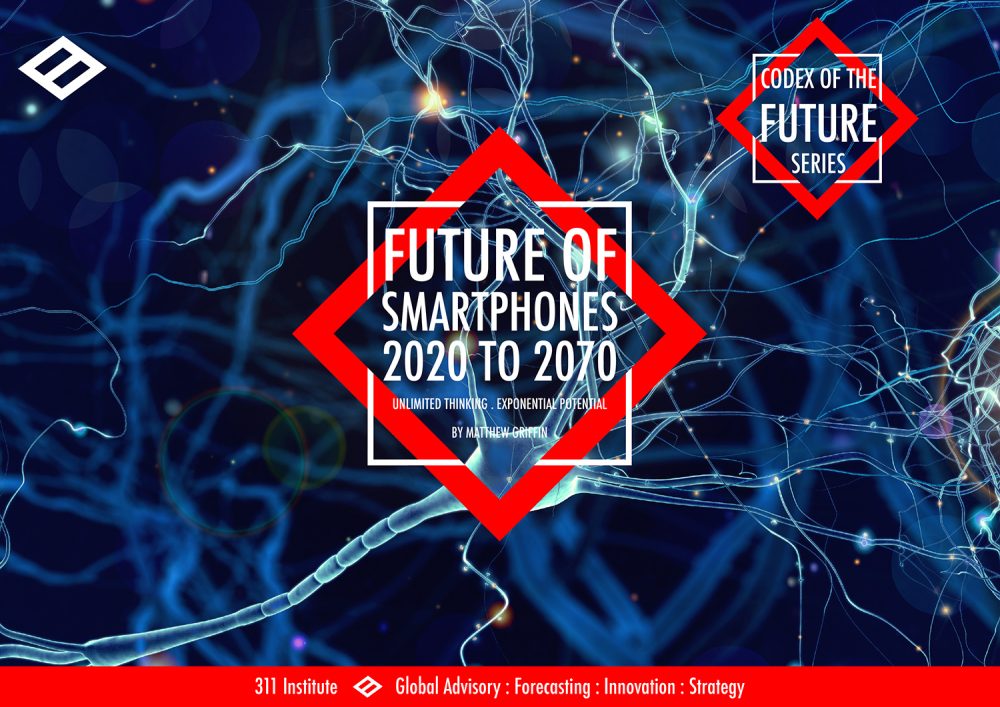
The Future of Smartphones and Smart Devices is a 68-page codex by Matthew Griffin, Founder, President and Futurist of the 311 Institute, that explores what comes after the smartphone. The fifth edition, published in January 2019, covers future smartphone scenarios, the decline of the app economy, emerging technologies and the form factors that could replace the phone between 2020 and 2070.
Who it is for: It is for leaders and strategy, product and innovation teams at device makers, telecoms operators, technology partners and any organisation that reaches its customers through a smartphone.
The codex in numbers
The next platform is coming
Every year consumers buy more than 1.5 billion smartphones, around 60 percent of them from the top five manufacturers.
Matthew has advised some of these manufacturers and their technology partners on their journey to take the platform to the next level.
What you will explore
What smartphones and smart devices could look like.
What comes after the smartphone.
Thinking used by the world's largest manufacturers.
Key findings
Bring the codex to your organisation
Book Matthew Griffin for a keynote session, executive briefing session or foresight workshop session built on this codex. Or start with a free 15-minute expert call.
Questions and answers
The future of smartphones is less about the phone and more about mobile computing. Matthew Griffin's codex argues that once people are comfortable separating the screen from the device, the smartphone will fade into ambient, assistive computing spread across everyday objects, glasses, clothing and eventually the body, guided by AI Companions.
No single device will replace it in the near term. The codex expects many devices working together, with an AI Companion that follows the user. Candidate formats include smart glasses, retinal displays and smart contact lenses, displays on clothing and skin, and, longer term, neural interfaces, assessed across horizons running from 2020 to 2070.
AI will turn the smartphone from a reactive device into an intelligent companion. The codex predicts AI Companions will filter, organise, prioritise and respond to notifications for you, replace much of the app economy and decide which brands are shown, which raises hard questions for every company that relies on apps to reach customers.
Because the barrier is cultural rather than technical. The codex explains that the computing, communications and sensing parts of a phone can already be built into other objects, but society is not yet ready to give up the screen. It suggests separating the display first and targeting younger generations such as Generation Z and Generation Alpha.
It was written by Matthew Griffin, keynote speaker and Founder, President and Futurist of the 311 Institute, who has advised some of the world's largest smartphone manufacturers and their technology partners. 311 Institute runs keynote sessions, executive briefing sessions and foresight workshop sessions on the future of smartphones and smart devices for leadership teams.
The codex is free to download from this page after a short form. It is a 68-page PDF, the fifth edition published in January 2019, and part of Matthew Griffin's Codex of the Future series, which also covers topics such as gaming, insurance, sport, synthetic content and the connected world.
Keep exploring