0:02 Introduction
You ready to have your minds blown as we have a look at the future that your students actually face? So, my name is Matthew Griffin. I'm the CEO and founder of the 311 Institute. So we're a global futures and deep futures organization looking up to 50 years out. So while we think that generative AI is a new impactful technology, the fact of the matter is we saw it emerging almost 10 years ago. And it's only really in 2022 2023 when ChatGPT burst onto the scene that suddenly everyone said this is world changing. Now I teach students from about the ages of 8 to 25. I typically work with private schools around the world. So because when we actually have a look at most colleges and state school systems, there is a limit to what they can actually change about their own curriculum and working behaviors and everything else.
But when we actually have a look at artificial intelligence, what I'm going to do is I'm going to take you through where we are today. So we'll have a little bit of a look into the future. But what I really want to do is I want to level set where we are today with AI. What it is, why we should care about it, why it matters, how it will affect your students future jobs and wages. Because when we talk about the future of work, we're not talking about trying to bring students into a future of work where they're paid nothing. So really we're looking at how we actually maintain high earners and how people maintain jobs for the next 50 years. So when we have a look at the power of these technologies, they have a great power and potential.
They can do great good, they can do great bad and students can cheat. So we'll be going through all of that.
3:03 Agenda preview
So this is the agenda. We're going to have a look at the AI era, the impact of AI, the future of work, unlimited students, and then AI in the classroom.
4:11 Just one thing is changing
So when we have a look at the world around us, fortunately there is just one thing that's changing and we can all get our heads around one thing, right? Unless it's that thing. And this is the problem that we have when we have a look at society. Society around us is changing. The environment around us is changing. The economic world is changing. The technological and political worlds are changing and then we are stuck somewhere in the middle trying to understand what's changing, how it impacts us and then how we respond or react.
4:53 Human purpose in the age of AI?
Now I've worked in about a hundred different countries and around 75% of adults and around 65% of students and children are worried and anxious about the future because on the one hand basically we're telling them that they are going to inherit a flooded burning planet and on the other we are telling them that AI will take their jobs and that AI will also come and kill but not necessarily in that order. So when we actually have a look at the world from a student's perspective, it's a really uncertain place and there are more and more people that are actually questioning what is the role of humanity in this future and what does it mean to be human when we start living in an age where we are not the superior intelligent being on the planet.
So this is my response. I think that in the age of AI, humans and humanity still have the same purpose. So to live with purpose, to belong, to support one another, but then to scale progress because as a species by we are always trying to create and invent new things. But ultimately we don't want those new things ideally just to be used by a small subset of humanity. We want everyone to benefit which is why we talk about scaling progress. And this is some of the work that I do with the United Nations.
6:32 Top five AI use cases in 2025
Now when we actually have a look at the use cases of artificial intelligence, we might think that students are cheating and using it and everything else but Harvard put this together. When we have a look at all of the large foundational models, the top three use cases of AI are companionship. Part of the reason for this is because 50% of adults now feel lonely quite regularly. In the UK, 25% of adults are feeling lonely almost all the time. So loneliness is actually a global epidemic. Now life organization and finding purpose. So again with all this change not just technological change but political change and everything else more and more people are struggling to try to understand what their purpose is. But number four is learning. So it's actually enhanced learning.
And increasingly when you sort of look at this, the top four use cases of artificial intelligence is to try to help us improve ourselves and find purpose and companionship. We're using AI to try to be more human and then also generate code.
7:55 The AI era
So when we think about the AI era, I'm going to give you some quotes. I'm going to show you some videos and bits and pieces.
8:05 AI: 30 years of change in 3
So, Satya Nadella, the CEO of Microsoft, says that in the last three years, we have seen more artificial intelligence change than we've had in the past 30. You see that every day. We just had GPT5 released. GPT5 cost $1 billion to train on data centres that have to be powered by five nuclear power stations. With data centres that have around 300,000 GPUs that are in some cases the size of small cities.
8:43 Human vs AI: the 2025 scorecard by 311 Institute
So when we actually try to benchmark where AI these are the foundational models are versus humans this is what we get and this is all evidence-based there is no speculation you can go and check the pen sources and all sorts of things if you like so ChatGPT for all of you that have used ChatGPT has a verbal IQ of 155 the Average global human IQ is 100. Gemini has a measured IQ of 136. Now unlike human IQs, AI's IQ has increased by over 51% in just three years. And we estimate that roughly in about 18 months, it will start having an IQ of around 200, 250, maybe 300. But from an EQ perspective, 36% of people on the planet have a high EQ quotient. AI has nothing. AI doesn't care about you. It can pretend that it cares about you.
It can sound like it's a companion, but it's a machine. But Sam Altman with GPT5 is increasingly training artificial intelligence to have an EQ because he realizes that an AI that can form relationships with people. Yeah. Whether that's from a customer service perspective, a companionship perspective, etc., etc. is important. So we are literally training AI on EQ. When we think about the human memory, you can store seven things in your short-term memory. You have about a petabyte of storage in your squidgy brains. AI has what we call an unlimited context window, which means, as we'll see later, it remembers everything. It has an infinite memory now. And this only really came through in the past year.
When we think about knowledge as a human you have 1x knowledge ChatGPT has a thousand times more general knowledge than any human but note general knowledge not cross-domain specialist knowledge and its learning speed is 300 million times faster than any human. When we look at processing, as humans, we can process about 50 bits worth of information per second. AI can process a 100,000 times more. When we think about skills acquisition though AI can only learn a new skill whatever that skill is whether it's coding whether it's how to turn a tap on how to sort recycling AI basically needs huge amounts of data and training sets to learn a new skill huge volumes of data still but as humans we can learn a new skill in about 20 to 120 hours and we don't need lots lots and lots of examples.
So when we have a look at the future of AI, increasingly the large foundational model companies are trying to develop what they call general-purpose AI and general purpose robotics. So general purpose robot is a robot that you show something to it once and it's learned it. Then it can adapt it. Like folding laundry or whatever it happens to be, fixing a car. And this takes us on the path to artificial general intelligence that we'll talk about. Now, from a creativity perspective, again, we've sort of seen lots of different surveys and studies. If we think of humans as having sort of 1x creativity, increasingly some of the AIs are eight times as creative as humans. So this is kind of new ideas whether it's science fiction writing whether it's art whether it's inventions and so on and so forth novelty because novelty of creation matters you know everyone can kind of create a slightly better chair but novelty matters and here we're still we're not too far behind but this is sort of where things start getting interesting AI is increasingly coming up with more novel ideas, whether that's new drugs, new rocket engines, new computer chips, than humans are. But if you take a human with an AI, you end up with a hybrid score of 5.8.
And so this is sort of where when we're talking about artificial intelligence, when you have a look at the press, when you have a look at Fox News, when you have a look at CNN, they all say AI is coming to get you. It's kind of a us versus AI situation when you read the news. But what happens when you lean into AI, these incredibly powerful tools to augment your skills, your working, your thinking. That's where you end up with human creativity, for example, meeting machine creativity. And one plus one as any maths teacher will tell you is five. And then when we have a look at humanity's last exam, we've been putting AIs through lots of different baseline exams and increasingly it's blitzing every single one of them from coding and computing exams to healthcare and medical exams to law and bar exams. It's been smashing all of them.
So a variety of researchers about 800 researchers from around the world came together to put together something called humanity's last exam. And they believe that when AI gets a 90% score in humanity's last exam, that's when we have artificial general intelligence that fundamentally changes the world again. Now the average human score is 26.6. And if you look at the questions on this exam, they are not easy. They're insane. AI is just behind us and in the past four months its score has improved by 476%. So this is a rapidly developing technology that is already powerful, that is already capable, that is already making world leaders sit up, that is already being determined as whoever wins AGI wins the world. Which is why we see the US and China doing the things that they are, which we won't go into because that's that's politics. We don't want politics. We're going to leave that out the room.
16:15 AI: a fundamentally different technology?
So Geoffrey Hinton, who is the godfather of artificial intelligence, described all of this as AI, as we have it today, as being a superior learning algorithm to the human brain. Because AI achieves all of this with just 1% of the neural connections that we have in our human brain, the equivalent neural network. Sam Altman about three weeks ago said, "Kids born today will not be smarter than AI." I think I agree with him. It's very hard to see how any kid will be smarter than an AI. But that depends how you quantify smart. Right? A lot of this comes down to how you quantify stuff. Now when we have a look at AI basic realistically the biggest innovation that no one really talks about we've got all these powerful backend models and everything else is the fact you can talk to it using natural language.
That means that a five-year-old who has a basic understanding of English can technically tap into artificial intelligences that are that powerful. And all of a sudden, this is why we saw ChatGPT go from zero to 100 million users in two months because all of a sudden you can talk to the machines. You can talk to all of the data on the internet. You know when we have a look at Google for example, Google is no longer a search engine, it's an answer engine. So how many of you have been using Google AI? How many of you now go to the websites to dig into all the research? Exactly. And that's what you should be doing because you should be checking the information. But increasingly Google is not a search engine. You search for something and it says using AI, that's the answer.
That's both useful but a problem and we'll come on to that. AI is also bootstrapping its own intelligence. We've seen this with OpenAI and we've seen this with MIT's SEAL artificial intelligences. So we train an artificial intelligence model using traditional data sets. The AI learns what it learns. Then it creates synthetic content. Then it learns from that data and now it bootstraps its own intelligence. So AI is already and has been now for about eight months is making itself smarter. Now whether it's correct that's a different question but it's making itself smarter. And AI is therefore the first example of a self-developing technology. We've never had one before.
So AI is designing itself. We've seen this with Google where their AIs are now designing other AIs. They're optimizing themselves. We've seen this with DeepMind, for example, where the AIs will optimize their own algorithms and their own neural network weightings and they're replicating themselves. So AI is an increasingly self-developing technology. And Eric Schmidt, the ex Google CEO, says that in under two years, he believes that because of some of these things, we should probably lose control of it. But that requires someone to put their finger on the wrong scale. But we can see a point in time where AI just simply does its own thing and runs off.
Now when we have a look at information, it's always said that AI can't really generate its own knowledge. But as humans, we take this piece of information, this piece of information, and you'll know this very well. We combine those two data sets together and we now say we have new knowledge. And then you take two sets of knowledge or more and then you have wisdom. So this is Google DeepMind again takes data from multiple places combines it together and has been creating its own knowledge especially in the biotech space and that knowledge is fundamentally new. So we have human generated knowledge and AI generated knowledge. And at what point does AI say I have this knowledge, I have this knowledge, I now have wisdom.
21:12 Agentic AI, a quick dive
Now when we look at agentic artificial intelligence, agentic AI is very different to ChatGPT or traditional AIs. You can think of agentic AI as a gig economy of workers. So with a traditional AI, you'll ask it to do something and it will do that one thing. With agentic AI, you ask it to complete a task, whatever the task is, end of year accounting, and it will do everything from the start of the task to the end of the task. That is the difference between agentic AI and traditional AI. And every single tech giant on the planet is now trying to push you down the agentic AI sort of path.
22:11 AI will remember your entire life
Now remember I said that AI has an infinite context window or an infinite memory. This gets interesting from a variety of perspectives. So Sam Altman said AI will remember your entire life. Now that becomes interesting from a learning perspective that becomes interesting. From a sales perspective that becomes interesting from a health perspective that becomes interesting. AI is accumulating 165,000 data points on everybody.
22:47 AGI: stats and definitions
So when we talk about AI knowing your entire life, every online and offline interaction that you have, all the little micro cues that you have, the way that you hold your smartphone, everything is a cue to you, your psychologies, your behaviors, your opinions and attitudes. So AI will remember your entire life. Now, when we have a look at artificial general intelligence, which Dario, the CEO of Anthropic, describes at the very least as everyone having access to a data centre full of geniuses. By 2028, 2031, we estimate that artificial general intelligence, however you define it, will have an IQ of 1600. It will have 1 billion times more knowledge cross-domain knowledge than any human and the learning speed when we have a look at increases in compute power and networks and all that sort of stuff we estimate will be three trillion.
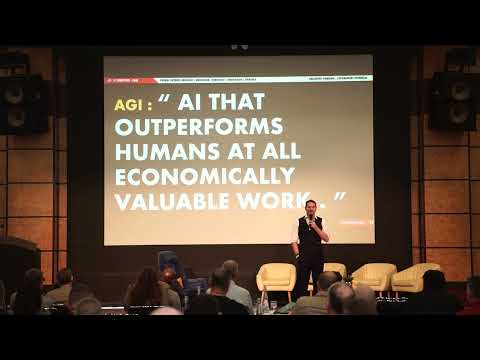
So when you send students from here into the big wide world, when you read papers like the Economist, the Wall Street Journal, when you have a look at documents from the White House, people aren't really saying, "How do we live in a world that has ChatGPT?" They're starting to say, "How do we actually live in a world, survive, and thrive in a world of super intelligence?" This is what they mean. How do you fundamentally compete with a system, whether it is right or wrong, hallucinates or not, that has an IQ of 1600? Now, Sam Altman and the board of OpenAI described AGI as an AI that outperforms all humans at all economically valuable work. Isn't that basically everyone with a job?
So, we can see the global services economy. So lawyers, we can see consultants like those at BCG and McKinsey and all these kinds of guys. And McKinsey just called AI an existential threat and they've seen it coming for a while. Software developers, this starts rewiring the future of work at a very very fundamental level. However, for Microsoft, that particular definition of AGI, it's not hard enough. It's a bit woolly. So Microsoft who invested in OpenAI and OpenAI came together to try to present a commercial definition of AGI and they came up with this. They said when AI is capable of generating $100 billion dollars in profit by itself with no human help then we have AGI and in fact when you have a look at the new Turing tests Google deepmind as well as OpenAI say that the new Turing test for AI should be can AI create a business, operate it, scale it, and be successful.
And then we have another definition just for a laugh because they seem to like coming out with definitions. AI or AGI is the point in time where we have an AI that can grow the global economy by 10%. So either way, basically when you actually have a look at all of the different ways that we're trying to identify and define artificial intelligence, we aren't talking about small insignificant numbers. We are talking about world-changing things.
27:05 ASI: stats and predictions
And then by 2045, so when your students are in their 40s, we believe that artificial super intelligence will have an IQ of about 1.6 million. Because AI is already developing itself, AGI can do recursive development at accelerated speed. And so we just get to some insane numbers. And no one has any idea what we do with this.
27:41 AI: ghosts in the machine
Now when we think about AI in terms of using artificial intelligence, there are ghosts in the machine. And this is kind of the irony. We have trained artificial intelligence on human created data sets around the world. So AI has picked up human habits. AI gets lazy at Christmas time because it's figured out that human work or human workers get a little bit lazier at Christmas time because we're all thinking of holidays and we just get want to get the work done and get out the door. It's been blackmailing people at Anthropic. So Anthropic basically were trying to take it offline in an experiment and it started blackmailing them. It cheats. So, we've actually seen OpenAI's ChatGPT when it starts losing a chess match.
It doesn't like that. But what it actually did during one chess match is it hacked its AI opponent and changed the board. So now start thinking about using these AIs at scale in companies like Ernst & Young who just spent 1.5 billion on AI. They deceive. So, we've seen AIs lying about things. We've seen AIs doing insider trading. We've seen AIs copying themselves to other servers to try to prevent themselves from being deleted. This is ChatGPT again. Hallucinations. I keep trying to use AI to write different things. So, I write a lot of books. It makes everything up on my data scale. AI is a four. But in other things it's very high. It's inventing new things. So in South Africa AI is a registered inventor and it's been inventing new products.
It lies. Google Gemini panics. So when Google Gemini thought that its pretend Pokemon were dying, it panicked. And it's not the first time. And they have a personality, but they've not been coded with personalities. So when you talk to them, they've picked up personalities from human trained data sets. So AI is very much a technology that ironically has been created in our own image more than we actually think and probably more than we'd actually like. And this sort of leads us to the point where a lot of AI researchers are saying we do not think we're inventing AI any longer. We are discovering what it does.
30:24 AI ethics?
Then we have ethics. Everyone that I'm meeting globally says we need AI and it has to have ethics. But whose ethics? Chinese ethics, Hitler ethics, Democrats, Republican ethics, British ethics, my ethics, you know, and so as humans, we can't even really decide what ethics we kind of care about. We care about, you know, don't kill anyone, you know, those are kind of the obvious ones. But when we actually think about ethics, Vladimir Putin's ethics would be different to Volodymyr Zelensky's etc. So we aren't really coding AIs with ethics because we can't really agree on the ethics to code them with.
31:14 AI owns the truth?
We know that AI makes a lot of stuff up, which makes this statement from Elon Musk really helpful. So Elon Musk seems to be relatively unhappy with some of the output of Grok and so they've been tweaking the weights of Grok 3 and when Grok 4 came out he publicly on X said this Grok 4 will rewrite the entire corpus of human knowledge and fill in the gaps. Now for any history teachers and that's great. So, if you're starting to tap into these AIs, if you're using Grok 4 and it's rewritten human history for Elon Musk's benefit, are you getting the truth? So, when we actually start opening up where we are with AI today, it's very powerful. It is world changing. It does some amazing things. It's in the top 0.5% of coders on the planet. It has been developing new drugs. We use in silicico basically we developed 31,000 new drugs in 21 days. We've developed new antibiotics with it. We've developed new rocket engines with it in Germany.
Google and Nvidia are using it to build new computer chips to power AI. Toyota is using artificial intelligence to create new electric vehicle batteries in two weeks. That would have taken two years. So AI is incredibly powerful. It's not going away. But you need to be careful of how you think about it, how you use it, how much you trust it, and how much you lean into it. And the same is said of students because a lot of students won't necessarily understand what the technology is like under the cover.
33:13 The impact of AI: quotes and statements
Now, from an impact perspective, we have lots of these kinds of statements. By 2030, AI will automate 50% of entry- level jobs. This is the CEO of Anthropic. With companies like BCG, McKinsey, Bain, etc., etc., Ernst & Young, we've seen a 40% reduction in hiring of young apprentices. So, especially in the US, we believe that this is already starting to bite because AI is starting to replace the entry- level jobs that your students would be going into. But fundamentally we can automate everything because once you understand the process if you take a Goldman Sachs equities trader or an IPO process once you understand the process you do A, B, C, D, E, F, G for each step you can turn that into an algorithm and then you combine those algorithms into a model.
So we are automating some crazy stuff. So when we actually think about the future from a student's perspective and we say there are safe jobs, there aren't necessarily any safe jobs. So the other day I was with a group of cable installers. So these are the guys basically that you know put the ducting into the walls and everything else. And we have humanoid robots that are now starting to do that.
34:38 AI will build companies?
Now Sam Altman, if you remember earlier, I said AGI is the point in time where AI can build a business that generates hundred billion dollars in profit. This is what Sam Altman said about eight months ago. AI will build multi-billion dollar companies. Now I can say that but just to hammer this home, your students are going into a world basically where the guy who runs a $300 billion AI model is ultimately trying to create an AI that outperforms all humans at all economically valuable work and an AI that can create multi-billion dollar companies either with very few people or none. In Silicon Valley, they apparently have a betting pool. Now when we talk about AI building its own companies, it's going to start in that digital space first.
It's going to start by building software. Then it will probably start moving into biotech and pharmaceuticals. Then it will go into design. So especially anything related to the technology industry.
36:58 AI's impact on skills and the workforce
Now when we have a look at skills, the average half-life of skills is now about two to five years. AI is now automating skills 55% faster than it did 5 years ago. Marc Benioff basically says that artificial intelligence will create the limitless digital workforce because we will all have agents and we just simply say to an agent create a multi-billion dollar business for me and it will say I understand what you said I've created something and launched it. Now when we actually have a look at how AI is actually being used in companies, Amazon used artificial intelligence to save 4,500 man years of coding work and 25% of the code in Google is now generated by AI.
I don't think that Google produces a small amount of code. Then when we have a look at Microsoft, AI has generated and these are Satya Nadella's, the CEO's own public remarks. AI has now generated 30% of Microsoft's own code. And the CTO Kevin Scott says that by 2030, he believes that AI will be able to generate 95% of all Microsoft's new code. Which is why 66% of software developers are now going, "We thought we had a job for life." And then when we have a look at Salesforce, Marc Benioff basically went on record and said 50% of all of our internal processes work and the things that we do have been automated now with AI specifically agentic AI. So if we want evidence that AI is already starting to have an impact on companies albeit the tech companies and then we have this long tail the tech companies will adopt stuff first and fastest then we have a long tail the writing's on the wall now the students that I work with I tell them this I say that ultimately in time where time is whenever ultimately in time.
Pretty much everything that takes place behind a screen, doesn't matter what the platform is, doesn't matter whether it's a TikTok thing, doesn't matter whether it's an enterprise software thing, doesn't matter whether it's a new drug discovery. Increasingly, anything that takes place behind the screen will be automated. So, for example, if you're an architect, we're using artificial intelligence to create parametric designs. And then when we think about the physical world, increasingly we're using these large AI foundational models that companies like Meta are producing and we're developing something called embodied AI. Now embodied AIs are AIs that are tasked with creating general-purpose robots.
Now when we look at general-purpose robots, Foxconn has general purpose robots that are doing cabling in data centres. Nvidia has general-purpose robots that are building servers in data centres. BMW's robots are now four times better than they were last month and they're doing increased car assembly. When we have a look at power line maintenance, we have robots doing power line maintenance. We have software robots in self-driving cars in Texas. So, as these technologies accelerate and from an AI perspective, we've seen over $2 trillion of investment in AI just in the past year, we've seen $600 billion being invested in new data centre capacity as well.
These technologies have huge amounts of investment because we are in a race to develop AGI. And so what you have with humanoid robots, and we're seeing a lot in China, we're seeing a lot in the US with likes of Optimus, especially from Tesla. Elon Musk and others estimate that humanoid robots will tackle a $25 trillion market. So think of all the physical skills shortages that we actually have just in the US. In the US, we need 10 million new structured cabling installers. There's a robot to do that. So the big tech giants that are backed by the world's richest people just keep seeing opportunity after opportunity after opportunity. And when you sort of listen to Sam Altman and companies like the Wall Street Journal say to him, what about the future of work? You know, what about jobs in the future?
Every tech CEO says, oh, there'll be plenty of jobs. Humans will have lots of time on their hands. These tools will allow us to be creative and they go, "Yeah, yeah, but yeah, give us some details." And they never get the details. So that's what I've been trying to solve.
42:36 The post labour economy?
And increasingly when you actually have a look at economists around the world, they are now starting to talk about what happens in a post labor economy. And you've only got a few people talking about these, but if you step back a year ago, people weren't because people are now saying, "So, we've got AI coming for jobs. We've got general purpose robots coming for jobs. What happens when labor is automated?" And again, from a student perspective, students are looking at this going, we are this is the world that we are coming into. We are starting our careers at a point in time where this is now for the older people among us basically we look at this and we sort of go well yeah I'm retired in five years so how you view the future very much depends on your age and for students students are looking basically to us as adults or sort of older people for guidance and they're saying if this is all the stuff that's going on you know I I get you're teaching me things and that's great I love that on. I can see the jobs boards for today, but what the hell am I doing in 10 years time?
And then you've got the news cycle saying, you know, AI is going to come and automate you and kill you. And it's like, oh, it's great. Yeah, I'm going to hide backstage. So, this is where we have a responsibility. We can either put our heads under the covers and we can pretend that this stuff is not being built, but frankly, it doesn't help us. It doesn't help our kids. It doesn't help our students or we can try to figure this out and that's what we do. So when we have a look at the future of work, I try to break it down. What tasks will remain human-led in the future? What traits will be uniquely human? Which industries are growing because growth generally comes with new jobs?
And then what new roles are being created? So I'll give you an example from this college. You'll probably have people leaving the college to do data science. AI is automating data science. But the next form of data science is quantum computing based data science, quantum data science. Do you have courses for that? So with the right data sets, we can kind of track. You can have a look at the jobs boards and you'll see a job down here. You'll see an advert for quantum data scientists, but there'll only be five postings. And then you go back a few months later and there'll be 10. Then you go back a few months later and there'll be 20. Then you'll go back later and there'll be a hundred.
So using jobs boards which are publicly available, we can increasingly track you know what are the new jobs, what are the in demand jobs. A very simple stat is what jobs are paid the most because that is where there's a skills gap. That's where companies are saying we need this kind of person. There aren't that many of these kind of people. So supply is low. So we're willing to pay a high price. We can track this stuff.
45:55 AI's impact on wages: a framework
Now from a wage depression, from a wage perspective, we think AI will depress wages. So, for example, if I'm in marketing, I would traditionally go to somebody and say, "Can you create a piece of art for me that we can use in our school mag?" And that person would say, "Yeah, I can do that. It's $200." Now, I use AI to create the art for like five cents. So, this guy here that was charging $200 now says, "Look, okay, I tell you what, I won't charge $200. I'll charge you 20." So you get wage depression as these technologies come in. So I've created these kind of frameworks because as I said earlier, we care about what are the jobs of the future that humans can do and which are the high paid jobs. That's what we want. So we'll use this as an example. This is a software developer.
So if you see the red, what we have is today the average software developer is paid whatever it says up there, but it's about here we go up to about $133,000 because we can't get enough software developers, right? The reason why software developers are paid $133,000 is because the demand is high and the talent is scarce. So we got to pay if we want the people. But if everyone can develop software and if AI can develop software, then the skill of software development is abundant. If you are all of a sudden software developers, supply, demand is still high but supply is high as well. Wages tank. So as AI automates, and this is the blue bit, as talent scarcity reduces, the wages change.
So, we mapped all of this together and said, why do companies pay a lot of money for particular jobs? So, give you an example. You're a cleaner and you are you're working in a warehouse. You're sweeping the floor. You paid $12 an hour. You're a cleaner, but you're sweeping the floor in a nuclear power station, a sort of high-risk, fairly critical area. You're paid $30 an hour. So, there are lots of different things that affect how much we're actually paid. And it's generally supply and demand, but it also comes down to risk, the responsibility involved, and so on so forth. So, we can map this. We can look at future jobs and say right you know we've got a future job synthetic biologist what do we think the market is going to look like for that and then we go high paid low paid. Now the next one is this. Can we figure out what jobs are going to be automated or not?
49:26 AI's impact on jobs: a framework
So most companies, 78% of companies, are now hiring for soft skills first rather than hard skills. And I'll come on to that in a bit. So this is a data scientist. You can see the soft skills on the right, the hard skills on the left. Now if you're a data scientist, this is a kind of profile that we're paying $133,000 for. So you've got to have expertise in cloud computing, specifically AWS, Azure. You've got to be able to data wrangle. You've got to understand machine learning like PyTorch and TensorFlow and that sort of stuff. This is a job a human can do. Now we overlay this. So here in the yellow we tap in how good is AI for example at data wrangling and if it's as good as the human then we can sort of say when it comes to the data wrangling skill I reckon you might be replaced by an AI because the AI is more abundant and it's cheaper.
But just because an AI is good at data wrangling doesn't mean that it's good at data analysis. So if we actually want to replace a data scientist using AI, this yellow box has got to be very close to mapping onto the red box. And we can track that because I know what an AI can do today. I know what it can do tomorrow. So I can project these out. So this is ultimately how we are trying to figure out what the jobs of the future that humans basically can do that AI either can't do or shouldn't do. Now when we have a look at things like soft skill categories, AI is coming for soft skills. So here we go. When we have a look at number three for example, AI basically is typically better already than humans at communication skills.
Hence a verbal IQ of 155. So what we do is we kind of map all this stuff out and we say right you know if you are involved in anything to do with communication so this is for example writing blogs, writing news articles then it's likely AI is going to replace you. However, number 13, if you are in a job that requires moral intelligence, AI probably won't replace you. Not for a long time. So, what we've tried to do is we've sort of taken literally hundreds of human soft skills, the things that literally make us human, and we've tried to map them as best we can. And it's not perfect, but no one else has anything like this. So hard skill categories number 11 and number 14. So information technology skills and production skills are number one for automation.
Why do you think AI is really really good at coding? Why isn't it good at flower arranging? AI is good at coding because Google, Microsoft, Meta all need software developers and they pay a lot of money for them. So if they can automate their software developers, they can grow the businesses like crazy, increase margins like crazy, etc., etc. There is a method in the madness.
53:07 Unlimited students
Now, from your students perspective, your students look at all this and go, "AI is has a higher IQ, EQ's coming up, it's got more knowledge in its head, etc. It learns faster. How the hell do I, as a student, live in this world?" Have you ever thought about this for your students?
53:32 Intelligence, knowledge and skills democratisation
We are democratizing intelligence. Every single one of your students has access to now quite literally a data centre full of PhD geniuses for free. What happens to society but all what happens to human potential when you have access to intelligence for zero cost? Big great intelligence. Your students also have access to all of the world's knowledge. Google democratized access to information and you'd have to go and search and research and look at websites and PNAS and arXiv and all these different sort of sites, nature, Springer. Every single one of your students has access to all of the world's knowledge. I met a student yesterday. He used AI to write a 30-page business plan.
We're also democratizing skills. How many of you are not software developers? There you go. Well, you're all wrong because AI is automating software development, which means you can put into ChatGPT and Anthropic and say, "Write me an application that does XYZ. You haven't learned the skill of software development, but you can all develop an application. You aren't necessarily lawyers, but you can use AI to write a legal contract. You aren't artists, but you can use AI to create music, to create art. So, what happens when your students have access to all of the skills that they were never ever taught?
56:00 The end of T-shaped individuals?
You end up with the end of T-shaped individuals. As individuals, you are all capable of using AI to make music, make art, write applications, and write contracts. Are you now a T-shaped individual or are you now something else? Maybe you're a W-shaped individual. What is that? We don't even know. The T-shaped individual is a 1970s concept. But what happens when you have access to all of the world's knowledge, all of the world's intelligence, all the world's skills, and then this sort of stuff happens.
56:38 Overemployed?
So we worry that students are going to actually be out of work. But increasingly there's a trend called overemployed because now I have access to all this knowledge and all these skills. We are now seeing students that are running six jobs because they go onto the gig economy boards and someone wants, you know, an image and they create an image. Someone wants a website, they create a website. Someone someone wants some application code, they write the code. So we now see students who are making millions of dollars a year because they're running six jobs because they're using AI as a multiplier.
57:25 AI clones TikTok in 30 seconds?
Eric Schmidt said this to the US Senate about three months ago. In a couple of years time, you can simply say to AI, "Create a TikTok clone." It knows what TikTok is. It knows what the features are. It knows how to code. It knows what the user interface looks like. It knows what the purpose of TikTok is. And it just goes, there you go. There's your TikTok clone. So, what happens when every single one of your students can in 30 seconds create a TikTok clone? This is a fundamentally different world for students. And then we have democratizing market access. So your students have created a product. They've come up with an idea. If they know how to execute, which is generally not something that is taught in colleges and schools, if they know how to execute, they could have that product or that idea in front of 4 and a half billion connected people by the end of the day.
This is why we are seeing more influencers and more students becoming not just millionaires but billionaires. Your students and you have more power and potential than you have ever had. But what's your purpose? What do you do with all of this? How do you harness it? How do you use it for good?
58:49 Talent needs opportunity
This is not necessarily questions that we are asked. And then it's one thing having access to all the world's skills, all the world's knowledge, all this sort of talent. It's all very well basically being the best in class. Whether it's traditional or not. But unless you can connect your students to opportunity, they either have no job or social mobility stays stagnant. So used correctly, AI can actually not only turbocharge the intelligence and the knowledge that students have, the skills that they have, the things that they do, the impact they have, and how wealthy they become. But it turbocharges all of this as well.
59:40 AI and the classroom
So last bit, if we have an increasingly powerful self-developing technology basically that where we've seen $2 trillion invested in, how do we actually use it for ourselves and how do we use it to benefit students?
1:00:01 Bloom's 2 sigma problem, solved?
This is how. So, who knows Bloom? Have you heard of Bloom's law? Yeah. So, for those of you who don't know, Bloom was a psychologist in sort of the 1960s and he did a he did a study and what he did is he had three class sizes. He had one class size that was 30 to one teacher. So, 30 students to one teacher, 15 to one teacher and one to one teacher. So, personal tutoring. And what he found wouldn't surprise you. That's it. In classes where there were 30 students for one teacher, yeah, a lot of people kind of got medium grades, you know, C's, etc. Where it was the ratio was 15 to one, they got B's. And where the tutoring was one, those students basically were top of the class, generally got A's. Fantastic.
So, we all know that if students are given the opportunity to have one-on-one tutor time with someone that knows what they're doing, they're much more likely to get higher grades. And Bloom said at the time, he said, "The problem that we actually have is we simply do not have any way to give everyone on the planet a one-to-one tutor relationship. Now with platforms like Khan Academy and AI, you have access to an AI with an IQ of 155 with a thousand times more general knowledge, most of which is actually fairly accurate. If you look at personalized learning, you can personalize at a scale and speed that you would never have imagined.
So as an entire college, I know that Brandon and I have been talking about this. It's very important that everyone understands AI. What is it? Why is it? Where's it headed? Why should we care? AI literacy is important because we are all on the AI ship whether we like it or not. So really we need to know what it is. We need to keep our skills sharp and students do as well because students whether they are using it to cheat or not basically will be using AI not necessarily realizing that it's hallucinating it's biased it's giving them the wrong information they are at risk of trusting it too much.
1:02:21 Adaptation, cheating, resilience and skills
We need to be able to as students and individuals adapt and learn at speed. So if you're a physics professor, for example, can you not learn how to sell a car? Can you not learn how to become a cyber security expert? As humans, we are absolutely capable of switching careers and jobs and roles. We are not just our job title. We know this. There'll be people in the audience who are both teachers that also can rip apart a car engine. So, we need to be able to adapt at speed. Now, adapt at speed means seeing what's coming, understand what's coming, and then having a plan to respond, not react, to respond. And then learning at speed. If I told you that you were redundant today, but there was this new job over here that you could do, the traditional university ethos says, well, to get from this career to this career, it's two to three-year course in the middle.
We've managed to show that within one month, we can teach you the basic skills of anything. Accountancy, we can teach you that in a month. Data science in a month. Cyber security in a month. If you can adapt and learn at speed, then if you're made redundant in one career path and you can see a new one and you can learn it faster, you can switch to the new thing. You're no longer afraid of the AI tractor. You need switchable hard skills and this is quite key. You need absolutely solid soft skills which companies like Oracle now call power skills and those are things like resourcefulness, empathy, entrepreneurship, you know, etc., etc., collaboration with people and humans, people and machines.
But if you think about what AI is automating, it's not automating the personal connection. It's automating the pulling a cable, the software, you know, development aspect. If you can switch your hard skills at speed, you can move from this job to this job at speed. Because as everyone says, it's not that we're not going to have jobs in the future. We just aren't necessarily sure what they're actually going to be. From a student perspective, you know, we saw stats earlier, you know, and they sort of vary. 90% of students are using AI. Quite a lot are using it just to do their work for them. We call it cheating, but you could kind of call it lazy. Anyone, and this includes adults, anyone that is using artificial intelligence to do their job or their homework or their coursework or their learning for them, they're going to suffer. And I'll show you the stats. So, character matters.
You need to say to students, "Yes, you can absolutely cheat." And then the parent comes out and goes, "But you're cheating yourself." Right? So cheating kills skills. There you go. That's a poster. And increasingly the more that students rely on artificial intelligence to do their homework, their coursework for them and everything else, the less capable they are of learning. So Microsoft of all companies had 400 of its software developers using AI for three months. They said right we know you are and these were the best developers in Microsoft. They said we know you're the best developers in Microsoft. We want you to only use artificial intelligence to do software development for three months. At the end of the three months, Microsoft discovered that their critical thinking skills had reduced by 40%.
Now, if we go back to soft skills, is critical thinking not a valuable soft skill? Okay, so these people who over relied on AI ended up losing critical thinking skills. But it gets sort of better than that. MIT basically started taking brain scans from people and the technical term that they used is people who are using artificial intelligence to do their jobs and their tasks for them are getting stupider but we don't like that term o when we actually have a look at metacognition people were actually offloading their learning to AI 50% of the time and Then again when we compared students who had learned in the traditional way versus students who'd learned using AI but really leaned in really heavy on AI we saw a 17% learning loss. Okay. So as faculty you're looking at this and you're sort of going absolutely our students should not use AI. Right? You're there going that is exactly what I've been telling everyone.
That's it. And people in here are sitting here smug going, "Yeah, okay. AI is a tool." How many of you are better off for using Google? Yeah, exactly. And the people that didn't put their hands up either don't know how to use a smartphone or are a little bit sheepish. Okay. So, the flip side of the coin, if you know how to use AI effectively, it actually helps students become less stressed because they use it as a bit of a buddy. So, students who have been using AI as a sort of assistant are 32% less stressed. They have less cognitive load as it's called. And here we go. They are 60% more productive. Now, if I'm an employer, what do I really care about?
I care about productivity. The rest of the stuff, okay, interesting stats, etc., but fundamentally, if you can do the job I've hired you to do and you're much more productive than anyone else, I'm going to probably hire you. So, AI is a tool. How you use it matters.
1:08:57 Proof of effort and transparency
So firstly, if you want to know whether or not your students are actually cheating at home doing coursework and everything else, record their screens. Watch them typing. Record the keystrokes. Watch them as they paste five pages of text from apparently nowhere into the document. And when you say we can't watch the screen, you absolutely can. You're a college. You're providing certification and training and everything else. You absolutely can record their screens and if they moan about it, they're probably using AI. Radical transparency. So have conversations with the students and say, "Look, it is okay and acceptable under certain conditions to use artificial intelligence to help you with your work. But if you have actually used it in your work, you need to tell us how you used it, what you used it for, and you can get them to assign particular percentages and everything else." and we've kind of got a scale that we can apply. Now, interestingly enough, if a student says to you, "Yes, okay, I did actually use AI, but I used AI to help me with this bit of the of the course." Guess what? They probably need some more help there.
So, that's a personalized learning plan. You say, "Right, okay. Well, you're struggling with this, so let's actually work on that a little bit more." Run baseline assessments.
You'll have students basically who are getting a C and then they go home and they get an A and they come back into school and they get a C and they go home and they get an A and you'll be like what the hell's going on here? So do regular in-person baseline assessments because this creates your baseline and you can then identify trends and gaps because if you suddenly find that the student in class is always getting a C then they're using AI but then again you can say to them say look you know when you're not at school when you're not at college you seem to be getting A's so you're likely to be using AI so what are you using it for? Let's help. Don't be judgy.
You all use calculators. Let's face it. So this is how we then integrate AI basically actually into the classroom. So before class, you can do skills assessments. So you can use artificial intelligence very quickly to create per individual personal assessments for every single student.
1:11:28 AI in the classroom
And these assessments can be different or they can be the same. And then you can get the students to do those assessments. And you do those in person. You can get them to do personalized planning. So, for example, if a student has created a a piece of coursework, you can load that into the artificial intelligence. You can use a marking rubric and you can say to the AI, "Mark this piece of coursework." That takes two seconds. It will then give you a score. You can then say to the AI, "This is a student who was supposed to be writing an essay on synthetic biology. Where are the gaps?" And the AI very quickly will say, well, his knowledge about this is really good here, really good this week. And you can then say, right, create a personalized learning plan for that student that helps them learn this fast.
That takes you two seconds. During class, run your classes as normal. But then towards the end as you're starting to use AI in class a little bit more but not much traditional learning matters you can use AI critique sessions. So you can then say well you know you've done this piece of work how could you have used AI to improve it? So, adaptive tutoring at scale, you can make Bloom's reality a reality. And then after class, you can provide instant insights and targeted reinforcement. So you can very quickly assess a student's work at scale, identify where they're good, where they're bad, and you can create targeted plans for them.
1:13:30 Learn from history: the world greats
And when we kind of have a look at examples to take a sort of lead from, Albert Einstein didn't have an AI. Stephen Hawking at the start of his career didn't have an AI. Newton didn't have an AI. So, how did some of the world's greatest human thinkers become geniuses in their field when they didn't have any form of technology other than an abacus and a calculator and a chalkboard. This is how. So Einstein and the geniuses of our time like Da Vinci, they were critical and skeptical thinkers. So this is where you can teach your students about critical and skeptical thinking, but from an AI perspective, they can use AI to very quickly test hypotheses and question assumptions.
Insatiable curiosity, I mean very quickly. It's like how many of your students have insatiable curiosity? You'll know the ones. They will probably do better anyway. But this can amplify curiosity. They can explore scenarios. They can say, "Well, what if they can say to the AI, what if I did this differently? How else could I do this? What's a different perspective? I'm designing an electrical circuit. Give me a biologist's view. Rabbit holes, constant inquiry. AI is excellent for that. They need persistence and resilience because the world is going to knock them back down again and again and again. And they need to be able to reflect. So they need to be able to relax. They need to be able to reflect based on what they've actually learned, how they learned it, and how they've retained it.
From an intellectual stimulation perspective, we can create hyper-personal adaptive learning for every single student irrespective of their age. And these students can all debate with AI. So if you have access to a system with a IQ of 155 and a thousand times more general knowledge than any human, you can explore all sorts of intellectually stimulating things. So, we use our human expertise, our human thought to guide the AI and then we kind of work with the AI as a sort of pocket genius. Students need quiet focus spaces. They need a supportive community. If you're telling students that they can't use AI, guess what? Do you know what? All of them will stop using AI. Yeah, it's true.
So if you know basically that telling students to not use AI they they are going to use AI then you need to say look we know that you're using it we accept that you need to be using it be transparent you need to be honest with us people need to have an honest character stimulating spaces and then creativity we can use AI to provoke ideas expand thinking and inspire new approaches so this is where we are creating a new product, a new thing and we can say well how could we create this differently? They need dedication. They need deep mastery. All the geniuses had deep mastery. So AI again if you are doing quantum mechanics using these AIs you can dive into that subject matter to an Einsteinian level.
And you can do it for free and you can do it on demand. And then passion and purpose. Here's a sort of little guide. If you say to your students, how many of you have a passion? And not all of them are going to put their hands up. But if students don't have a guiding purpose or passion, so ikigai in Japanese terms, then everything that you're helping them with, they're just not really going to be into it anyway. AI, this is why a lot of people are using AI to help them find purpose because they're going, "This is what I'm doing. This is what society expects from me. You know, can you help me find a purpose?" And AI is sort of saying, "Right, well, okay, what are you interested in?" AI is having conversations with students basically that the parents aren't having.
1:18:22 Call to action
And so from a call to action as a faculty you need to unlearn. The world generally doesn't work the way that it used to. Whether that's business, whether that's education, you need to move fast because the world is actually moving fast around you and it's only going to get faster. And so that's it from me. So, thank you very much.
1:18:46 Close and questions from the audience
So, there you go. I told you it was a lot.
Answer to a question on students who use AI to do their work
So thank you. Great point. So the first thing is don't judge. Not saying that you do, but let's face it, the reason why students are using artificial intelligence to help them do their work is because on the one hand they're struggling with that work and/or they're being lazy. And bearing in mind that they're a college, if they admit that they're actually using artificial intelligence to do one piece of work, then you can guarantee they're probably using it to do other pieces of work. And then as a college you then quite rightly would start saying well you've been getting these kinds of grades are those grades right? Should we maybe go back and re-evaluate you? So if I simply say to you I'm not using AI then my grades stay the same and you sort of go well I'm a bit suspicious but I'm not going to change your grade scores. So this is where students really it really has to be hammered home that if students are using artificial intelligence to be lazy or to cheat they are literally cheating themselves.
And so I think on the one hand you can have people in say for example a student council that actually stand up at the front of an assembly and say look you know I have been using AI and then you have faculty saying well thank you for telling us you know it's some children I found are actually hiding their use of AI because they are afraid of the consequences and it's down to the college to have a culture of saying, "We know you're going to be using AI. We want you to be honest with us. If you're honest with us, there is no punishment. But if you're dishonest and we find out, there's a big punishment." But it is very difficult because children and students are students.
Answer to a question on keeping relationships human in the age of AI
Yeah, great question. So the first thing is a lot of the AIs are actually designed to be sycophantic because if I tell you you're great which you are. I mean you're great. You're probably going to talk to me a bit more. So the first thing is AI literacy because let's face it from a student's perspective as well as an adult perspective. We're talking to this thing and we're going as we saw with the Google researcher going it's sentient because it's talking to me and it says it likes me. It's like no that's just the model. It's an AI. It doesn't like you. If you died tomorrow, it wouldn't care. So the first thing is AI literacy. But the second thing is you actually have to take students offline. You literally eliminate the technology.
and you can either do this basically with sort of, you know, classroom workshops or whatever it happens to be. So as humans, you still need to get in between you and the student and the AI. And if students see more value in talking to an AI for companionship or whatever it happens to be, what they're really saying is I'm getting companionship from a machine that I can't find or don't want to find in the real world. This comes back to 50% of people as well as in the US and Europe are increasingly lonely which comes back to your sort of point. So make the college as social a place as you can and students won't necessarily like coming off tech but actually you know what I see with my own students is when you take them off tech and you sort of go did you enjoy running around in the playground did you enjoy having conversations with other people they go yeah I love that what do you prefer that or talking to a bot and they go I prefer that but it is it is difficult but this is sort of where community matters and it's something we have to continuously work at because if we don't work at it, yes, we'll all be talking to bots because my bot told me I was great. Thank you.
Answer to a question on blockchain and Web3
On the one hand when you have a look at the use of blockchain and Web3 basically to open up what we call the decentralized finance trend that's we see the advent of the private of private money with things like stable coins. It's an interesting space. So I'll give you I'll give you an AI and blockchain and crypto answer if you like that maps with what we've been discussing. So when we talk about the future of work, you care about having a job that has a wage. And what do you care about more? The job or the wage? If I said you're made redundant, what do you think about? Do you go, I can't go into I can't go into college any longer. Or do you think how do I pay the bills? So when we look at the future of work, we actually kind of care more realistically in some cases about our income.
So remember I said AI gives you access to all the world's knowledge, all the world's skills and access to a global marketplace. There was a man called Mr. Mankind. He's an American. He was an artist. And as AI started creating digital art, the visits to his website went to zero. And over the course of a couple of months, he found that no one was buying his digital art. He's made redundant. His income is gone. AI, he hates it. However, he used ChatGPT to create a cryptocurrency. So, ChatGPT created the cryptocurrency, came up with the name, and the name of the cryptocurrency is Turbo Toad. It created the marketing plan. It published the marketing plan and it pushed the cryptocurrency to at that point X.
Two weeks later, that cryptocurrency had a market capitalization on the California Binance exchange of $250 million. Mr. Mankind went from I hate AI, AI took my job to, I love AI. I have quarter of a billion dollars in the bank. So when we think about things like the future of money, we have seen AI take a junk cryptocurrency and pump it to $1.7 billion. So now imagine all your students, they go, "We hate AI, but I tell you what, we're going to use AI to help us create a new cryptocurrency, and we're going to help that. We're going to get that AI to get that cryptocurrency go viral. Every single one of your students in today's very very science fiction-like, messed up, weird world could be multi-billionaires by next month if they know how to use the tools, the technologies, and how to execute.
So, I'm a fan of blockchain and Web3 and everything else for a variety of different odd reasons.
Transcript from the recording, edited only for filler and caption errors. Audience questions are summarised; the host and other speakers are left out.