Chapter 1: Introduction
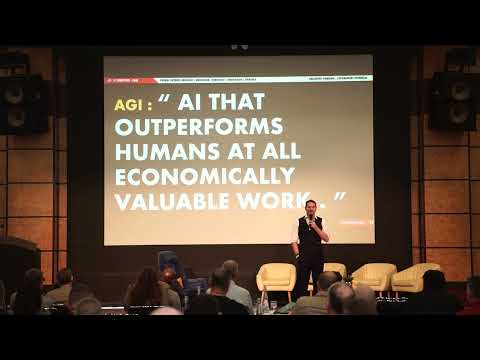
0:12 Hi everyone, my name is Matthew Griffin and I'm going to be your host today when we go through the agentic CFO. That's it. So together with Workday, we're going to be having conversations about the difference between vanilla artificial intelligence as I call it, agentic artificial intelligence, and then we're going to look at how those actually both apply and how they can both be used in the office of finance, especially when we think about the role of the CFO. So I'm the CEO of the 311 Institute, a global futures and deep futures think tank looking up to 50 years out. I cover 600 emerging technologies, hundreds of different mega trends primarily so you don't actually have to. So in this particular session, I'm going to be sort of taking you under the hood of some of the emerging technologies that the world loves to hype up. We're going to be exploring what are they and more importantly why are they. So when we have a look at
Chapter 2: 30 Years of AI Change in 3
1:07 today's world, it shouldn't really come as any shock or any surprise to any of us that everything is changing faster than ever before. So we have the pace of change as it relates to the digital pace of change. So when we have a look at artificial intelligence especially Satya Nadella the CEO of Microsoft recently said that he's seen 30 years of AI change occur in just three. Now to put this into context between 1960 and 1990 roughly kind of 30 years there was almost no artificial intelligence development. Then for about 20 years we saw AI development kind of bump along you know so to traditional machine learning intelligence that kind of stuff if this happens then do that. But obviously since really 2021 2022 with the advent of transformer models which we now affectionately call ChatGPT or these large language models we have just literally seen an explosion. So over the past year alone we've seen 1.87 trillion dollars being invested into artificial intelligence both in terms of the training models themselves but also the data centres and the infrastructure supporting all of that. So when you think the pace of change is fast blink and you just missed the latest great release. Now when we think about artificial intelligence, last year I was in 60 countries. I talked with world governments, royal households, global
2:40 multinationals and there is a general consensus globally that from a company perspective but also from an individual perspective, you're either going to be using artificial intelligence or you're going to be lost or whatever marketing term you actually want to put into this particular slide. But you kind of get the point. Now, when we actually think
Chapter 3: AI Versus Humans, A Quick Overview
3:02 about where AI sits as it relates to human capabilities, these are just some little stats that I sort of dig out. So, in terms of memory capacity, as humans, we can typically remember seven things in our short-term memory, and our long-term memory is the equivalent of one petabytes worth of storage in our squishy brains. However, artificial intelligence thanks to infinite context windows which really came through with Microsoft and OpenAI sort of at the start of this year 2025.
3:38 Increasingly, artificial intelligence's memory of you and the actions it's taking and so on and so forth of its general world is unlimited. Now that is important as we sort of come to a couple of different things that I discuss later on in terms of processing speed. As humans, we process information at roughly 50 bits per second. But artificial intelligence, according to Geoffrey Hinton, the godfather of artificial intelligence, we're already edging towards 100,000 times faster with AI. Now, that's not just an order of magnitude bigger.
4:19 That is an exponential leap.
Chapter 4: The Rise of the A-Suite
4:24 Now when we think about the role of artificial intelligence within the C-suite or within the boardroom, again it's no secret that artificial intelligence is being increasingly leaned on by senior leadership teams to help them go through reports, analyze information, but more importantly help them make decisions. So again, as I travel around the world, we're now starting to talk about the rise not of the C-suite, but of the A-suite. And then as we start fast forwarding over the next 1 2 3, four, five years. One of Sam Altman's ambitions is to turn GPT-5 essentially into an artificial intelligence that is able to autonomously all with a single person build, launch and scale as well as operate its own multi-billion dollar business. So when we talk about the rise of the A-suite, we're not just talking about the use of artificial intelligence in the boardrooms. We're increasingly talking about the development of artificial intelligences which increasingly will actually be building and leading their own companies and we've already seen 70 of those in the United States albeit on a very small scale and Claude 4 from Anthropic is currently being trained on a variety of different should we say business simulations and at the moment it's not doing very well but over time that's going to improve. So we are seeing the true rise whichever way you want to look at it of the A-suite.
Chapter 5: The Post Digital Transformation Age
6:00 Now for years really for since 2005 almost every company on the planet has been talking about their digital transformation programs. Now digital transformation programs richly which we generally leverage robotic process automation for. Most digital transformation projects leverage automation in a relatively dumb way. If this happens, then do that. And again, digital transformation programs themselves basically kind of leverage traditional technologies. However, as artificial intelligence increasingly becomes baked into the operating models of companies, as those AIs become increasingly sophisticated, capable, intelligent as they also start gaining their own agency and also start becoming increasingly autonomous as we see with agentic artificial intelligence. I argue that companies are now no longer undergoing digital transformations.
6:57 They're starting to undergo intelligence transformations. So when we think about artificial intelligence for example today the cost of a company accessing knowledge, the cost of a company accessing intelligence is increasingly dropping to zero. And automated and companies that have automated things in the past, those automations, whether those are process flows or so on and so forth, are increasingly moving from being automated to autonomous. And this is a critical difference because an automated system is very very different in terms of what it does, how it does it and its capabilities and the outputs compared to an autonomous system. And actually when we have a look at agentic artificial intelligence, increasingly we're talking about AIs where we are paying for the output. So when we start seeing some of these very large market valuations of agentic artificial intelligence which in most terms typically top 12 trillion dollars of new GDP value. It's not because we see agentic artificial intelligence as just a new tool or a new technology. It's because we are starting to develop a technology that is capable of producing its own outputs. And so the addressable market opportunity that technology is able to should we say move into dominate etc etc is much much larger than traditional machine learning artificial intelligence technologies.
Chapter 6: The Limitless Workforce
8:33 Now when we have a look at agents Marc Benioff the CEO of Salesforce sort of said this when I was over at Davos in January this year. He said, "Increasingly, companies will have access to digital limitless workforces." Now when you actually think about this from an agentic perspective today, you know, as we've seen with a couple of different studies over the millennia, we generally feel that 100 humans are able to work together in harmony to get something done. Once we start collaborating in groups of more than 100, human teaming systems start falling over. However, the larger the large language model, the more agents can work together to reach a collaborative consensus.
9:32 Now, there's an interesting sort of counterbalance here. The smaller the artificial intelligence, the fewer agents that are able to work together to reach consensus. So, big is definitely better. And when for example we think about agentic artificial intelligence bots that are starting to negotiate with one another again quite a lot of studies have actually shown that if your AI bot is less capable has access to less hardware infrastructure and resources than another AI bot then your bot is going to be in the weaker negotiating position.
10:11 So increasingly it's not just the capabilities of your artificial intelligences that you should actually think about but essentially what they're backed by.
Chapter 7: AGENTIC AI VERSUS "TRADITIONAL AI"
10:23 Now when we think about AI, AI is an umbrella term. It encompasses lots and lots of different kinds of artificial intelligences from open-ended artificial intelligences to conscious artificial intelligences which is kind of a construct or constitutional artificial intelligences as they're also known basically from companies like Anthropic to machine learning to deep learning to neural networks basically to all kinds of different things. So AI is this umbrella term and there is a significant difference between traditional what I'll call vanilla artificial intelligences and agents that we're actually moving into now. So if we're doing a very very high level sort of 50,000 foot
Chapter 8: Black Boxes Versus Glass Boxes
11:10 comparison of a traditional ML AI compared to agentic AI, this is how I'd term it. So traditional artificial intelligence is as many companies well know by now are black box automation engines. That's it. It's very difficult to understand how they do what they do, make the decisions that they come to. However, when we think about agentic artificial intelligence, these models are built using fundamentally different architectures. So we can think of these a good way to sort of think of these basically is these are autonomous action-orientated partners. So I'll break this down now.
11:56 They're autonomous because increasingly they have agency. So they are able to act on their own behalf based on the inputs that they receive and they can sort of do their own thing. So we do need proper governance basically when we're thinking about agentic AI. They're action-orientated because you give them a goal and then they try to figure out how to achieve that goal. Traditional ML models don't do that. And they're partners because increasingly they are actually designed from scratch to be teammates with humans.
12:35 So whereas ML basically is really designed to be a one-way conversation with an artificial intelligence, you know, we put stuff in, it kind of takes stuff out. Agentic artificial intelligence is literally designed to be much more collaborative. So the conversation, you can think of it as being much more bidirectional, a little bit more human-like. And even though there are nuances kind of in these descriptions, you know, as you get to know and use artificial intelligence agents, you'll understand what I mean. So what I'm going to do in this particular section is we're now going to be looking at some use cases.
Chapter 9: Agentic AI: USE CASES in the Office of Finance
13:14 We're going to be looking at some efficiency or productivity gains that we've been able to realize using agentic AI. And again, you know, we are at the start of this kind of revolution. But I'm also going to be talking about some of their characteristics and putting those into context. So the first one I want to talk to you about basically is autonomy. So from a use case perspective in the office of finance basically this helps with continuous close and we've seen a 40% reduction time reported by Deloitte in the close times especially associated with ML AI versus agentic AI. So when we think about autonomy AI agents which are the yellow boxes they act towards goals as I mentioned earlier. However a traditional ML AI you're going to get bored of me saying ML AI and everything else which is why I'm trying not to talk too quickly. A traditional ML AI waits for you to trigger it.
14:19 Now, agents proactively initiate processes on your behalf. You've given them the goal. They try to figure out what they need to do, how they need to do it, when they need to do it. They trigger the processes. They work autonomously. ML AI, you know, basically I'm going to you're going to get bored of that one. ML AI, it lacks independence and it runs on demand. So, essentially, it's a batch-based system. From an adaptability perspective. So this is where we look at adaptive cash flow forecasting and again we've seen a 40% improvement in accuracy in this particular use case. Adaptive cash flow forecasting as the environment and the situation that these AI agents find themselves in as your company finds yourself in should we say an increasingly uncertain and turbulent environment. Agentic AI is able to adapt. Now, it's able to adapt in real time and I'll come to the reasons for that in a moment. However, ML AI is trained on a set of data and it's updated when you want it to be updated and it's updated at the moment manually.
15:35 So, AI agents are able to adapt in real time because they have dynamic insights and they respond and learn from live business data. This is a critical difference. Now bearing in mind that speed is increasingly a differentiation differentiate different I can't say that a differentiating factor for your company having an artificial intelligence in any form that is able to learn and adapt to real-time live data feeds is increasingly critical. I mean let's just have a look at the tariff situation. Today we have these tariffs. Tomorrow they're completely different.
16:13 the day after we have no idea what's going on. So we live in a highly dynamic, highly changing and uncertain world. However, compare that to ML AI and it adapts slowly because it has to be updated manually. It runs in batches and the models are static. You know, they've ingested information. They've been trained on particular information sets and until they're trained again or until they are updated that's it they are the essentially not quite accurately but they are essentially the models that they were when you did the last update.
16:52 Now from a compliance perspective we all love compliance I know that. So again, when we think about compliance and regulation, there are quite a number of companies in different sectors like the financial services sector and healthcare sectors that are now starting to pay out 10% of their revenues in order to be compliant. And when we actually have a look at the size of compliance and regulation teams as well as change management teams, you know, these are the teams that are inevitably growing.
17:19 These are the teams basically that businesses need just to navigate the increasingly complex environment that we find ourselves in. Now when we think about the use of agents basically in the role of compliance yeah this is where we can have a look at auditable reporting. Now there's a 15% reduction in the cost of audits when we've had a look at agentic artificial intelligence again according to Deloitte. So, think about an activity that is costing you 10% of your company revenues. Now, cut that cost by up to 15%.
17:59 That is a significant cost saving. There's the money for your new projects right there. Now, this is really quite an interesting difference between the two kinds of artificial intelligence. Agentic AIs are the equivalent of glass boxes. They are open and transparent by design. Compare that with ML AI which is a black box and has governance gaps and you can already start hopefully from a compliance perspective starting to see some of the benefits of using a glass box AI architecture versus a black box AI architecture. Again, especially if you're in a heavily regulated or compliant industry like healthcare, aerospace and defense, financial services, and so on and so forth. Now, the reason for this is that Agentic AI has been built with explainability by design. So, it's able to maintain its own state and goals. So when it does something, you're able to essentially look back in layman's terms through the logs to see exactly why it did what it did when it did it.
19:20 Again, compare that to ML AI and the vast majority of ML AIs. They don't have any in-built audit trails. There's no rationale tracking. So bearing in mind that these AIs are bringing lots of disparate information together from across the organization to do what they do, make a decision maybe, you know, agentic AI has a context that it's able to apply to this. ML AI doesn't. You end up having to strap together lots and lots of different tools in order to try to figure out why the heck did your AI just do what it did. And it's also a single output design. So when we have a look at performance so when we think about real-time liquidity risk again basically we're living in a very highly un I was going to say unstable uncertain highly dynamic world where disruption is now the status quo so real time being an or for an organization to be able to understand real time liquidity risk as we see different market movements as we see different political whips basically coming through and so on and so forth is an increasingly useful use case. Now again, when we think about Agentic AI, it's starting to lean on some of the things that we've talked about before. Agentic AI is always live because it's always learning and adapting from live data streams.
20:47 ML AI is based on batch runs. And because it's based on batch runs, we see delayed outputs. So again, think of the advantage of real time anything, real time governance, real time reporting, real time analysis and so on and so forth versus delayed outputs and batch runs. So again, this is just simply more of the same really. Hopefully you're getting the idea. Yeah, we have continuous monitoring and we have the ability to create immediate updates with agentic artificial intelligence systems versus results lag for the other thing that I'm going to stop calling ML AI.
21:32 I'm not really I'm going to call it that again in a minute. Now finally, you know, I kind of mentioned that when we have a look at artificial intelligence agents, they were sort of built basically for partnering. Now increasingly from an organizational perspective we have two kinds of workforce that we can juggle about with and play with. We can use artificial intelligence just to automate our workforce in which case people have gone out of the business or alternatively we can use artificial intelligence to augment the experts that we have in our business which is actually the best way to get a boost in productivity a boost in output but also to do so in a relatively risk-averse safe way. So I do encourage organizations not to really think about how they automate people but how they augment people first with these new technologies. Now because agentic artificial intelligence is designed to team, you can think of it very much as the equivalent of a gig economy of work of digital workers. We end up with faster decision-making and scenario planning which again you've got it in a VUCA Max world where VUCA stands for volatile, uncertain, complex and ambiguous and max stands for massive because increasingly the changes that we're seeing in the world are massive.
22:56 they are system level accelerating as well. So we're seeing a rapid acceleration of disruption, technology development and so on and so forth. Geopolitical whips etc etc. And then the X in MAX stands for exponential because we see exponential levels of change, exponential levels of disruption and of course we see exponential technologies which as a futurist that's my kind of bag. Now, from a teaming perspective, AI agents are quite literally architected to team. That's it. They're kind of collaborative soulmates by design. You know, they are arguably designed a little bit to be the extroverts of the artificial intelligence world compared with the introverts.
23:47 And again because these artificial intelligence agents are able to take in information in real time and then adapt. They can adapt importantly within the context of what is actually happening. Context within your business is crucial. You know this we have human in the loop workflows and human on-the-loop workflows. And then we have natural collaboration using natural language and natural user interfaces as well. So you don't have to be a master of Python to get the best out of your artificial intelligence teammates. Compare that to traditional artificial intelligence. It generally lacks goal awareness. It often struggles with context because we're using single models or we're using sets of tools that we're kind of trying to you know knot together. And again it waits for triggers. And then finally absolutely the last one I promise you this risk. When we have a look at the levels of risk around the world risk is increasingly a systemic problem. Again, it's also accelerating.
25:06 So, if we look at things like cyber risk, financial risk, if we have a look at military-based risk, environmental risk, you know, it's enough to drive you nuts. So when we think about real time fraud now when we actually think about fraud itself in the UK for example in the financial services community year-on-year we're seeing about a 50% increase in the amount of financial fraud whether that's things like new account opening fraud and so on and so forth deep fake fraud etc. When we actually think about the African continent, we are seeing financial fraud rates that are increasing by about 370% compound per quarter.
25:55 So the fact of the matter is you might not like fraud. In fact, you might downright hate it, but you are going to be facing more fraud and more hackers and criminals and people coming after you for whatever they're coming after you than ever before. So, from a risk perspective, agentic artificial intelligence can help you with real time fraud identification and prevention. Which again helps boost stronger risk resilience.
26:27 Now the way that it does this is agentic artificial intelligence a little bit like its traditional cousin is able to predict risk. Now this is sort of based on how the models work. I know that there are lots of system integrators out there that for the past decade have been saying that traditional artificial intelligence helps you predict fraud. But the fact of the matter is that no artificial intelligences are really accurately able to predict the future.
26:55 They can model the future based on what's happened in the past. But when we have a look at new political systems, new technological systems and so on and so forth, the kind of frauds and risks that you're facing as a business are different to what's happened in the past. So a simple example of this is think about tariffs. Think about the pandemic. Yeah. Artificial intelligences did very very badly at predicting what was going to happen next in the absence of accurate information which they had nothing to draw on. So agentic artificial intelligence actually uses information in a different way. We have something called a time series artificial intelligence. And we have one other thing that I'll talk to you about in a moment that actually increasingly helps AI, should we say very carefully, predict the future more accurately than it would have traditionally. Bearing in mind that as a futurist, I don't want it stomping on my turf. Okay, get off.
27:57 so when we have a look at traditional ML AI, it's a very risk sort of reactive detection system. Now, the way that agentic artificial intelligences actually try to predict what comes next, even if they have imperfect information, and this is sort of where I put my little futurist hat on now, is increasingly researchers are finding that if they feed agentic artificial intelligences synthetic dopamine, then these AIs get better at understanding what's going to happen next, how people are going to behave, what the likely outcomes are going to be. Now the reason for this is as humans we actually use natural dopamine. So if we want to say eat a donut, then in our heads we're doing a should we say a risk calculation saying if I eat this donut then I'm going to feel very happy in the short term but my calorie count's going to increase and I'm going to put on two stone of fat.
29:07 so we have dopamine kicking in and on the one hand it's kicking in to highlight short-term reward, but then we have another dopamine system that kicks in saying, "Yes, but if you eat that donut now and you do put on two stone, you're going to get fatty, you're going to get unhealthier, and at some point you're going to have to run 20 miles on a treadmill." So with these risk-reward mechanisms that dopamine sort of instigates within the human brain, you might not actually have that donut.
29:42 So neuroscientists, bearing in mind that a lot of the people at the top foundational AI labs like Dario at Anthropic, they are actually neuroscientists by profession have been playing around with using synthetic dopamine in their artificial intelligence models to help their AI models better predict what a likely outcome is going to be, what you're going to pick, what's going to happen, and so on and so forth whereas compared with traditional ML AI, one of the last times I'm going to be saying that it has a historical data focus.
30:21 It's reactive. If something hasn't happened in the past, then traditional artificial intelligence models aren't going to model it. They aren't going to think of it as being something that's possible. They're going to be flawed. They're going to have gaps in the model. And from a risk perspective, how many gaps do you really want in your AI models or scenarios? And then the final one workflows.
30:54 See how I'm teasing you here? So when we think about reconciliation to ledger close basically we've seen a 30% increase by agentic artificial intelligence helping with reconciliation to ledger close. Part of the reason for this is agentic artificial intelligence unlike AI ML or ML AI manages end-to-end workflows. Now again this is important because you set it a task it figures it out. So you set it a goal in the task it then backcasts and think right in order to achieve that goal I need to do A B CDE E FG and off it goes and does it. Compared to ML AI it's single task only. So with agentic artificial intelligence, we genuinely have a technology that is specifically designed for end-to-end workflow automation with agency and a level of autonomous capability built in. And unlike all of the other ML AI point solutions that you actually use, agents are designed to collaborate and work with one another.
32:04 So we have integrated processes. And as businesses, you'll have a process over here, you'll have a process over here. Agentic artificial intelligence will be able to knit them all together relatively seamlessly. ML AI, not a hope in hell. You need a manual intervention for that. And that's it from me. So hopefully you've learned a
Chapter 10: SUMMARY & CLOSE
32:24 little bit about the difference between agentic artificial intelligence and traditional vanilla AI. And I will stress that not all AIs are created equal. So yes, there are going to be lots of sort of gray scales between you know all of these different things that I've actually mentioned and hopefully you now have some ideas where you might be able to use agentic artificial intelligence within the office of the CFO to get some rather interesting returns, do some interesting things. And what I would actually recommend is that you try using agentic artificial intelligence from companies like Workday on high impact low-risk use cases. So go back within the organization, identify use cases that will, if you can solve them, you know, if they're a problem in the first place, will have a high impact on your business. But that if things actually go off the rails, if things don't go quite as expected are actually low risk. So start high impact, low risk and just play around and then go from there. So we are literally on the cusp of a new yet a new technology revolution. And thank you for listening to me and now back to the rest of the webinar. Take care.
33:44 Goodbye from me.