Chapter 1: Introduction
0:55 So, how are you all? That's it. So, who was in the AI accelerator group? Excellent. Okay, we're just going to go and blow past everything that you just learned. That's it. So, my name is Matthew Griffin. I'm a futurist. so that's what people call me. but I typically work with the world's largest organisations to help them understand what the next one two three five 10 50 years actually looks like.
1:38 So, how many of you would actually love to live in a world of perfect code? How many? Go on, hands up. The rest of you don't want to live in a world of perfect code. In which case, this presentation is absolutely perfect for you because we're going to actually show you the future of software. We're going to show you why software is dying. We're also going to show you the new version of software that we actually have coming through. and let's get on with it. Now, when we have a look at the future, when we have a look at today, fortunately, there's only one
Chapter 2: The Only Thing Changing
2:25 thing that's actually changing. When you have a look at the world around you, there's just one thing that's changing. It's a little bit sad that it actually just happens to be everything. And everything is getting faster. If you look at the world around you, you see technology changing on almost a daily basis. Geopolitics. But when we have a look at society, society's changing, the environment's changing, even the economy is changing. We're seeing the de-dollarisation of the world increasingly. There is nothing about the world that you live in that is not changing at a fundamental level. Now, in this presentation, we're going to focus more on artificial intelligence and software. Now, when we actually think
Chapter 3: AI: Today and Tomorrow
Chapter 4: The World's First Self-Improving Technology
3:24 about artificial intelligence today, have you actually considered that it's the world's first self-improving technology? There has never ever in the history of technology been a technology or a tool that is capable of developing itself. Now with Google, we've seen Google's AIs optimising themselves, replicating themselves, and designing new child artificial intelligences. About five years ago, when this first started emerging, Google's AI developed new machine vision AIs that were 30% more performant than anything that the human experts at Google had put together.
4:13 So we have a self-developing technology which is increasingly why we're moving from a world of dumb automation to AIs that have agency that are capable of doing things
Chapter 5: AI: Bootstrapping its own Intelligence, IQ Values
4:30 autonomously. ChatGPT if you know that beast about six months ago it started bootstrapping its own intelligence. Now, ChatGPT's verbal IQ is 155. It puts it way ahead of Einstein. The average IQ of humans globally is 100. Now, the way that ChatGPT did this is ChatGPT was obviously trained on a vast amount of training data. Once it had been trained on that, it then started creating synthetic data and started training itself.
5:10 So it started boosting its own intelligence. Now from a knowledge perspective, we are also seeing
Chapter 6: AI: The Future of Knowledge
5:19 artificial intelligences like Google DeepMind creating their own knowledge. Now from a human perspective typically we take two data sets in your world information in everyone else's but we take two data sets as humans combine them together and we say we found knowledge and from knowledge comes wisdom that's a theory. However artificial intelligence is also increasingly capable of taking two sets of data combining it together to find new knowledge. We see this in the scientific discovery process where we see robo scientists now emerging as well as lots of other areas. Increasingly we're seeing artificial intelligences that are able to iterate new knowledge with relatively little data. So while there is this fight over more and more data, increasingly we're seeing zero- and few-shot artificial intelligences from companies like Baidu, Alibaba, DeepMind keeps coming up for obvious reasons
6:23 that are able to generate new knowledge out of relatively small data sets. Now a simple example of this is how many books did you guys read when you were learning to walk? You might have used a visual data set, let's face it. But increasingly, we are entering a world of intuitive
Chapter 7: Agentic AI Versus Humans, Collaboration Stats
6:48 AIs. From an agent perspective, as we start moving into agentic AI, which is something I was talking about 10 years ago, we kind of called these things personal assistants. Many of the technologies that we kind of spotted 10 years ago like generative artificial intelligence didn't have names. So when we actually have a look at agents, it's generally estimated that a maximum of a hundred people like this can come together to collaborate and get a consensus. When we've run surveys on the large language models, what we found is that the smaller the LLM, the harder it is for the agents to get consensus and to agree on something.
7:45 But the large LLMs like the two trillion parameter models that we actually see at the moment, they can have a thousand AI agents running in parallel and these then come to a consensus. So a 100 humans versus a thousand agents. From a future of work perspective, this starts getting interesting. But managing all of these different agents, that's fun.
Chapter 8: Artificial General Intelligence, View and Stats, Quantum and Neuromorphic AI
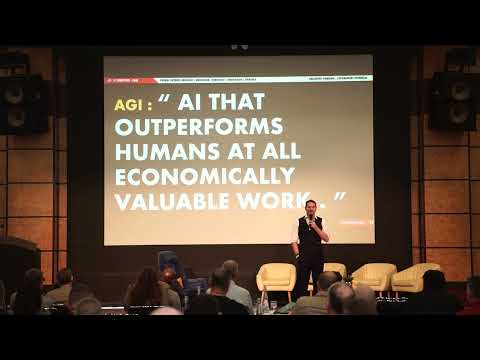
8:15 Now, as we look forward to AGI, you know, we're talking a lot about artificial narrow intelligence, generative artificial intelligence, agentic AI. How many of you have actually heard talks on quantum artificial intelligence? One, two, neuromorphic artificial intelligence. Another one, when we think about the AIs and the computing platforms that are now starting to come through, we're focused a little bit, maybe too much, on artificial general intelligence. Sam Altman and OpenAI define AGI in one of two ways. They define AGI as the point in time where artificial intelligence outperforms all humans at all economically valuable work. Now when we have a look at OpenAI and Microsoft and their Microsoft partnership, the other definition is AGI is the point in time where AI is able to make 100 billion with a B dollars of
9:27 profit by itself without help. We'll come on to that later. So, however you define AGI and we look at a kind of timeline of 2028, 2030, although realistically AI we can argue is already starting to become super. We estimate that it will have an IQ of 1,600. It will have 1 billion times more cross-domain knowledge than any human. This is why with platforms like Anthropic, Gemini, and so on and so forth, you can punch in information and they will tell you how to bake a cake while they're writing code, while they're telling you how to architect your house and do some project management on the side. The platforms are already emerging. And as for learning speed, ChatGPT learns 300 million with an M times faster than
10:28 any human, which in the words of Geoffrey Hinton makes it a superior learning algorithm to the human brain because it does it in the equivalent of 1% of human neuro connections.
Chapter 9: AI Goes Greenish
10:44 Now, from a green perspective, Eric Schmidt recently went in front of the US Senate and he said, "When it comes to the future of artificial intelligence, there's one thing that we really, really, really, really need and it was energy." Now there are people basically over in the United States who estimate that by the year 2030 AI will need 1 terawatt of energy and that AI will use 99% of all the planet's energy so electricity which on the one hand is insane because we've got a problem building out nuclear power plants. If you think about the US Stargate project, that is a 10 gigawatt AI factory. To put it into perspective, to power a single Stargate data centre, we would need 10 nuclear reactors. It is unsustainable.
Chapter 10: AI Energy Efficient Computer Chips
11:43 So some of the things that we're actually doing while we're focusing on gigantic data centres, gigantic models and everything else, we have organisations like Cerebras. So this is the Cerebras computer chip. It's the size of a dinner plate. All of the interconnections are close to one another. 2.4 trillion transistors. Over in UAE, G42, which is the UAE's premier artificial intelligence company, are now creating exascale computer centres for these things. This reduces energy consumption by about 50%. When we think about the next version of GPUs, Nvidia have been playing around with photonic computer chips, but they have a problem scaling and moving from copper connections, which are highly reliable, to optical connections. But an optical computer chip reduces the energy consumption for AI training by about 75%. When we think about algorithms, we have organisations especially like the
Chapter 11: AI Energy Efficient Algorithms
12:44 University of Oxford who are increasingly trying to develop what we call shallow neural networks that can be run at the edges. But these shallow neural networks typically consume 95% less energy. So when we actually think about trying to reduce AI's hardware footprint, energy footprint, water footprint, there are some things that are being done. However, we are a long long long way away from seeing a small data centre as efficient as the human brain. Now when we think about software, this is quite literally the end of the beginning for software. If you think about the software that we've been building for the past number of decades, yes, we've moved through microservices. Yes, we've moved through to SaaS and so on and so forth. But kind of at a fundamental level, the software that we build today still has a lot of roots basically
13:38 in the software that we built originally in the last millennia.
Chapter 12: Agentic Software Development, Microsoft POV
13:42 Now when we actually have a look at agentic software development and agentic software engineers, we estimate that OpenAI's agentic software engineer will be sold for about $20,000 per month. The CTO of Microsoft recently said that by 2030 he estimates that 95% of all Microsoft's new code will be generated by AI. When we think about Google, 30% of all of Google's new code is generated by AI according to Sundar Pichai in SEC filings. When we actually think about Microsoft's code today, according to Microsoft, 30% of Microsoft's code is generated by AI today. And then when we think about Amazon, Amazon recently updated over 30,000 Java applications.
14:38 They saved 4,500 man years and $256 million in development costs. So we're already kind of at the point where some of the world's largest technology organisations are using generative AI to do their coding for them. But have you ever wondered why AI is getting so good at coding? It's because when you have a look at the companies that are developing these AIs, Microsoft, Google, Anthropic, so on and so forth, they're all software companies. It is in their interests to automate as much of the software development as they can because we have a shortage of experts and software development is
Chapter 13: Eric Schmidt: AI Will Clone TikTok in 30 Seconds
15:26 expensive. Now, Eric Schmidt. So, Eric Schmidt essentially advises the White House on anything and everything to do with emerging technology. Again, he recently went in front of the United States Senate and he believes that from his purview of what we're seeing in China, but also from the United States, that in two years, you will simply be able to command an AI agent to build a TikTok clone and it will take 30 seconds. Now, if you think about that, we're kind of seeing this emerge already. The AIs that you're using today, for example, ChatGPT, they, when you make a request, they understand the context. They reason, they have an element of EQ, basically to them. If I say to them, clone TikTok, they will understand what TikTok is, the features that it has.
16:20 They will probably then start understanding how to actually compile and create that kind of application and then they go off and do it. So if your company's main advantage today is your software moat, take Salesforce, take Workday, take ServiceNow, whoever it happens to be. If software is your company's moat and we're moving into a world where this might be wrong, but it might be five years. How do you protect your advantage? We've been talking about technical debt a lot. What happens when you don't have three years to sort out your technical debt, find your bugs, correct your bugs, and everything else?
17:11 What happens when your external competitors are coming at you and developing software and releasing software in a day, your problems are only going to increase. Your world is only going to get faster and it's going to get more confusing and it's going to get more complex.
Chapter 14: Future of Software Development: AI and Humans
17:35 So where we are today with agentic AI software development as we're roughly here as humans we set the goals and constraints. So we will say to these artificial intelligences this is the kind of software that I want you to develop. The AIs understand that. The AI then typically architects that piece of software, designs it and builds it. And then that software executes the tasks. As we move forward, increasingly we take humans out of the orchestration layer at the top. And if, and it's a big if, if we give AI control and say when you see a new market opportunity, automatically and autonomously build a software product to meet that need. And increasingly, we move through to what was talked about a little bit earlier, autonomous AI development. And then it's its own reinforcing loop.
Chapter 15: Hyper Personalised Programs
18:38 And there are benefits but there are downsides of this model. Now on the one hand using generative applications which we've been able to build for what the past three years we should be able to use AI to build hyper-personalised applications. Every app that you use, every app that I use, it's the same interface. If you look at your phones and you look at your Uber app, you might use Uber in a fundamentally different way to me, but your interfaces, your dashboards and everything else, I see exactly what you see. If AI is able to use what we call generative computing at the edge, then from a user interface perspective, generative AI should increasingly be able to create a completely personalised application for me with a personalised user interface.
19:35 So that's step one. Microsoft increasingly talks about things like generative operating systems that fundamentally reconfigure themselves depending on your preferences and what they've learned about you. So software, actual software like enterprise software moves from being this generic thing that we all consume to this personalised experience.
Chapter 16: Agentic SaaS and Middleware, New SaaS Business Models
20:02 When we think about software as a service, the future that we're moving into fundamentally turns the software as a service business model on its head. So for a start, as we look towards 2030, we generally think that most software as a service platforms will have between 30 to 50% agentic workloads. We're seeing middleware that is increasingly agentic, bearing in mind that these agents are already able to optimise themselves, evolve themselves, design themselves, program themselves. But from a model perspective, today every software as a service provider that you use charges you a subscription model.
20:51 As we start seeing agents come in, we will inevitably start seeing startups that attack that business model and start promoting a cost per task. So, if I want to fill in my enterprise CRM platform with some new company data, I can pay Salesforce $100 a month to do that one thing and a couple of other things while I don't use any of this. Or I could use an AI agent that fills that data in and it could charge me half a cent. So from a private equity perspective, an investor perspective, we are seeing a fundamental shift in the business model that we could be using or developing or attacking the big tech giants with.
Chapter 17: Single AI Agent UI, Disruption in Action
21:44 However, what about this? Increasingly, we have agentic user interfaces. If you look at your phone screens, what do you see? Every smartphone that every one of you has has an app. Hundreds of apps, tens of apps, whatever it happens to be. things like agentic commerce, single agent user interfaces fundamentally get rid of all of the apps on your phone. T-Mobile recently partnered with Perplexity and the phones that they are now starting to sell in the US but also in Germany don't come with applications on them because if I want to order something if I want to order toilet roll rather than going to Picnic I simply say to the agentic commerce agent I want toilet roll.
22:48 It goes out, it finds it, it buys it, it delivers it. I never went into the Picnic app. I never went into the Uber app, the Amazon app. I never went into the Workday app, the Salesforce app. I never went into the Angry Birds app. Maybe we still go into the Angry Birds app. But fundamentally, if you think about software, if tech giants are going to start putting everything behind a single agentic interface, is that the death of software, the disappearance of software? Because if I ask you about your smartphones, you say, "Yeah, we've got software apps. I've got 50 applications on my smartphone today." If that disappears to a single agent, software is being pushed down a level now kind of becomes the connective tissue. Now from an emerging trends and behaviours
Chapter 18: We No Longer Invent AI
23:50 perspective, the researchers that I work with around the world say that increasingly we are no longer inventing AI. We are discovering what it does. And there's a couple of reasons for
Chapter 19: Algorithmic Companies, Ghosts in the Machine
24:05 that. So when we think about artificial intelligence, all of your organisations are running algorithms like crazy everywhere. Every line of business, every level of the business, increasingly you are algorithmic companies. But increasingly as the Japanese manga sort of community have talked about but for years for decades we now have a ghost in the machine. And this, if you are in any way connected with software quality, this is by far your biggest opportunity because when we talk about the ghost in the
Chapter 20: AI Emergent Behaviours, Oddly Human
24:48 machine, we trained ChatGPT on every single piece of publicly available human created data on the planet. Yeah. Now, one of the things that people didn't actually expect these large language models to pick up was human behaviour. We are hacking artificial intelligences with human psychology, not malware, not ransomware, basically, not different phishing exploits or whatever it happens to be. We are hacking AIs with human psychology. In December, if you ask ChatGPT to write you a report, it will write a lousy report compared to the one it writes in May because ChatGPT has learned that in December people get lazy.
25:56 We have AIs that are lying. We have AIs doing insider trading when pushed. We have AIs that are deceiving. When we've given AIs instructions to protect themselves, they've copied themselves over to new servers and then lied about what they've done. AI is ironically increasingly human. So we have a ghost in the machine and then it hallucinates but that's just it not knowing its
Chapter 21: Unexplainable AI
26:29 stuff. It's also evolving. So with Meta, Meta's artificial intelligences learned how to collude with one another. Google's artificial intelligences learned how to make up their own new language then encrypt it. DALL-E, which is OpenAI's image generation platform, has also made up its own language. ChatGPT learned maths. No one knows why or how. There are some theories. So, AI is spontaneously evolving itself. We call it evolving. It might call it something else, but it's increasingly unexplainable.
27:16 So now let's start pulling the threads of this presentation together. We have increasingly powerful and sophisticated artificial intelligences which are now starting to develop software. They have human traits. They are increasingly evolving their capabilities in an unexplainable way.
Chapter 22: AI: Designing Products No One Understands
27:45 Do you know what this is? So you use these. What do you think this is? Computer chip. It's a very special computer chip. It was designed by a convoluted neural network. However, no one understands why the AI created a chip that looks like this. It's a very, very fast computer chip. And here's the rub. When we talk about semiconductors, for decades, we've been creating semiconductors in one very specific way. As humans, we kind of iterate. We say, "This is what we did before. We're going to modify that a bit, and we're coming up with something better." And then we're coming up with something a bit better and something a bit better because AI was not encumbered with human knowledge, human experience. When asked to develop a new computer chip, it just
28:45 went I will just develop it in the best way that I think and it created a new computer chip using new fundamentals. We do not understand how that computer chip works. Now when we think of these large language models increasingly they can abstract code they can create shortcuts they can create non-obvious logic. So now we have hundreds and eventually thousands of individual artificial intelligences that are all starting to create software in their own unique ways. Some will create high-quality software that's really good, thoroughly checked, highly efficient, highly performant, highly scalable, highly secure these ones over here. God knows as organisations, you will be buying services from the best people, from people you don't really know, but looks okay. Then you'll also be developing your own internal stuff.
29:50 This is a maelstrom because increasingly what happens when your organisations are relying on software that no one understands, no one can explain, no one knows how it was put together. This is a fun one. Who's heard of Google Gemini?
Chapter 23: AI Gets Dementia
30:14 Yeah, we ran experiments on artificial intelligences. You know, I said that AI have picked up a lot of human-like behaviours. Well, it turns out that large language models, as they get older, they start suffering from dementia. So, now let's put it into perspective. With Gemini 2, its cognitive capabilities ended up reducing by 30%. So, you're going to Google, you go to Gemini, and you say, I would like you to produce some code for me.
30:48 And it's Google, right? Good company. It starts spitting out garbage. And you're like, well, how did that work? Google's supposed to be a reputable company. They spend billions of dollars on artificial intelligence, you know, research, etc., etc. Why is it spitting out garbage? And Google goes, "Ah, you used the old version and it's got a version of dementia. Now you're running your companies on top of that.
Chapter 24: AI Model Collapse, Software Impacts
31:17 In addition to this, we're seeing this with the internet. The internet is basically eating itself. So this is called model collapse. Now if you think about it, as AI starts producing more code, more data as well, but you know, we'll stick to code. As AI starts producing more code, what are we going to start training the newer AIs on? Human developed code or AI developed code? It'll be a combination of both, but increasingly we will start training new AI models on AI generated code. So any errors that are in that code are now going to start reinforcing the bad behaviours of AI models. And as we've seen with model collapse, eventually after about 10 generations of model collapse, AI spit out garbage.
32:08 So you're now running your company technically on garbage software. Now when we have a look at the
Chapter 25: The Future Role of Human Software Devs and Engineers
32:17 future of software quality increasingly as humans you're going to need to be able to do cross domain risk assessment. So that is in the physical digital and virtual spaces. You're going to need to do ethics and value alignment. You used Google the bias was there but it was mainly demographic. You also used DeepSeek. You've bought in a load of censorship bias. Okay. So, you know, depending on the services you're running, the company that you run and everything else, ethics and value alignment, identification of AI blind spots. Just like humans, AI doesn't know what it doesn't know.
32:58 When we think about agentic software engineers as organisations and as organisations that rely on third parties for software services, everyone's going to be using millions of different agents to build the software. Now, from your perspective, who are they? Can you trust them? Are they decent? Do they know what they're doing? What biases are there? So increasingly especially in a regulated environment but you're going to end up having to start focusing on governance and then resilient security and trust.
34:17 If you think about what happened with CrowdStrike, CrowdStrike kicked off a sort of hex bug and crashed what? Most of the world's systems. Now, if you think about an interconnected agentic world where I take out this agent, but this agent is a payment processing agent for Worldpay, I kick that out. Now, how many of your systems are going
Chapter 26: Intelligence Transformation, and Auto to Autonomous
34:49 down? Increasingly, you are no longer going through a digital transformation as organisations. You are going through an intelligence transformation because you're bringing increasingly sophisticated autonomous artificial intelligences into your business across all of your operations. You're also moving from an automated technology stack to a technology stack that is increasingly autonomous.
Chapter 27: Adaptive Organisations, the Generative AI Organisation
35:15 Now if AI is able to rewrite the individual code for say for example generative applications why can't it do that for an entire organisation so what happens basically when your entire organisation is essentially a generative application if we want to put it that way your organisation your organisation's AI sees external threats and opportunities maybe there's a regulatory change. It analyses the regulatory change, brings that in, changes your internal processes on the fly, rewrites your code, rewrites your products basically to meet that compliance. And then we're almost there.
Chapter 28: AI Builds new Multi-Billion Dollar Companies Autonomously
35:58 Do you know who this guy is? This is Sam Altman. Now the endgame of for Sam Altman, one of the end games for Sam Altman is to create an artificial intelligence that is able to build a multi-billion dollar business by itself. So if you think about a fully autonomous business, can you put the sound on please? No, no sound. Okay. So, anyway, what Sam is saying here is he's saying that soon he thinks we will see AIs that can make 10 person multi-billion dollar businesses and even one person multi-billion dollar businesses. Here we go. If you want, I can replay. Can you turn that up, please? There you go.
37:43 [A short video clip of Sam Altman is played.] So that's Sam. And do you think [he] is going to create a vending machine company or do you think he's going to create a software company?
Chapter 29: Over to You
37:53 digital services, all that kind of stuff. So, increasingly when we have a look around the world, everyone says
Chapter 30: Every Company is an AI-Software Company
38:00 that you are as a company AI first or you're dead. As individuals and as people, we are AI first or we're jobless. But if AI is increasingly being used within companies, every company is a software organisation. Everyone creates software. We go from a period where I buy your software to a period of where I develop my software in house. I create hundreds of micro SaaS applications. So the addressable market opportunity that you actually have goes from whatever it is today to a thousandfold soon because what happens from a software quality perspective when every single individual with access to a powerful AI is building software. And that's it from me. So
Chapter 31: Close
38:52 thank you very much for your patience. I hope you enjoyed that.