The US Army just 3D printed a grenade launcher and grenades
3D printing will let armies print bespoke weapons and equipment out in the field on demand and change military supply chains, and warfare forever.

Key takeaways
- Called Rapid Additively Manufactured Ballistics Ordnance, or RAMBO for short, the new weapon is a modified M203 grenade launcher with a shoulder stock and pistol grip.
- The M203 grenade launcher is an older, pump-action design that was fitted under the barrel of an M16 rifle or M4 carbine.
- The Army is impressed with the process, which proves that someone with uncommon 3D printing equipment can actually build durable grenade launcher parts.
Cite or link to this article
Griffin, M. (2017) 'The US Army just 3D printed a grenade launcher and grenades', 311 Institute, 11 March. Available at: https://www.311institute.com/the-us-army-just-3d-printed-a-grenade-launcher-and-grenades/ (Accessed: 8 October 2026).
3D printing has come a long way, companies are using it to print new buildings and sneakers, doctors are using it to print new organs and GE recently printed out a jet engine, but now it looks like the US Army have gone one step further and they’ve managed to 3D print a grenade launcher that launches 3D printed grenades. Yes, you heard that right.
All my printer has ever printed out is proposals and the occasional cat photo, maybe I’m missing out…
The project highlights the Army's interest in integrating new manufacturing technologies, ideally lowering costs and easing supply demands down the road.
Called Rapid Additively Manufactured Ballistics Ordnance, or RAMBO for short, the new weapon is a modified M203 grenade launcher with a shoulder stock and pistol grip. The M203 grenade launcher is an older, pump-action design that was fitted under the barrel of an M16 rifle or M4 carbine.
RAMBO is made up from over fifty individual 3D printed parts. The barrel and receiver were made from aluminium using direct metal laser sintering, which the US Army's Acquisition Support Center describes as a " process that uses high-powered precision lasers to heat the particles of powder below their melting point, essentially welding the fine metal powder layer by layer until a finished object is formed,” and the trigger and firing pin were printed in 4340 steel.
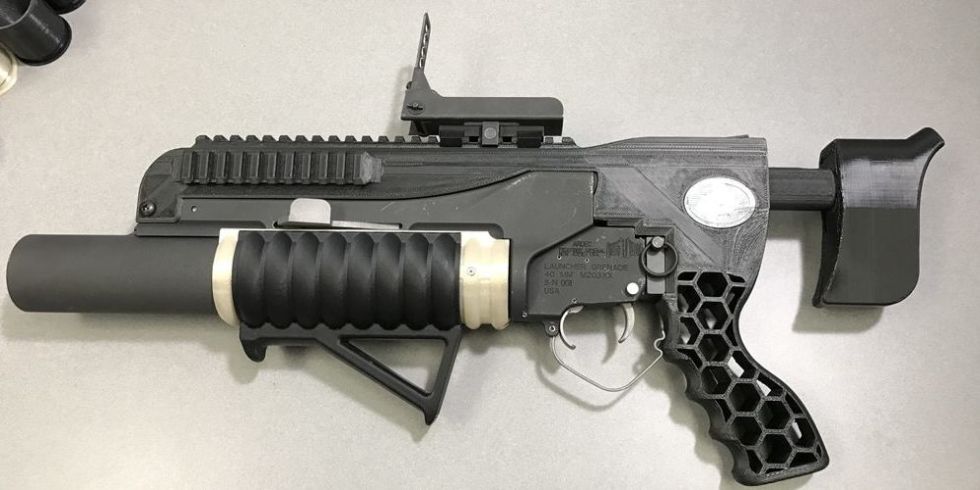


The grenade launcher barrel and receiver took about 70 hours to print and then required 5 hours of post-print finishing. The barrel was tumbled in an abrasive rock bath and then Type III hard-coat anodized to provide a rugged finish.
The Army is impressed with the process, which proves that someone with uncommon 3D printing equipment can actually build durable grenade launcher parts.
"The tooling and setup needed to make such intricate parts through conventional methods would take months and tens of thousands of dollars, and would require a machinist who has the esoteric machining expertise to manufacture things like the rifling on the barrel," they said.
As for the grenades they printed several M781 training rounds, which aren’t explosive, out of aluminium and glass filled nylon, but recently the US Marines showed off their own 3D printed explosive ordnance, which one day could be incorporated into the next generation.
The 3D printed grenade launcher and grenades were tested in October 2016 and displayed no degradation after 15 shots, and the 3D printed grenades came within five percent of the muzzle velocity of regular production grenades, proving that the system was performing close enough to the real thing to be very, very interesting.
Army engineers involved in the project hit just one snag during testing though, but it was easily fixed - early versions of the grenades kept cracking. But to fix the problem the engineers simply went into the software and made the walls of the cartridge case thicker. Problem was solved.
The production of actual, useful heavy weapons has serious implications for defence manufacturing, as well as their supply chains – after all if you can 3D print weapons then you can print them on demand, as and when they’re needed. That’s something that isn’t lost on British Aerospace who recently went three steps further and announced a new molecular assembler technology – truly sci-fi stuff, and that's bearing in mind I also talk about deflector shields and rat to rat, human to human, and human to robot telepathy – that they used to grow a drone.
The additional benefit of using 3D printing in this way though, especially if it’s combined with new artificial intelligence (AI) based generative design technologies, basically creative AI’s that can innovate new products, is that it will allow the Army to iterate, prototype, test and deploy new designs much much faster than they’ve ever been able to in the past, and that changes almost everything we know about warfare.
FAQ
Why does this matter?
3D printing will let armies print bespoke weapons and equipment out in the field on demand and change military supply chains, and warfare forever.

About the author
Matthew Griffin Founder, 311 Institute
Matthew Griffin is a multi-award winning Futurist and expert in Disruption and Innovation, Geopolitics, Leadership, and Technology, who NASA have described as a "walking encyclopaedia of the future" and a "futurist Polymath."
Read full bio
Matthew Griffin is a multi-award winning Futurist and expert in Disruption and Innovation, Geopolitics, Leadership, and Technology, who NASA have described as a "walking encyclopaedia of the future" and a "futurist Polymath." 15-time best selling author of the "Codex of the Future" series, Matthew is the Founder and Futurist in Chief of the 311 Institute, a global Futures and Deep Futures advisory firm working with royal households, world leaders, G7, G20, and G77 governments, NGOs, and multi-national mid and mega cap firms to help them explore, shape, and lead the next 50 years of business and society.
An award-winning YouTube creator with over a million followers, with an unrivalled global reach and impact, Matthew is a highly sought-after international keynote speaker, lecturer, and mentor who collaborates with global leaders through the United Nations Alliance of Civilizations (UNAOC) and United Nations General Assembly (UNGA) to shape pivotal initiatives such as the UN’s AI for Humanity program, the United Nations Conference of the Parties (UN COP), and the World Economic Forum in Davos.
As the former Global Head of Cloud, National Security, and Enterprise Sales for companies including Atos, Dell-EMC, and IBM, Matthew has a proven track record of building multi-billion dollar business units and turning failing divisions into market leaders. His ability to identify, analyse, and communicate the implications of hundreds of emerging technologies and trends is unparalleled, and his insights are trusted by many of the world’s most respected organisations, including ABB, Accenture, Adidas, AON, ARM, BCG, Centrica, Citi, Coca-Cola, Dentons, Deloitte, Dow Jones, EY, Google, KPMG, Lego, Legal & General, LinkedIn, Microsoft, PepsiCo, Qualcomm, RWE, Samsung, Siemens AG and Siemens Energy, T-Mobile, UBS, VISA, Walmart, Workday, Worldpay and many others.
Regularly featured in the global media including the AP, BBC, Bloomberg, CNBC, Discovery, Forbes, Khaleej Times, Telegraph, TIME, ViacomCBS, WIRED, and the WSJ, Matthews mission is to help organisations create a fair and sustainable future whose benefits are shared by everyone irrespective of their ability, background, or circumstances.
What future do you need to see?
Choose one to get started on industry and manufacturing and the future of your organisation.
Sources and further reading
- M203 grenade launcher en.wikipedia.org
- direct metal laser sintering en.wikipedia.org
- News alt amj17 rambos premiere asc.army.mil
Source: first published by the 311 Institute on 11 March 2017. Cite as: Griffin, M. (2017). The US Army just 3D printed a grenade launcher and grenades. 311 Institute. https://www.311institute.com/the-us-army-just-3d-printed-a-grenade-launcher-and-grenades/
You are welcome to quote this article with credit and a link to the original.